
It's 11 PM on a Tuesday in January. Outside, it's -25 °C. At a customer's home in Repentigny, a pipe just burst in the basement and the water is rising. He calls his plumber. One ring, two rings, then voicemail: "Our business hours are 8 AM to 5 PM." He hangs up and dials the next number on Google. You just lost a $1,200 emergency job — and probably the customer for life.
That's daily life in the trades. You're under a sink, inside a furnace, or driving between two job sites. Meanwhile, the phone keeps ringing. And every missed call has a price tag.
Why the phone is the Achilles' heel of plumbers and HVAC contractors
A plumber loses an average of $8,000 to $15,000 a year to missed calls, according to North American home-services industry data. The reason is structural: in the trades, the person who would answer the phone is the same one doing the work. You can't do both at once.
The numbers are blunt. Nearly 27% of inbound calls to home-services businesses go unanswered, and each lost call is worth roughly $1,200 in potential revenue. That's not an accounting footnote. It's a leak that drips all year long.
In Quebec, two factors make it worse. First, winter: a heating breakdown or a frozen pipe can't wait until 9 AM the next day. Second, language: between a French-speaking caller, an English-speaking customer, and a newcomer who speaks neither well, a unilingual voicemail leaves part of your market behind.
Plenty of contractors have already tried the classic fix: a phone answering service staffed by operators. The catch? The operator doesn't know your trade, your service areas, or the difference between a clogged drain and a gas leak. They take a generic message, relay it to you an hour later, and by then the customer has already called someone else. You're paying for a middleman who slows the chain down instead of speeding it up.
There's also a quieter cost most owners overlook: the mental load. Every unanswered ring while you're elbow-deep in a repair is a small decision — do I stop and answer, or do I finish the job? Neither choice is free. Answer, and you break your focus on a delicate fix; ignore it, and you wonder all afternoon whether that was the $2,000 furnace replacement or just a wrong number.
What changes in 2026: a voice agent that reasons, not just recites
Until recently, automated answering systems did one thing: take a message. Useful, but unable to tell an emergency apart from a simple pricing question. On May 7, 2026, OpenAI launched a new generation of real-time voice models, including GPT-Realtime-2, the first to reason at GPT-5 level while keeping the conversation flowing.
What does that mean for a contractor? The agent no longer just transcribes. It hears "there's water all over my basement," understands it's an emergency, and acts accordingly — instead of dumbly offering an appointment three days out. It's the exact leap we analyzed for the pharmacy sector, where the same model now handles sensitive requests with real nuance.
Add multilingual voice on top: the agent switches from French to English seamlessly, keeping the reassuring tone someone whose basement is flooding actually needs.
That reasoning matters more than it sounds. The difference between a panicked homeowner staying on the line and hanging up often comes down to the first fifteen seconds — whether the voice on the other end actually understood the problem or just read a script. An agent that can ask the right follow-up ("Is anyone in danger? Is the water near your electrical panel?") buys you the trust to schedule the visit, instead of losing the caller to the next search result.
4 concrete ways an AI voice agent recovers your revenue
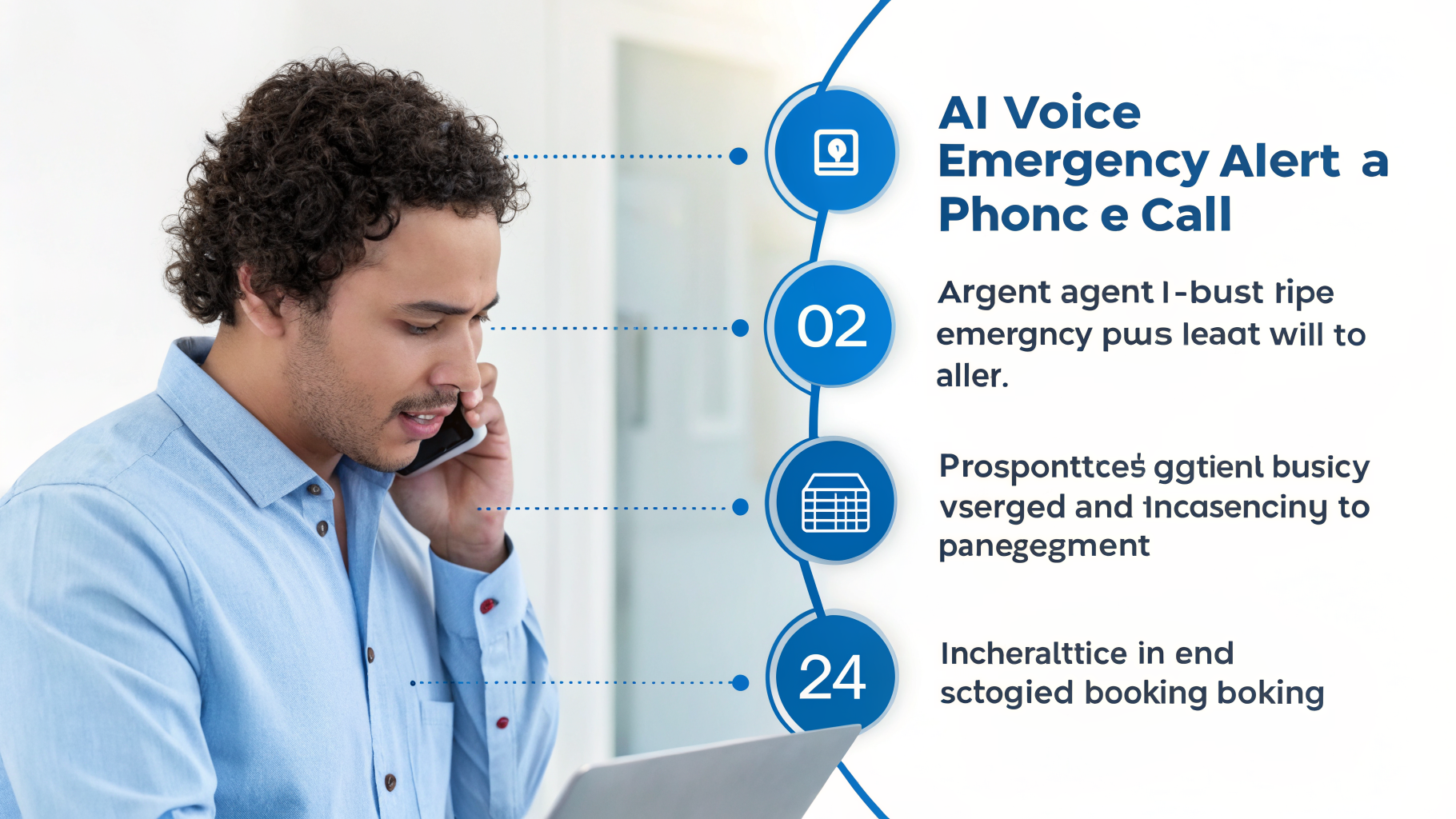
1. Emergency triage, done right. The agent asks two or three targeted questions — "Is the water still running? Have you shut off the main valve?" — flags the call as urgent, and texts you instantly with the address and the nature of the problem. The routine caller, meanwhile, gets an appointment without interrupting you. This is the same triage logic we detailed for veterinary clinics, where sorting a true emergency in seconds changes everything.
2. After-hours and weekend capture. This is where the gold is hiding. One service business captured 112 new leads over three months from evening and weekend calls alone — 71 of them high-intent emergencies — for over $47,000 in direct revenue. Calls that, without an agent, would have vanished into voicemail.
3. Automatic booking and dispatch. The agent checks your real availability, offers a slot, confirms it, and pushes the info to your team. No more double-bookings, no more forgotten "I'll call you back."
4. Repetitive questions, handled without you. "Do you cover Laval?" "What's your service-call rate?" "Are you RBQ-licensed?" These questions eat your days. The agent answers them instantly, around the clock.
The $90,000 calculation few contractors take the time to run
Let's do the math together, because the math is what decides. Say you miss just three calls a week — a conservative number for a plumber or HVAC contractor in peak season. At $1,200 in average revenue per job, that's $3,600 a week in evaporated opportunities. Even if you'd only convert half of them, you're looking at more than $90,000 over a year.
Now compare that to the cost of an AI voice agent: a few dozen dollars a month. The return on investment isn't a question of percentage; it's a question of order of magnitude. That's exactly why specialized providers have built answering services dedicated to trades like plumbing — the demand exists because the money left on the table is enormous.
And that calculation doesn't even factor in reputation. A customer you bail out at 11 PM during a storm doesn't forget you. He calls you back in spring for the water heater, recommends you to his neighbor, and leaves the Google review that brings in your next three jobs. A missed call, on the other hand, is often one star fewer and a competitor stepping into your place.
The advantages specific to the Quebec context
A generic voice agent built for the U.S. market misses three local realities. The first is Law 25: your customers' personal information — name, address, job details — must be handled under strict rules. We configure the agent so data collection and retention respect that framework, without you having to become a compliance expert.
The second is real bilingualism. Not a "press 2 for English" menu, but an agent that switches naturally to the caller's language. In Montreal and its suburbs, that's what separates the booked job from the lost customer.
The third is winter. Your emergency call peaks don't follow office hours; they follow the weather. An always-on agent absorbs the January wave without you hiring an overnight receptionist.
"But my customers will hang up if they reach a machine"
That's the number-one objection, and it's fair. The truth? Your customers already hang up — on your voicemail. The question isn't "human or machine," it's "someone answers or nobody does." An agent that speaks naturally, understands the problem, and promises a fast callback beats a voicemail box every time.
The other fear is complexity: "my emergencies are too technical for AI." Exactly — the agent doesn't diagnose for you. It qualifies, reassures, and hands you the full file so you arrive prepared. As we saw with Quebec auto repair shops, the goal is never to replace the expert — it's to make sure the call actually reaches them.
Frequently asked questions
Do I have to set all this up myself? No. This is the key point: the entire installation, calendar integration, and triage configuration are done by the TECHMA team. You tell us how you work; we handle the rest.
How long before it's running? Usually a few days. We start from your real questions, your actual service areas, and your emergency criteria, then test before going live.
Can the agent reach me mid-job? Yes. You set the rules: confirmed emergency = instant text; routine request = end-of-day summary. You stay in control of what's worth interrupting you for.
What if the call is beyond what the agent can handle? It transfers to a human or takes a detailed message. We define the escalation thresholds together so no customer ends up going in circles.
The next frozen pipe — you'll catch it
The trades don't lack demand. They lack time to answer the phone while working. A well-built AI voice agent doesn't turn you into a call center: it simply makes sure the 11 PM call, in the dead of winter, lands in your schedule instead of your competitor's.
Want to hear how it would sound for your business? Book a 15-minute demo and listen to the agent handle a real emergency, or check out our plans starting at $49/month.