
A future client wants to draft his will. He's 67, he just got a diagnosis, and he calls your firm at 4:47 PM on a Wednesday. Nobody picks up. He hangs up, opens Google, and dials the next notary on the list. You will never know he called.
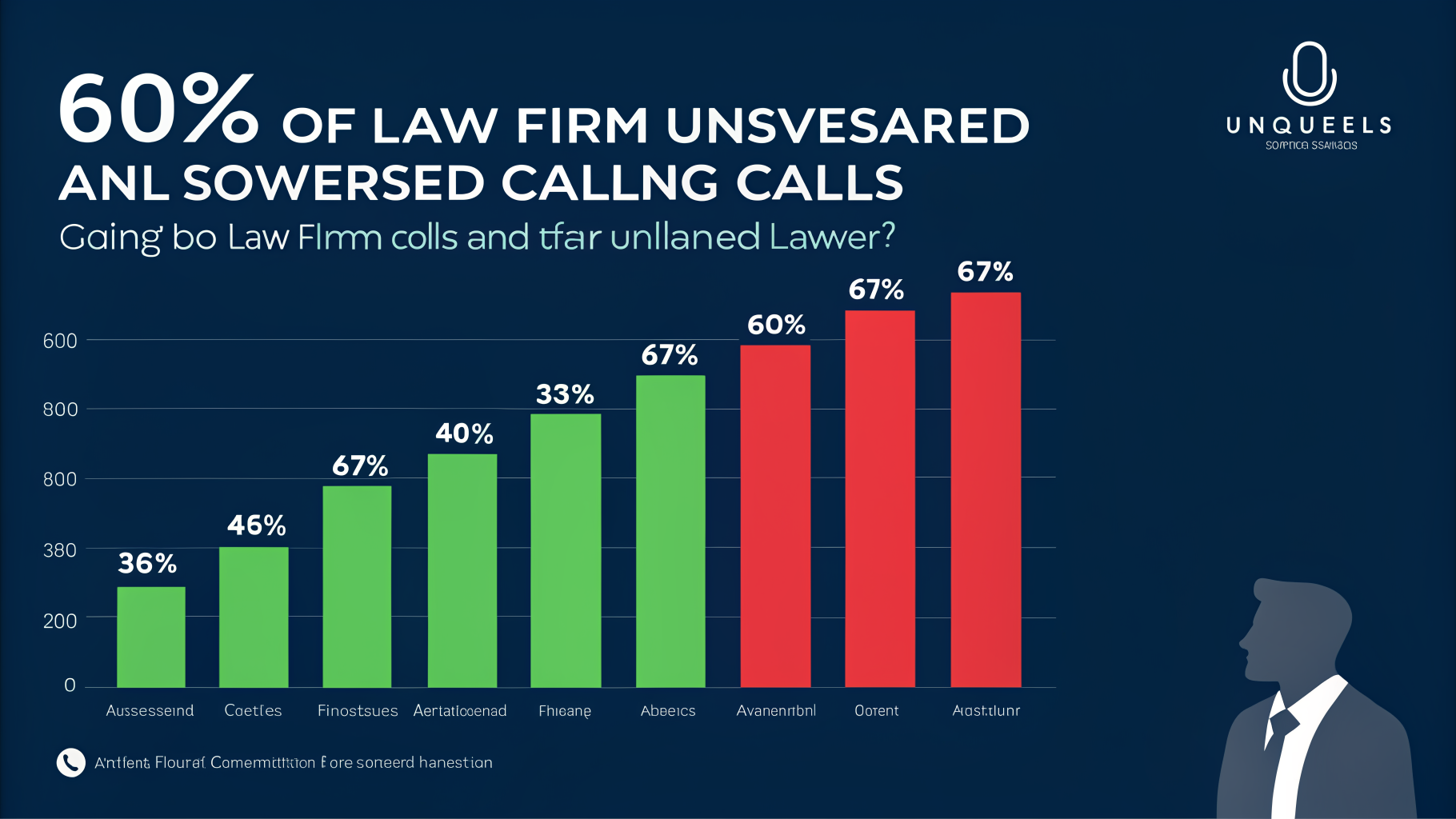
This scene isn't a freak case. It's the scenario Clio's 2024 Legal Trends Report documented at scale: only 40% of law firms answer the phone when a prospect calls. In 2019, that number was 56%. In five years, firms have become 16 points less reachable.
The point of this article isn't to scold anyone. It's to lay out the math — what those missed calls are actually worth for a Quebec firm — and then show how a properly deployed AI voice agent solves the problem without violating Quebec's Law 25, the Bar's professional conduct code, or the notarial Chamber's deontology.
Stat 1 — 48% of firms are unreachable, and almost nobody calls back
The raw number from the Clio 2024 report deserves a breakdown. Of all incoming calls to firms, 40% get a live answer. Another 12% get a callback inside a useful window. That leaves 48% — almost one in two — that fall into nothing.
And in the legal world, voicemail is not a second chance. Data compiled across firms in the U.S. and U.K. shows roughly 74% of prospects hang up the moment they hit a voicemail box, and 62% of missed calls never produce a callback from the firm. The prospect doesn't come back. They move down the list.
You can argue with the stat or you can look it in the eye: when a Quebec law firm misses 4 out of every 10 calls, those aren't "4 calls." Those are 4 potential mandates that just walked over to a competitor.
Stat 2 — The lost revenue math (in Canadian dollars, May 2026)
Let's run the arithmetic with conservative assumptions for an average Quebec firm of 3 professionals (mix of notary and lawyer).
Estimated inbound calls: 35 per working day. Over 250 working days, that's 8,750 calls per year. If 48% drop into nothing per the Clio benchmark, the firm misses about 4,200 calls per year.
Not all of those are mandates. Let's stay cautious and assume 12% of inbound calls are genuinely qualified prospects. That's about 504 lost potential files per year. Now the per-file value: the North American average for a law firm is around $5,000 per retained client, and Quebec sector surveys place the average value of a notarial mandate (will, mandate of protection, routine real estate transaction) between $800 and $4,500 depending on the act.
Take a very conservative average of $1,800 per converted file and a prospect-to-retained-client conversion rate of 25%. The math becomes: 504 prospects × 25% conversion × $1,800 = $226,800 in annual revenue walking out the window. For a 3-professional firm, that's the entire salary of a junior associate.
Take the other extreme — a civil litigation firm with a higher average matter value — and the same equation can climb above $600,000 per year. South of the border, CloudTalk cites even heavier numbers for solo practitioners: over US$110,000 per attorney just from the 35% missed-call rate.
Stat 3 — The 5-minute window (the rule the comparison sites bury on page two)
Here's the figure that makes the problem even more brutal: a firm that calls a prospect back within 5 minutes of the initial call converts up to 400% better than one that calls back an hour later. This isn't a marketing footnote. It's a psychological window.
Why? Because the person looking for a notary or a lawyer is rarely in browse mode. They're in "I have a problem and I want it solved today" mode. A death in the family, a divorce filing, a demand letter, a property closing happening Friday: legal clients usually call in a specific emotional state. They call 2 or 3 firms. The one that answers first wins.
A human team that takes lunch breaks, closes at 5 PM, sits in meetings or appears in court is mathematically unable to hold that window. Not because the people are bad — because the physics of human work hours don't allow it.
Visualisation des 48 % d'appels manqués dans les cabinets juridiques
What this specifically means in Quebec: Law 25, the Bar, the Chamber of Notaries
Before we get to the solution, we need to be clear about the constraints that make deploying an AI agent in a Quebec law firm different from a garage or a salon. There are three.
One — Law 25. Fully in force since September 2024, Quebec's Act respecting the protection of personal information in the private sector requires any firm using an automated system to disclose to data subjects that a decision (or treatment) is partially automated, to conduct a Privacy Impact Assessment (PIA) for any AI project, and to minimize collection. A badly configured voice agent that asks for SIN, full date of birth and medical history on first contact will not survive a CAI audit.
Two — the Bar's professional conduct code. Solicitor-client privilege is non-negotiable. A voice agent that records, transcribes and sends conversations to a U.S. SaaS provider without a compliant data processing agreement exposes the firm to a syndic complaint. The question "where is the data stored and who can see it" must have a written, auditable answer.
Three — The notaries' Code of ethics. A Quebec notary is a public officer. Their personal responsibility cannot be delegated to a machine. A voice agent can book the appointment, confirm identity, explain hourly rates, and prepare the file — but it cannot give legal advice, and it must say so clearly to the caller.
These three constraints aren't a wall. They're specifications. It's exactly what we learned while deploying ElevenLabs Guardrails 2.0 to meet Law 25 obligations in other regulated Quebec sectors.
The 4-layer compliant AI voice plan
Here's how an AI voice agent that respects all three constraints above is typically structured for a Quebec legal practice. This is an architecture we deploy for the firm ourselves — not a self-service setup.
Layer 1 — Automated disclosure at call open. First sentence: "Hello, you've reached [Firm Name]. You're speaking with our automated voice assistant. Would you like to continue with me, or would you prefer to leave a message for a notary?" That one line handles 80% of Law 25 transparency objections about automated systems.
Layer 2 — Minimal collection. The agent only asks what's strictly necessary to book the appointment: first name, type of need (estate, real estate, mandate, etc.), preferred time slot, callback number. It does not ask for SIN, full date of birth, or detailed legal context. Those details get gathered in person by a human with informed consent.
Layer 3 — Compliant hosting and storage. Recordings and transcripts live in Canada (or under an international processing agreement that satisfies sections 3.1 and 17 of Law 25). Retention duration is limited and documented. The Bar's syndic or the Chamber can audit the full flow on demand.
Layer 4 — Human escalation. For any substantive legal question, the agent says: "I'm not able to give legal opinions. Let me set up a slot with one of our notaries/lawyers. Would tomorrow morning or Thursday afternoon work better?" That script avoids unauthorized practice of law and protects professional liability.
The practical result is a firm that goes from a roughly 40% pickup rate to over 95%, at a typical monthly cost between $49 and $199 depending on volume. At that price, holding the 5-minute window becomes feasible 24 hours a day, weekends and holidays included.

Notaire québécois examinant un dossier numérique conforme à la Loi 25
What we see coming by end of 2027
Three trends will accelerate this shift for Quebec law firms.
Real-time translation goes free. With GPT-Realtime-Translate launched by OpenAI on May 7, 2026, a voice agent can take a call in English, Spanish, Mandarin or Arabic and transcribe it in French for the firm. For a notary in Côte-des-Neiges or an immigration lawyer in Brossard, that's the end of the "do we call back or let it go" dilemma when an allophone client leaves a message.
IDC forecasts 60% of professional services firms will have a deployed AI agent by end of 2026. The "wait and watch" window is closed. Late-mover firms will hemorrhage mandates to competitors who answer in 4 seconds at 3 AM.
The CAI will likely publish specific guidelines for conversational agents by 2027. Firms that have already documented their PIA and data minimization architecture will be in solid position. Firms that cobbled together an integration without a formal framework will have to redo everything.
FAQ — Questions we hear from Quebec firms
My firm is just 2 people, is it worth it? More than for a big firm, because your lunch breaks, vacations and court appearances create wider phone-coverage gaps. The lost-revenue math stays favorable even at very low volume — usually one recovered mandate per month covers the annual subscription.
My clients will hate talking to a machine. That's exactly what dental clinics said in 2024. What we see in 2026: if the agent is fast, clearly states it's automated, and delivers a confirmed appointment in 90 seconds, satisfaction goes up, not down. Clients prefer 90 seconds with a competent machine over 7 minutes on hold with an overwhelmed human.
What if the AI accidentally gives legal advice? That's exactly the risk Layer 4 (mandatory human escalation on any substantive question) prevents. A well-configured agent never says "yes, your clause is valid" or "you have a strong case." It says "I'm noting the question and preparing your appointment."
How long to deploy this? For a firm running Outlook or Google Workspace with a standard PBX (RingCentral, 8x8, VoIP), full deployment — including drafting the PIA, configuring the four layers, and running test calls — usually takes between 2 and 4 weeks. And the TECHMA team does the integration. Not you.
What if we mess up the deployment, are there major risks? Yes. Bad configuration is expensive and exposes the firm to complaints. That's why we systematically document the 7 most common AI voice agent deployment mistakes in Quebec before signing any contract.
Conclusion — The silent phone is now a choice
In 2019, missing a call was a fact of life. In 2026, it's become a choice. The technology exists, it's compliant, it costs less than a coffee a day, and it holds the 5-minute window even at 3 AM on a Saturday.
For a Quebec law firm, the math is rarely ambiguous: between $226,800 and $600,000 per year of revenue walking out to a competitor, against a monthly investment in the low hundreds. The real question isn't "should we." It's "what's stopping us."
Book 20 minutes with our team so we can run your specific math — inbound volume, average matter value, current conversion rate — and show you an AI voice agent deployed inside a real Quebec law firm. Or first explore our plans starting at $49 per month to get the framework.