
Ask yourself one thing: when a customer calls your business and says "I need to move my Tuesday appointment, but nothing after 3 PM, and is my card still on file?" — how many voice agents can actually handle that without falling apart?
Until recently, the honest answer was: almost none. First-generation AI voice agents were great at simple scripts and a disaster the moment a request went off-rail. But something shifted in 2026, and it's worth slowing down to look at.
The newest voice models don't just "hear and reply" anymore. They reason before they speak. That's a deeper change than it sounds, and it directly affects whether a Canadian business — in Toronto, Calgary, Halifax, or anywhere else — can trust a machine with its phone line. Let's look at the facts, no hype.
Trend #1: Voice models grew a brain
The real turning point of 2026 isn't a nicer voice. It's reasoning. In May, OpenAI shipped a new generation of real-time voice models with reasoning on par with its best text models, as tech press reported in May 2026.
What does that mean in practice? The agent can break down a complex request, call a tool (your calendar, your CRM), recover from an interruption, and pick the thread back up — all mid-conversation. The context window on these models jumped from 32,000 to 128,000 tokens, enough to follow a long exchange without losing the beginning.
It's the difference between an employee reciting a script and one who actually understands what you're asking. For a customer calling a clinic in Ottawa on a Thursday night, that nuance changes everything.
Trend #2: Latency keeps melting away
A smart agent that takes two seconds to answer still sounds like a machine. The good news: latency is collapsing right alongside the smarts.
On July 6, 2026, OpenAI released upgraded voice models that cut response latency by at least 25%, while handling silence, background noise, and barge-in (when the caller talks over the agent) far better. The best platforms on the market now run around 600 milliseconds of response time, according to a 2026 benchmark.
Six hundred milliseconds is faster than the natural pause between two people talking. Pair that with sharper recognition of alphanumeric strings — order numbers, phone numbers, confirmation codes — and you get an agent that stops asking "was that a 5 or a 9?" three times in a row.
Trend #3: Real-time translation, a win for a multilingual country
Here's an underrated trend. Among the new 2026 models, one is dedicated to live speech translation: it converts speech from 70+ input languages into a dozen output languages while keeping pace with the speaker, as described in OpenAI's documentation on its real-time models.
Canada is officially bilingual, and its cities are far more than that — Vancouver, Toronto, and Winnipeg together speak hundreds of languages at home. An agent that naturally switches between English, French, and beyond, based on the caller, is a concrete advantage. A new resident in Mississauga, a supplier in Montreal, a tourist in Banff: the same agent serves them all, in their language, with no transfer.
We're a long way from "press 1 for English." The agent listens, recognizes the language, and answers. That's it.
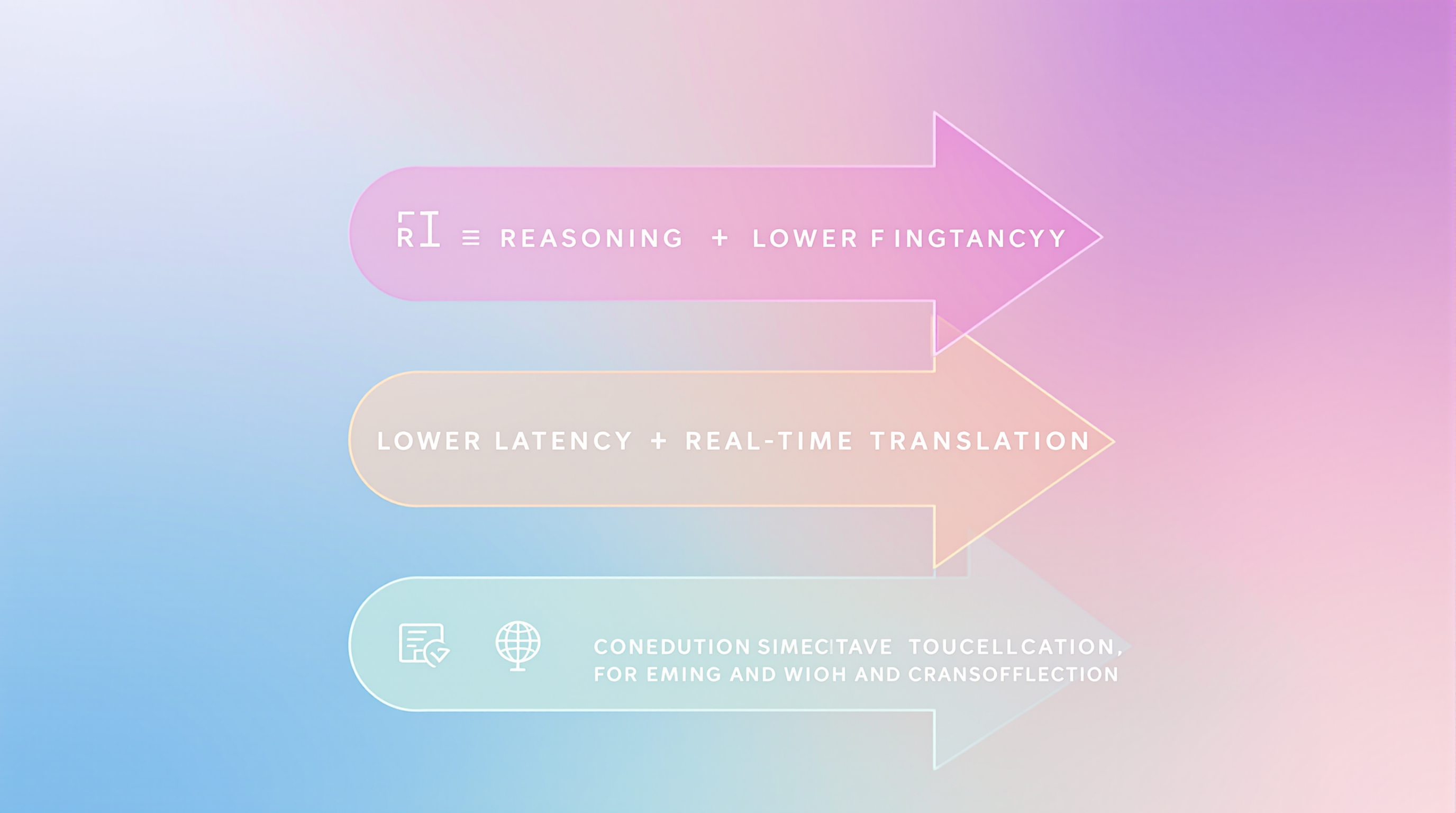
The three 2026 voice AI trends: reasoning, lower latency, real-time translation
What this means for Canadian businesses
Stack those three trends together and you get a change in kind, not just degree. The 2024 voice agent was a fancy answering machine. The 2026 one is closer to a genuine phone assistant.
For a plumbing company in Edmonton, that means an agent that can book a job, check a part in inventory, and recall a customer's history without making them repeat it. For a salon in Halifax, it's an agent that handles a last-minute cancellation and offers another slot — no double-booking.
The psychological threshold matters: when the technology sounds natural and truly understands, customers stop avoiding it. That's exactly what we dig into in our piece on making an AI voice agent sound human instead of robotic.
The catch: a better brain doesn't guarantee a better result
Careful, though — don't fall for the opposite trap. A smarter model doesn't magically fix everything. We already see businesses bolt on the latest headline model and act surprised when it doesn't perform better.
Why? Because a voice agent is 20% model and 80% configuration. Escalation paths to a human, bidirectional calendar wiring, privacy rules, brand tone: none of that sorts itself out, even with the best "brain" on the planet.
In other words, reasoning has become table stakes. The competitive edge moved to whoever configures and monitors the agent. A brilliant model that's poorly set up is still a poorly set-up model.
Does "smarter" mean "pricier"?
Fair question, and the answer often surprises people. Despite the capability jump, platform per-minute costs didn't blow up in 2026 — fierce competition between providers actually pushed them down across several segments.
Some of the new reasoning models even come in a "mini" version: faster, cheaper, built for routine tasks. For a business, that means yesterday's power costs less today. We break down the real numbers in our guide to what an AI voice agent actually costs.
So the expensive trap isn't the model's price. It's the time lost configuring everything yourself, or the opportunity missed on every call that goes unanswered while you hesitate.
Predictions for 2026-2027
Where is this heading? Three reasonable bets. First, reasoning becomes the baseline, not a selling point: by the end of 2027, an agent that can't handle complex requests will look as dated as a cassette answering machine.
Second, real-time multilingual support becomes an expected standard, especially in bilingual and immigrant-rich markets. Third, value shifts for good from "which model" to "which configuration" — exactly like a good website depends not on the server, but on who built it.
For businesses, the lesson is simple: technology is no longer the limiting factor. The question is no longer "is voice AI good enough?" but "which calls should I hand it first?" — something we tackle in our guide on which calls to automate and which to keep human.
Frequently asked questions
Does my current voice agent become obsolete? Not necessarily. A good managed solution updates the underlying model without you rebuilding anything. That's a core advantage of done-for-you: you get the progress without lifting a finger.
Can an agent that "reasons" still get things wrong? Yes, like a human. That's why escalation paths and monitoring stay essential. Reasoning reduces errors on complex cases; it doesn't erase them.
Does it actually work in French and other languages? The 2026 models handle accents and local expressions far better than two years ago. Quality still depends on configuration and testing with real, local voices.
Should I wait for the next model before starting? No. Waiting for "the next one" means never starting — there's always a next model. A good solution evolves with the tech; what matters is starting to capture the calls you're already missing.
Conclusion
The real headline of 2026 isn't "voice AI exists." It's "voice AI now thinks before it speaks." Reasoning, plunging latency, and live translation turn a gadget into a serious business tool.
But technology is only half the story. The other half is careful, compliant, well-monitored configuration — exactly what our team does for businesses across Canada.
Book a demo to hear what a 2026 voice agent can do for your business, or check out our plans starting at $49/month.