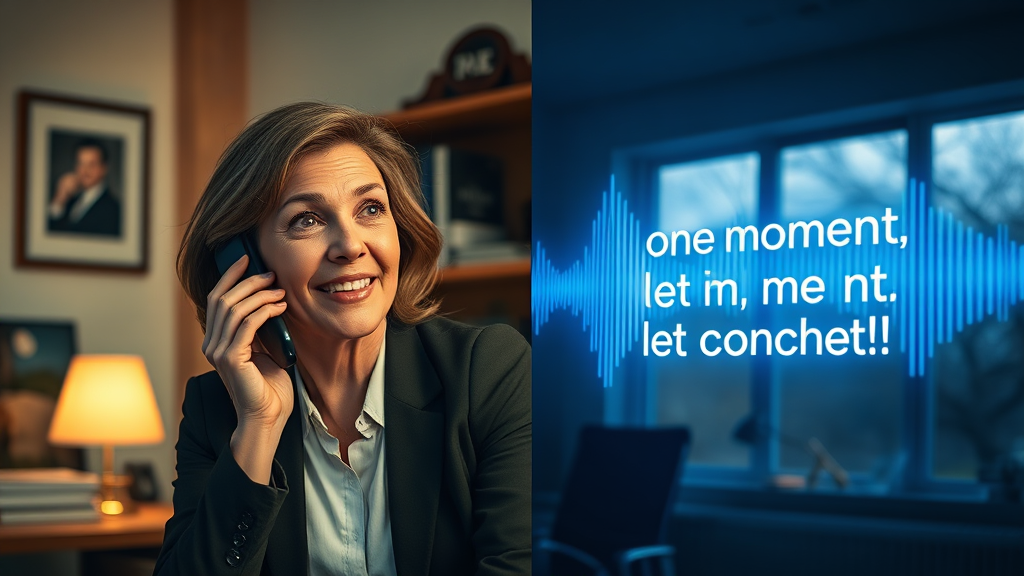
Three Little Words That Change Everything
"Let me check that."
Four words. Half a second. And yet, in most of the calls we listen to each week at TECHMA, it's precisely this micro-moment that separates a voice agent that sounds human from one that sounds... well, like a voice agent.
On May 7, 2026, OpenAI quietly dropped a trio of voice models — GPT-Realtime-2, GPT-Realtime-Translate, and GPT-Realtime-Whisper — and amid the usual benchmark theater (P50, P90, latency, pricing), there's one detail nobody in marketing really underlined but that, in the field, is about to change what your customers feel when they call your SMB: preambles.
Here's my thesis, no hedge: for Quebec SMBs already running an AI voice agent on ElevenLabs (or still on the fence), GPT-Realtime-2's preambles are the most important launch of spring 2026 — more important than the new modalities, more important than guardrails, more important than MCP. And most voice consultants I'm reading don't seem to have noticed.
Why I Believe This (And Where It's Coming From)
For close to two years, I've been listening to hundreds of call transcripts a month. Dental clinics, plumbers, real estate brokers, restaurants. We've deployed AI voice agents for dozens of Quebec SMBs, and we watch the conversations the way a hockey coach watches video: frame by frame.
There's a pattern that keeps showing up. Whenever an agent needs to check a calendar, cross-reference availability, hit a CRM, or wait on a Zapier response, something dehumanizing happens: silence. Not a long silence — often less than two seconds. But a silence that the human ear instantly tags as "not human." Nobody, in a real conversation, stays mute and motionless while they think. People say "hmm," "hold on," "okay, give me two seconds."
That's exactly what preambles add. And the timing couldn't be better.
Argument 1: OpenAI's Own Numbers Are Unambiguous
In OpenAI's official announcement on May 7, 2026, two numbers stand out: calls are roughly 30% faster at P50 and up to 200% faster at P90, compared to classic cascaded pipelines (STT → LLM → TTS).
P90 is the number that actually matters. It's the latency of the worst 10% of calls — typically when the agent has to hit a tool, cross multiple systems, or handle a complex question. That's where your customers used to hang up. Now it's where GPT-Realtime-2 says "one moment, let me look that up for you" while it does the work in the background.
Combined with parallel tool calling — something we covered in our article on ElevenLabs' MCP protocol — the agent can query your Google Calendar, your CRM, and your product database simultaneously, narrating what it's doing. The customer no longer waits in dead air.
There's a wallet bonus too: OpenAI dropped the price 20% versus gpt-4o-realtime-preview. We're talking $32 USD per million audio input tokens and $64 USD on output — landing, per Latent Space's analysis, around $0.25 to $0.35 USD per minute of production conversation. For a Quebec SMB handling 800 calls a month, that's material.
Argument 2: The 'Human' Perception Curve Isn't Linear
Here's something counterintuitive that human-computer interaction research has been confirming for a decade: the naturalness of a synthetic voice isn't a smooth curve. It's a cliff.
Below a certain fluency threshold, humans perceive an agent as "robotic" — no matter how beautiful the voice itself is. Above the threshold, perception flips abruptly to "good enough human" and people literally stop noticing. 2026 AI voice agent benchmarks put that threshold around 500–800 milliseconds of perceived latency after the caller finishes speaking.
Without preambles, as soon as an agent hits a heavy tool, perceived latency explodes. Not machine latency — perceived latency, because silence subjectively stretches time. With preambles, even if the tool takes 2.5 seconds to respond, the customer heard "one second, looking at that now" at 200 milliseconds. Their internal timer resets.
It's exactly the effect human receptionists have been chasing forever. The difference: at 3 a.m. on a Tuesday in January, your receptionist is asleep. GPT-Realtime-2 isn't.
Argument 3: ElevenLabs Already Gives You the Switch
Here's what a lot of Quebec SMBs don't realize: if you're running an AI voice agent on ElevenAgents, you don't have to pick between the ElevenLabs voice and the OpenAI brain. ElevenLabs explicitly supports plugging in an external LLM, including OpenAI via your own API key.
In practice, this means you can keep the voice you've spent months tuning — the prosody, the Quebec accent, the specific tone of your clinic or your garage — and swap only the reasoning engine underneath to move to GPT-Realtime-2. Think changing the engine without changing the body of the car.
On the ground, that's three things for you. One: the brand voice your customers recognize doesn't change. Two: you immediately pick up the preambles, the improved P90, and parallel tool calling. Three: your per-minute cost drops, which ends up mattering once you're handling hundreds of after-hours calls.
Obviously, all of that assumes a clean integration, up-to-date guardrails, and solid monitoring — exactly the kind of work the TECHMA team handles for you during the upgrade, in line with the approach we detailed in our piece on ElevenLabs Guardrails 2.0.
But Wait — Here's What the Skeptics Say
The strongest counter-argument I'm hearing, and one that deserves a real answer: "It's just marketing. Preambles still sound scripted, like a fancier IVR."
Honestly? On some deployments, it's true. Hearing the exact same "let me check that" three times in a single call kills the magic fast. Several production teams have already documented the issue: when the system instruction is lazy, preambles become a new flavor of robotic.
The fix isn't to turn the feature off. It's to write a system prompt that offers 6 to 10 contextual variations ("hang on, pulling up the calendar," "okay, opening your file," "give me a second, checking with our system"), and letting the model rotate based on what tool it's hitting. A few hours of work. A complete experience change.
The other objection, and a more legitimate one: data privacy. GPT-Realtime-2 is hosted by OpenAI. For a Quebec SMB under Law 25, that means revisiting your data processing agreements, where recordings transit, and what gets stored. It's not a blocker, it's a piece of work — and it's exactly why ElevenLabs Guardrails 2.0, which we covered recently, becomes even more relevant.
Why Quebec SMBs Are Better Positioned Than They Think
I'll say something that may surprise you: Quebec SMBs are structurally well placed to benefit from this upgrade.
Reason 1 — size. Most of our clients handle between 200 and 1,500 calls a month. At that volume, OpenAI's 20% cost savings alone don't justify a big IT project. But combined with a quality jump every caller can hear, the ROI flips quickly. A large enterprise hesitates to touch a system that works; an SMB can roll the upgrade in two weeks.
Reason 2 — service culture. In Quebec, missing a call feels almost like ignoring a neighbour knocking at the door. That's not anecdotal — we documented it in detail in our analysis of 2026 adoption statistics. This culture makes preambles more effective here than elsewhere, because your customers are unusually sensitive to micro-signals of attention.
Reason 3 — bilingual. GPT-Realtime-2 handles 70 input languages and, paired with the Translate model, can switch between French and English without breaking rhythm. For an SMB in Laval handling roughly equal French and English call volume, that's a gain that doesn't show in spreadsheets but does show in customer satisfaction.
What It Actually Looks Like Next Week
If you're already running an AI voice agent on ElevenAgents with a non-GPT-Realtime-2 LLM, here's what a well-done upgrade looks like, in order:
First, the audit. We listen to 30 to 50 recent calls and pinpoint the exact moments where your current agent produces silences over 1.5 seconds. That's the baseline.
Then, the LLM swap inside ElevenAgents. Literally a few minutes in the interface, plus adding your OpenAI key to the credentials. Voice stays the same.
Then, rewriting the system prompt to embed a varied, contextual library of preambles tailored to your trade. A dentist doesn't say "let me check that" the way a plumber does. That work is what separates "wow" from "meh."
Finally, we re-listen to the first 30 post-upgrade calls and compare silences over 1.5 seconds. On the deployments we've already shipped this month, the drop is in the 60–80% range — not because the system is faster in absolute terms, but because it talks while it thinks.
All of that, at TECHMA, we deliver turnkey. No DIY. That's also why we exist.
FAQ — Questions People Already Asked Us This Week
"Does this change anything if my current agent already runs on gpt-4o-realtime?" Yes, and it's probably the fastest-ROI upgrade you can do. You keep your architecture, your voice, your integrations. You only change the model. Preambles, P90, and cost all improve instantly.
"What if I'm on Twilio + Vapi + ElevenLabs in a cascaded pipeline?" That's where you'll see the biggest leap. Vapi remains very solid for orchestration, but a direct S2S architecture with GPT-Realtime-2 removes two of the three latency sources. Worth a case-by-case discussion.
"How long to migrate an existing agent?" For most of our production clients: 1 to 2 weeks, running both agents in parallel during the transition. We don't cut over until the new version beats the old one on the metrics.
"What if OpenAI ships GPT-Realtime-3 in six months?" Even better. The whole point of building on ElevenAgents is LLM portability. We swap. That's the opposite of vendor lock-in.
Want to Talk About It?
If you're already running an AI voice agent and you want to know, concretely, whether upgrading to GPT-Realtime-2 is worth it for your specific case, that's exactly the kind of conversation we exist for. We look at your current metrics, we listen to two or three calls with you, and we tell you honestly whether it's worth doing or not.
Book 20 minutes with our team or explore our plans if you're starting from scratch. Either way, TECHMA handles the integration — not you.