Introduction: the 8:17 AM phone wall
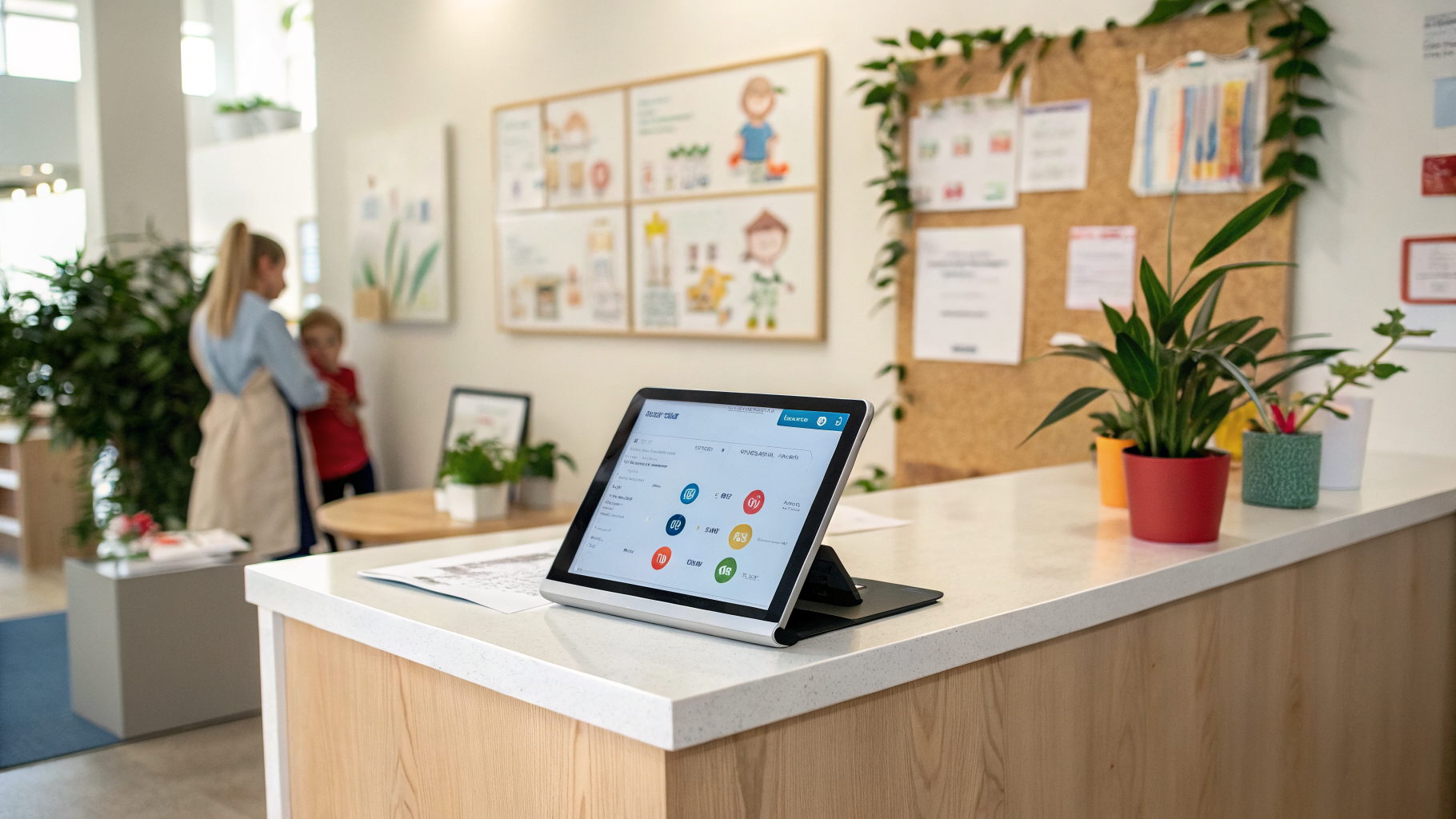
8:17 AM, a Tuesday in May. Marie-Hélène, director of an 80-spot CPE in Sainte-Foy, hangs up for the sixth time in thirteen minutes. One parent calling to delay their son's arrival. Another to confirm their spot on Ma Place 0-5. An anglophone grandmother who didn't realize the daycare closes at 6 PM. And at the counter, two strollers waiting.
If that scene sounds familiar, you're not alone. It's the reality of more than 1,600 subsidized daycares, CPEs, and home childcare networks in Quebec. Between 7 and 9 AM, then 4:30 and 6 PM, the phone becomes a ball and chain. Nobody trained you to run a call center — you were trained to educate children.
This tutorial walks you, step by step, through deploying a bilingual AI voice agent in your daycare. No marketing fluff. No empty promises. Five concrete steps, realistic timelines for each, and what it'll cost at the end. By the time you finish reading, you'll know exactly how to free up 8 to 12 hours a week from your director's role — time you can put back into the infant room or into updating your pedagogical plan.
What you get (and what you need before starting)
Expected outcome: 70-85% of inbound calls handled without human intervention, in French or English, 24/7, with a written follow-up in your inbox within 90 seconds of each call.
Realistic implementation timeline: 2 to 3 weeks from signed contract to the first call answered by the agent. Not 24 hours like some vendors promise — that's a polite lie. A real implementation accounts for your daycare's specifics (late-pickup policy, emergencies, allergies, building access codes).
Prerequisites: an existing phone number (yours), an email address for notifications, and 90 minutes of your time in two blocks to answer questions from the team setting up the agent. That's it. You don't install anything on your computer, and nobody is going to ask you to touch DNS or APIs.
Important note: at Agent IA Vocal, all installation, integration, and configuration is handled by our team. You don't deploy anything yourself. The tutorial below describes the process from our side — so you know what to expect and can ask the right questions.
Step 1 — Map the 12 calls you actually receive
Before writing a single line of script for the agent, we map the calls your daycare actually receives. Not in theory — in real life. Over three days, you (or your assistant) log every inbound call on a sheet with three columns: reason, duration, language.
The exercise sounds basic, but in 72 hours you'll discover that 80% of your calls fall into 10 to 12 repeating buckets: presence confirmation, absence reporting (stomach bug, fever, vacation), waitlist status question, new-enrollment inquiry, late payment, forgotten item, request for an educator meeting, mid-day medical incident, occasional schedule change, request for a tax receipt.
These 12 buckets form the agent's knowledge base. Anything that doesn't fit in those 12 slots gets transferred to a human. That's the golden rule of a successful deployment: never let the AI improvise on a topic it doesn't know. We've seen it too many times in other deployments — a poorly scoped AI ends up inventing refund policies or imaginary opening hours.
Step 2 — Pick a voice that doesn't scare parents
You'd be surprised how many daycares pick a generic synthetic voice "to move fast" and then two weeks later get complaints from parents who say it sounds like a telemarketer. The voice is the first impression. It matters.
For a Quebec daycare, we almost always configure two voices: a Quebec French voice (not a Parisian one — the difference is audible from the first sentence) and a neutral North American English voice, calm and steady. ElevenLabs released in May 2026 a system that preserves the emotion and intonation of the original speaker across languages, which makes FR-EN transitions much more natural than before — you can see the official announcement in the ElevenLabs changelog.
In practice: a parent starts in French, the agent answers in French. Next sentence, the parent switches to English — the agent picks up in English, without resetting the conversation, without asking the parent to start over. That's exactly what you'd expect from a real bilingual experience in Quebec childcare, where more than one in four families in Montreal speaks English at home.
Step 3 — Connect Ma Place 0-5, your daycare software, and your calendar
This is the technical part. You don't touch any of it — our TECHMA team handles it. But here's what happens behind the scenes, because you should understand it.
We connect the agent to your daycare management software (Amisgest, Le Gestionnaire, Acceo Solutions, Symbiose, or whatever you use). When a parent calls to report an absence, the agent logs it directly into the child's file — no need to retype it by hand the next morning. When a new parent asks where they stand on the waitlist, the agent can check your internal tracker and give them a realistic window ("Based on your rank and the turnover from the last two years, your spot should open between January and March 2027").
For Ma Place 0-5, the integration is trickier: the government platform doesn't expose a public API, so we can't tap into it directly. What we do is prepare scripted responses that walk the parent through the official steps on quebec.ca and remind them that their rank is updated on the first of each month.
We also configure human transfer for four situations we NEVER automate: an active medical emergency (a child is hurt, a child fell), a child-protection concern, a formal complaint, and any conversation where the parent explicitly says "I want to speak to someone." Four red lines. Hard-coded.
Step 4 — Test with 15 real parents before cutting the ribbon
This is the step 9 vendors out of 10 skip. Bad call.
Before official launch, we ask 15 parents (ideally parents you have a good relationship with, not your full board) to call the number during the test phase and simulate the calls they normally make. We record the conversations, listen back, and note what breaks.
You'll discover surprising things. One parent will pronounce their child's name in a way the agent doesn't recognize (multicultural first names are a classic). Another will ask for something you hadn't planned for — say, a separated parent who wants to know if their ex already picked up the little one. You'll also hit the "long pause": a parent hesitates 4 seconds mid-sentence, and the agent assumes they're done talking.
These adjustments cost very little time when you make them before launch. After launch, they cost trust — and in a daycare, trust takes months to rebuild.
Step 5 — Launch softly and watch the first 14 days
On day one, we don't flip 100% of calls over at once. Too risky. We start with after-hours — 6 PM to 7 AM, and weekends. During the day, your team keeps answering like before.
After 4 days, if things look good, we extend to the lunch lull (11:30 AM-1 PM). After 8 days, to the full day except the morning rush. After 14 days, 100%. This gradual ramp lets you keep control and catch anomalies as they show up.
During those 14 days, you get a morning email summarizing the previous day: calls received, calls handled, calls transferred to a human, calls where the agent hesitated, average duration. That dashboard is your barometer. If you see the same type of call transferred 8 times in 2 days, the knowledge base is missing an answer — we add it and you're set.
The 4 mistakes daycares make (and that we refuse to make)
Mistake #1: deploying without telling parents. Parents who call and hear an unfamiliar voice wonder if they dialed the right number. We always send an announcement email 5 days before, with a simple sentence: "Starting June 12, your call will be answered by Sophie, our new virtual receptionist. She speaks French and English, she can log absences, and she transfers you to an educator the moment you say it's urgent."
Mistake #2: forgetting Law 25 compliance. A daycare handles children's personal information, which makes it one of the most sensitive contexts covered by Quebec's personal information protection law — Law 25, administered by the CAI. Every call data point must be hosted in Canada, encrypted at rest, and made available to the parent on request. You can revisit the technical implications in our piece on the 4 safety layers in Guardrails 2.0.
Mistake #3: underestimating the true cost. An AI voice agent for a 60-100 spot daycare runs between $199 and $349 a month on a managed plan, all-in — voice, minutes, integrations, support. But if you DIY with self-serve tools, expect that bill to double or triple once the real costs are layered on, as we documented in our total-cost-of-ownership analysis.
Mistake #4: believing the agent replaces an educator. It doesn't. The voice agent absorbs the repetitive administrative calls. It frees up your assistant and your director. Human expertise stays where it should be: with the kids, not glued to a phone.
Real results: what daycares see after 6 weeks
Across the deployments we've done since early 2026 in Quebec's early-childhood sector, the pattern is fairly stable. Between 71% and 82% of calls are handled without a human. Average response time goes from "6 rings, then voicemail" to "2 seconds." The number of voicemails to call back drops from 30-40 a week to 4-6.
The impact we didn't anticipate: educator satisfaction. Several have told us that not being interrupted 12 times a morning by a phone ringing in the classroom changes their ability to be present with the children. That's not the ROI we sell in a demo, but it's the one that makes the difference on the ground.
On general adoption, you're far from alone in exploring AI. Per the Institut de la statistique du Québec, 12.7% of Quebec businesses were already using an AI application in production in Q2 2025. In May 2026, that number is clearly trending up in the service sector.
FAQ
Can the agent handle an emergency call if an educator can't be reached? Yes — and it's the first rule we configure. Any call containing the words "emergency," "hospital," "hurt," "not breathing" or their French equivalents triggers an immediate transfer to the director's cell, in parallel with a text alert. If nobody picks up within 30 seconds, the agent dials a second number on the escalation list.
What if a parent doesn't want to speak to an AI? They say "I want to talk to someone" and the agent transfers without asking why. No friction loop, no interrogation. The parent's preference is respected.
What's the typical monthly cost for an 80-spot CPE? Between $249 and $299 per month on an all-inclusive managed plan, with setup handled by our team. The contract is month-to-month, no long-term commitment — you can exit on 30 days' notice.
What if we already have an IP phone system (VoIP)? No issue. We layer the agent in parallel, on top of your existing setup. You keep your number, your provider, your extensions. We just add intelligence on top.
Ready to claw back 8 to 12 hours a week?
If the morning Marie-Hélène lived through at the top of this article sounds like yours, we should talk. No 45-minute PowerPoint — a real 20-minute conversation where we show you, live, how an agent would take two or three typical daycare calls from your specific facility.
Book 20 minutes with our team to see an agent in action on daycare scenarios, or browse our plans starting at $199/month with installation and integration fully handled by TECHMA.
One last thing: if you reach out in May 2026, we include at no extra cost the bilingual configuration with Quebec French and North American English voices, plus the first knowledge-base update after 30 days. Not as a marketing gimmick — because we know those two adjustments are what separate a deployment that sticks from one that quietly dies.