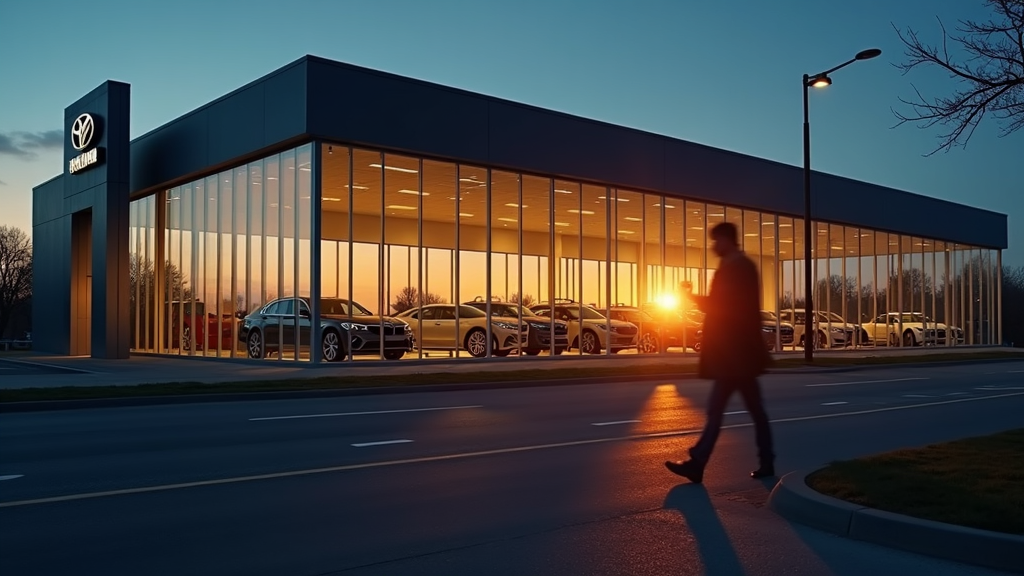
The scene plays out every Saturday morning in Laval, Brossard, Lévis. A customer calls their dealership to check if that SUV they spotted online is still available. Four rings. Five. A voicemail announces the sales department opens at 9:00 a.m. It's 8:47. The customer hangs up, opens the next dealership's tab, and dials.
You just lost a potential $47,000 sale because of 13 minutes on the clock.
If you run a Quebec dealership — Hyundai, Toyota, Ford, Kia, BMW, any banner — that scene isn't an anecdote. It's a statistic. According to industry numbers compiled in 2026, 30 to 35% of incoming dealership calls never reach a human. And 71% of North American dealers name missed calls as their #1 operational pain, according to data published by STELLA Automotive AI.
The 1-in-3 nobody wants to put on paper
Let's run the math your GM doesn't enjoy seeing in writing.
A mid-size Quebec dealership takes 120 to 180 calls per business day, all departments combined: sales, service, parts, F&I, delivery, follow-up. Take the low end — 120 calls, 30% missed — and you get 36 lost calls per day. Across a six-day week, that's 216 missed opportunities.
Now, break it down by department to see where the bill actually hides:
- Sales: roughly one in five inbound calls is a serious buyer in the next 7 days. Average gross margin on a new vehicle in Quebec in 2026: $1,800 to $3,200. On a used vehicle: $2,400 to $4,100.
- Service: a missed call = an unbooked appointment. Average service ticket: $480 to $720 (maintenance, brakes, tires, diagnostics).
- Parts: 60% of parts-counter calls are about an order. Average margin per call: $90 to $180.
- F&I and delivery: follow-up calls on open files — losing them tanks CSI, not just immediate margin.
Apply a conservative mix (40% sales / 35% service / 20% parts / 5% other) and assume only one in ten missed sales calls still ends up walking through the door, and you land on a weekly loss between $14,000 and $22,000 in gross revenue for an average dealership. Annualized, that's $720,000 to $1.1M walking out the back door. The number tracks with what U.S. analysts publish: missed calls cost the average dealership over $1M per year.
If you want to redo the math with your own numbers — your margin, your volume, your real conversion rate — we documented the 4-step method to calculate the ROI of an AI voice agent. It takes 15 minutes and produces a number you can defend in front of your shareholders.
Why 1 in 3 calls dies on the line (and your BDC isn't the problem)
Before you blame your in-house team or your Business Development Center, look at what a typical dealership schedule actually demands.

Comptoir service de concession avec horaire numérique de rendez-vous
1. Peak hours are brutal
Monday 8:30 to 9:30 a.m. Saturday 10:00 to 11:30 a.m. Thursday 5:00 to 7:00 p.m. Three windows where the phone never stops while the same clerk is also handling walk-ins, emails, and web leads. A human can't hold three lines at once. The fourth caller waits, the fifth hangs up.
2. After-hours isn't a niche — it's 40% of the volume
Buyers shop in the evening and on weekends. When your sales floor closes at 9:00 p.m. on Thursday, the calls between 9 and 11 p.m., plus all of Sunday, go straight to voicemail. In the U.S., dealers who deployed 24/7 voice AI report that nearly half of service appointments booked by the agent happen outside business hours. In Quebec it's even more pronounced: web-buying culture arrived fast, but not every dealership has caught up.
3. Bilingualism adds a hidden tax
A customer calls, opens in English. Your clerk is francophone-only, asks a colleague, the transfer drags, the caller hangs up. Same thing in reverse. The "Bonjour-Hi" on your voicemail is window dressing: if the only available human can't switch languages, you lose the call anyway. We dissected this exact problem in our guide on French-English code-switching for AI voice agents.

Comparaison appels manqués vs agent IA vocal 24/7
4. An in-house BDC is expensive and churns hard
A full BDC — supervisor, 3 to 5 agents, ongoing training, 40% annual turnover — runs you $220,000 to $380,000 per year. And it sleeps at night, on weekends, and during holidays. It misses exactly the hours when the phone rings the most.
What an AI voice agent actually changes on the floor
Let's skip the marketing fluff. Here's what a properly configured AI voice agent does — and doesn't do — in a Quebec dealership context.
What it does well, starting week one
Bilingual reception, 24/7. The agent answers in under 600 ms, detects the language from the first word, and holds a natural conversation in Quebec French or English. No robot; no IVR menu hell. The customer says "I'd like to know if the 2024 RAV4 I saw online is still available" and the agent checks live inventory through your DMS (CDK, Reynolds, PBS, Serti, AutoSoft).
Service appointment booking. The agent opens your booking system (Xtime, Dealer-FX, MyKaarma, whichever you use), finds the slot, confirms the postal code and the service type. The appointment lands directly in your calendar with no human touch.
Sales lead qualification. On a shopping call, the agent collects: vehicle of interest, budget, possible trade-in, decision timeline, contact info. It creates the record in your CRM (VinSolutions, Elead, DealerSocket, Activix) and notifies the assigned sales manager or business manager.
Missed-call recovery. If a line rings busy or a call comes in after midnight, the agent texts the incoming number immediately: "Hi! We missed your call. Want us to ring you tomorrow at 9, or would you prefer we text?" That combined inbound-outbound play brings back 18 to 24% of calls that would have been dead on average.
What it doesn't do (and that's fine)
The agent doesn't negotiate a vehicle price. It doesn't sign a finance contract. It doesn't give an opinion on the trade-in value of the customer's 2018 F-150. All of that stays with your human team, because that's where margin is earned. The agent handles the repetitive, scriptable work that adds zero emotional value — and frees your people for the conversation that actually matters.
Tiger Tech's "35%", and what it means for Quebec
In February 2026, the Canadian company Tiger Tech announced the expansion of its AiVA voice automation platform for dealership BDCs across North America. Their press release, picked up by Affaires Automobiles, names what dealers don't say out loud: 30 to 35% of dealership calls go unanswered, and the answer is no longer hiring a sixth BDC agent.
What Tiger Tech, Numa, STELLA and the other U.S. players do less well than what we can do in Quebec comes down to three things:
- Authentic Quebec French. Voices trained on Parisian French butcher local accents, street names ("Saint-Hubert", "Charlesbourg"), and everyday expressions. An agent calibrated locally understands "j'aurais besoin de faire changer mes pneus d'hiver" without flinching.
- Integration with Quebec CRMs. Activix, for example, runs in more than half the dealerships in the province. Native integration is the difference between an agent that creates duplicates and one that slots cleanly into your existing flow.
- Law 25 compliance. A U.S. vendor hosting everything in US-East-1 exposes you to complaints at the Commission d'accès à l'information. A deployment with Canadian hosting and a written agreement on personal-information handling is non-negotiable in 2026.
"But we tried a smart IVR — it was a disaster"
We hear it often. And it's a fair objection. The first generations of IVR — touch-tone menus, rigid decision trees — left a sour taste. A customer pressing 1 for service, then 2 for booking, then waiting on hold music for three minutes, is a worse experience than voicemail.
The 2026 AI voice agent has nothing to do with that. It's a free-flowing, natural-language conversation with 300 to 600 ms latency — imperceptible, in practice. If the agent doesn't know the answer to something ("can I finance with no down payment on a 580 credit score?"), it instantly transfers to an available human with full context already shared. No "could you repeat that question please".
A five-minute demo in Quebec French is usually all it takes to flip a skeptical GM. What was offered 24 months ago and what's available today are two different universes.
How to start without breaking everything
A dealership is a delicate ecosystem: DMS, CRM, service booking, F&I platform, telephony. You don't poke at it lightly. Here's the sequence we recommend for a clean rollout, ideally over 4 to 6 weeks:
- 90-minute audit: we listen to 30 recorded calls (sales + service + parts), identify the 5 scenarios driving 80% of missed calls, and quantify the lost revenue with your GM.
- Pilot on one line: start with after-hours and weekend service. It's the lowest-risk scenario and the fastest payback. KPI: appointments booked vs. baseline week.
- Sales extension: lead qualification, inventory checks, test-drive scheduling. At this stage the agent knows your inventory and your team.
- Outbound layer: service reminders (oil change, seasonal inspection), dormant lead recovery, delivery follow-up at day 30 and day 90.
- Continuous optimization: monthly transcript review, prompt tuning, adding answers for new frequent questions.
The full configuration, DMS and CRM integration, telephony hookup, voice training, compliance paperwork — our team handles all of it end to end. You give us access, we come back with a tested working agent. Nothing for you to install, no scripts to write, no technical learning required for your clerks.
The real question
How long are you willing to let 36 calls a day walk over to the competition while we wait for "the right moment" to act?
If that question makes you wince, it's probably the signal that it's time for a real, numbered conversation. The market is moving fast — the first Quebec dealerships to claim the spot will harvest the best Google slots, the best reviews, and the customers who never even saw your banner go by.
An AI voice agent runs roughly $1,200 to $2,800 per month, all-in, for a standard dealership. Compare that to $22,000 a week leaking through missed calls, and the choice tends to make itself.