
Introduction
A business owner in Calgary asks three vendors what an AI voice agent costs. One says seven cents a minute. She does the math on her call volume, budgets about $350 a month, and signs up. The first invoice lands at nearly $900. Nothing was hidden, exactly. The advertised per-minute rate was simply the smallest number in a bill that had four other lines on it.
This is the single most common way Canadian businesses get the cost of an AI voice agent wrong. The headline price is real, but it is the tip of the iceberg. Once you understand the three layers underneath it, the number stops being a surprise and starts being something you can plan around. Here is what an AI voice agent actually costs a Canadian business in 2026, in Canadian dollars, including the fees almost no vendor puts on the quote.
The three layers of the cost
Every AI voice agent bill breaks into three layers. The first is usage: what you pay per minute (or per call) for the conversation itself. The second is the platform and setup layer: a one-time build fee to configure the agent, plus any monthly base subscription or per-seat charge. The third is the layer buyers miss entirely: the add-ons that quietly ride along with usage, from premium voices to telephony routing to overage penalties.
Vendors love to advertise the first layer because it is the smallest and easiest to compare. The other two are where the real money sits, and where two agents quoted at the same per-minute rate can end up costing wildly different amounts. If you only compare per-minute prices, you are comparing the least important number.
A quick way to keep the layers straight: usage is what you pay to run the agent, the platform and build is what you pay to own the agent, and the add-ons are what you pay because you didn't ask the right question before signing. Only one of those three shows up on the marketing page.
Per-minute reality — and the exchange-rate trap
Across the market, per-minute rates run from about $0.05 to $1.00 USD. Infrastructure-layer platforms, where you assemble your own speech-to-text, language model, and telephony, advertise the low end at $0.05 to $0.15. Managed all-in-one platforms that bundle everything and include support sit around $0.25 to $0.50.
Here is the part built for a US audience that Canadian buyers keep tripping over: almost every one of these platforms bills in US dollars. At an exchange rate near 1.35, a $0.25 USD managed rate is really about $0.34 CAD, and a $0.50 rate is closer to $0.68. Budget in the currency you actually pay in. A quote that looks like $400 a month in the vendor's math can be $540 on your Canadian statement before a single add-on. If you want a sense of how call volume drives that number, our 12 numbers every Canadian business owner should know is a useful reality check.
The one-time build fee nobody quotes up front
The line that surprises buyers most is not the minute. It is the build. A production-ready agent has to be configured, scripted, tested against your real calls, and connected to your calendar or CRM. Someone does that work, and it is rarely free.
Managed providers commonly charge $500 to $2,000 for setup and onboarding, and integration into an existing system can add $1,000 to $5,000 when custom development is involved. The do-it-yourself route looks free until you count the hours: most self-serve deployments take 40 to 80 hours of prompt engineering, testing, and integration. If your time (or your best employee's time) is worth $75 to $150 an hour, that is $3,000 to $12,000 of real cost that never appears on any invoice. A cost model that counts only minutes will land far under what year one truly costs.
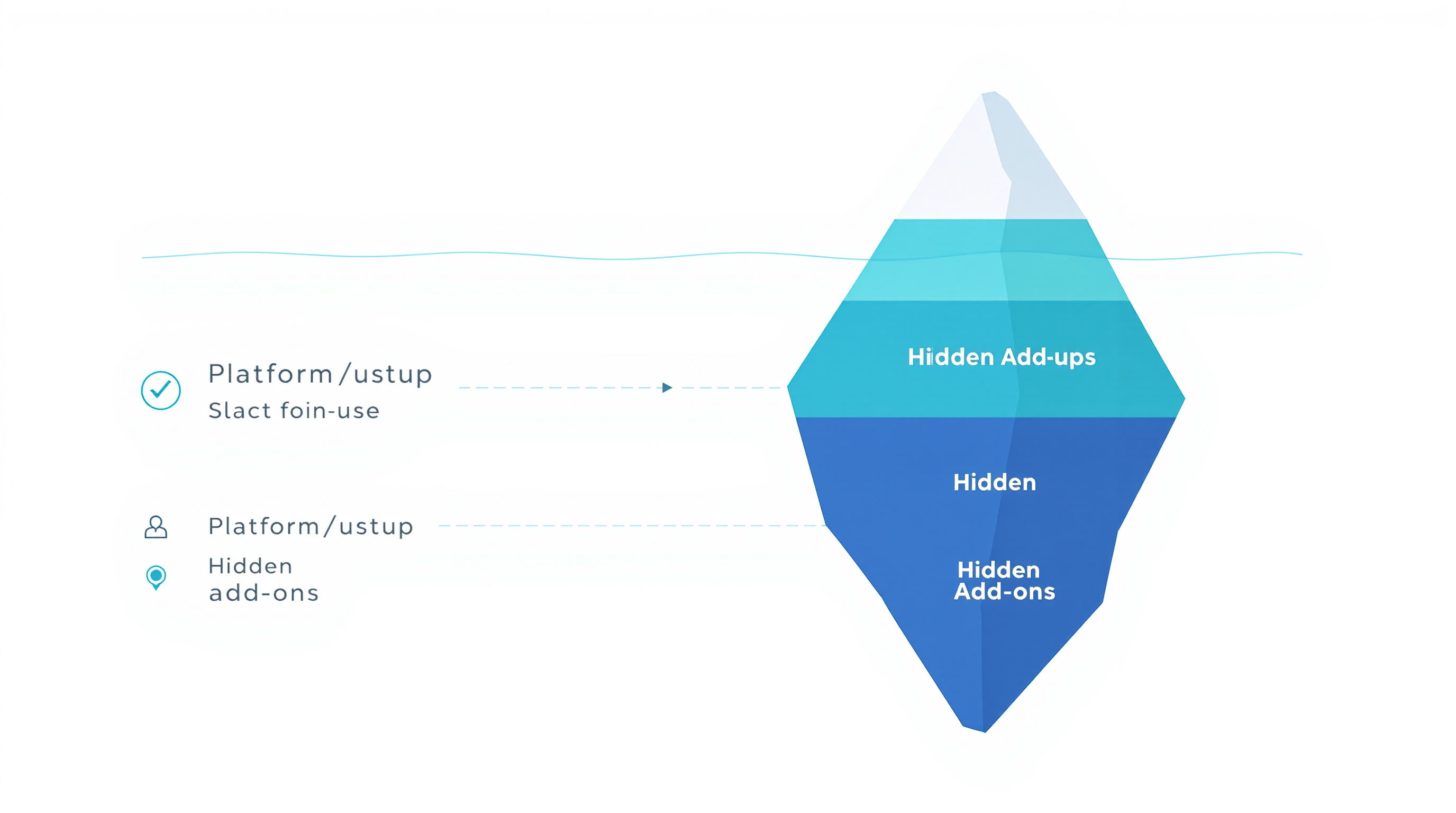
The three cost layers of an AI voice agent, shown as an iceberg
The hidden line items that inflate the monthly invoice
Underneath the per-minute rate sit several add-ons that turn a tidy quote into a messy invoice. Speech-to-text is sometimes billed separately by the second. Premium, natural-sounding neural voices carry a higher rate than the default robotic ones. Every conversational turn burns language-model tokens, which compound on longer calls. Telephony routing adds carrier markups, call-forwarding, and phone-number fees on top of the advertised minute.
Two more catch growing businesses off guard. Concurrency scaling: some platforms charge more as the number of simultaneous calls rises, which bites exactly during your busiest hour or an ad campaign that worked. And overage penalties: exceeding your included minutes can cost two to three times the base rate. The lesson is not that these fees are unfair, it is that they are predictable once you know to ask about them.
There's also a quieter cost in how these fees interact. A longer average call doesn't just add minutes; it adds transcription seconds, more tokens per turn, and a higher chance you brush a concurrency tier during a rush. That's why two businesses on the identical rate card can see monthly invoices 40% apart. The variable isn't the price — it's how your calls actually behave.
What it actually costs per month: a Canadian example
Model a realistic small business: 5,000 minutes of calls a month, averaging three to four minutes each, handling reception, FAQs, and appointment booking. On an infrastructure rate of $0.07 USD a minute, that is $350 USD, or roughly $475 CAD, in raw usage. On a managed all-in-one platform at $0.30 USD, the same volume is $1,500 USD, about $2,025 CAD, but with far less of your own time spent building and babysitting it.
Add telephony, a premium voice, and the odd human handoff, and most moderate deployments land between $400 and $1,200 USD a month, which is roughly $540 to $1,620 CAD. Then amortize the one-time build across year one. The right way to read this is not 'which is cheapest per minute' but 'what is my all-in monthly and first-year number' — and whether that number is smaller than what missing those calls costs me.
The comparison that actually matters
A per-minute rate means nothing in isolation. The honest comparison is against your real alternative. A traditional answering service runs around $800 a month for basic after-hours coverage, bills you by consumption, and rarely books an appointment. A full-time receptionist in Canada earns roughly $40,000 to $50,000 a year in salary; loaded with CPP or QPP, EI, and benefits, that is closer to $50,000 to $62,000, or about $4,200 to $5,200 a month — and that one person covers one shift, in one language, in one of the country's six time zones.
That is where an AI agent changes the math for a Canadian business. It answers in Toronto at 2 a.m. and in Vancouver at dinnertime for the same flat capacity, and it handles both official languages without a bilingual-hiring premium. For the full side-by-side, we broke down the numbers in AI voice agent vs. outsourced call centre. The point is that $600 a month is expensive if you get three calls a week and cheap if you are losing two booked jobs a day to voicemail.
It helps to flip the question around. Instead of asking what the agent costs, ask what one missed call is worth to you. A dental practice, a law office, and an HVAC contractor all answer that very differently. When a single booked job or retained client is worth a few hundred dollars, an agent that reliably catches even a handful of after-hours calls a week has usually paid for its entire monthly cost by the second week.
How to budget without surprises: five questions
Before you sign anything, get the answer to five questions in writing. First, is there a one-time setup or build fee, and what does it include? Second, are speech-to-text, the voice, telephony, and language-model usage bundled into the per-minute rate or billed separately? Third, what happens when I exceed my included minutes — what is the overage rate? Fourth, are there concurrency limits or fees when several calls come in at once? Fifth, what level of support and what SLA are included at my price, and what does the next tier cost?
Those five answers turn a vague per-minute quote into a real total cost of ownership you can forecast. If a vendor cannot answer them cleanly, that is itself information. For a broader buyer's checklist, see our 7 questions to ask before choosing an AI voice agent in Canada. Independent roundups like this 2026 comparison of answering services are also worth reading to benchmark the human alternative.

Monthly cost of an AI voice agent versus alternatives across Canada
The bottom line for 2026
An AI voice agent in Canada in 2026 rarely costs what the pricing page says, but it also rarely costs as much as the anxiety around it suggests. For a typical small business, plan on roughly $540 to $1,620 CAD a month all-in, plus a one-time build measured in hours or a few thousand dollars, depending on whether you go managed or do it yourself. Payback usually lands inside three to six months once you count the calls you stop losing.
The businesses that win with this technology are not the ones that found the cheapest per-minute rate. They are the ones who modelled the full number honestly, in Canadian dollars, and compared it to what their phone is already costing them in missed opportunities. Detailed vendor breakdowns from Aircall and Retell AI are a good starting point — just remember to add the exchange rate, the build, and the add-ons before you decide.