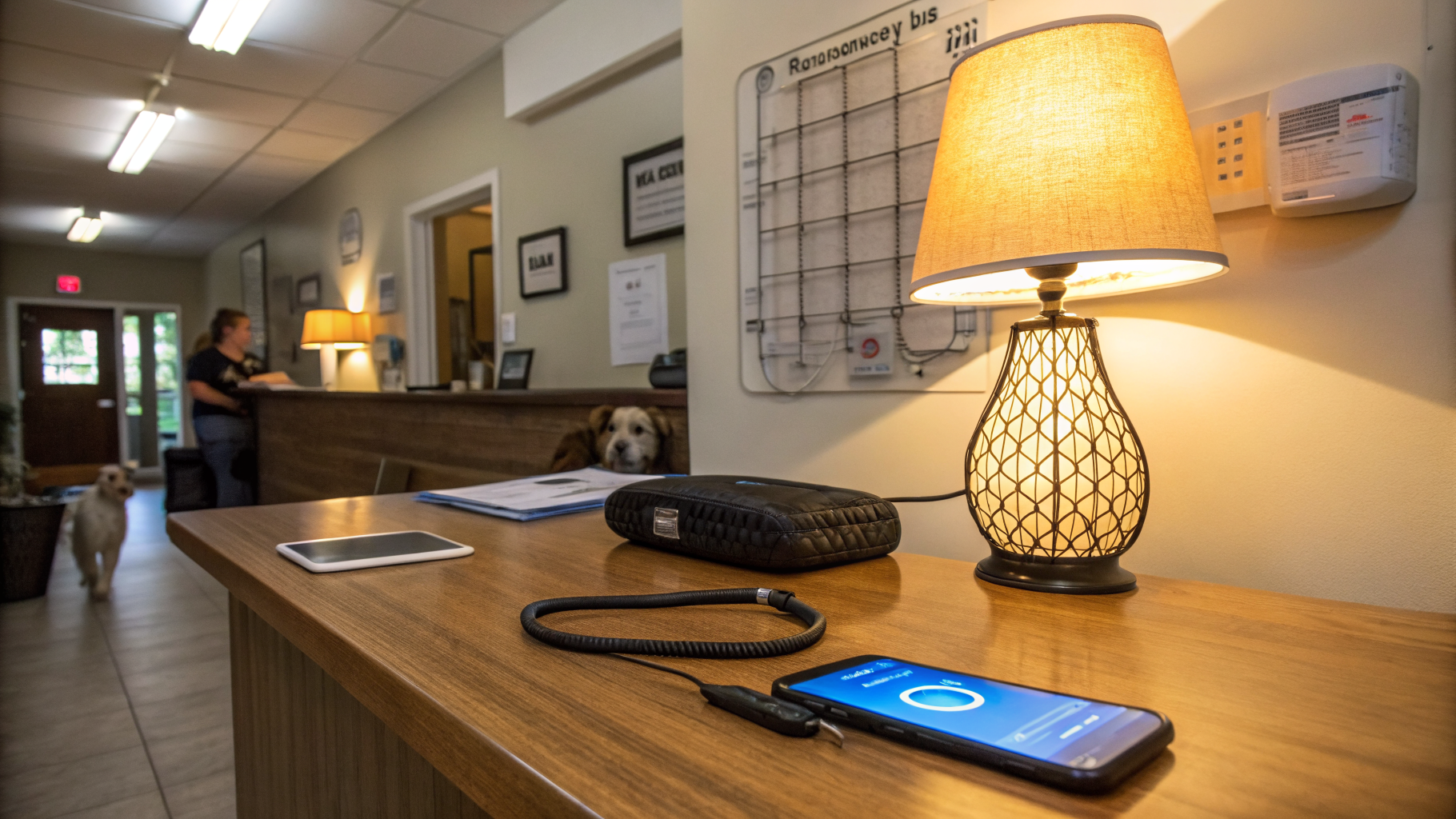
Sunday evening, 10:47 PM. A client leaves a voicemail at your clinic: "My dog Max just ate a bar of dark chocolate, he's thrown up twice, should I be worried?". You'll hear the message Monday morning at 8:30, maybe later if you have a surgery. By then, either Max is fine and the client got billed $280 for an emergency consult at another hospital, or Max is much worse and the client is writing a one-star Google review.
The numbers don't lie: North American veterinary clinics miss on average between 30% and 40% of incoming calls, and that figure climbs to 35% for new clients alone ending up in voicemail. For a Quebec clinic billing an average of $95 per consultation and $280 per after-hours emergency, that's easily $80,000 to $130,000 in phantom revenue per year. Not counting the dogs and cats that could have been stabilized in time.
Since the launch of GPT-Realtime-2 on May 7, 2026, an AI voice agent can now actually reason about a veterinary case — not just take a message. It can ask the breed, the weight, the amount of chocolate ingested, calculate an approximate toxic dose, and decide within 15 seconds whether the situation justifies waking the on-call vet or redirecting to a 24/7 emergency clinic.
This tutorial lays out the 6 concrete steps Quebec veterinary clinics must follow to deploy a bilingual AI voice agent capable of triaging a pet emergency — without breaking Law 25 compliance and without costing a fortune. It all starts with an honest audit of your missed calls.
Step 1: Audit your missed calls for 7 days (15 minutes a day)
Before you buy anything, you need to know when and why your phone is ringing into the void. Most clinics overestimate their pickup rate by 20-30%. The animal health tech who swears "everyone gets called back the same day" bases that on the calls she hears, not on the ones that never even reach voicemail because the client hung up after two rings.
Concretely: ask your phone provider (Telus, Bell, Videotron Business) for a 7-day report including abandoned calls, average time-to-answer, and peak hours. You'll see three recurring patterns:
- Monday 8 AM to 10 AM — post-weekend bombardment. Every owner who spent the weekend wondering if Rex needed to see a vet calls at the same time.
- Lunch hour (12 PM to 1:30 PM) — the AHT is alone at the front desk, sometimes also in exam rooms, and the phone rings 4 or 5 times in parallel.
- Evening and weekends — automatic voicemail with a generic emergency vet number nobody actually listens to.
If you run a boarding kennel, a shelter, or a mobile clinic, you also miss calls in the middle of exams — that's normal, your hands are on the animal. That's exactly when an AI voice agent becomes indispensable.
Step 2: Co-write the triage script with your lead veterinarian
A badly scripted AI voice agent that reassures a client whose cat is having a urethral obstruction is both a clinical and a legal disaster. The golden rule: no agent decides alone. It classifies, routes, and alerts.
Sit down for 90 minutes with your most experienced vet and list the red flags the AI must recognize without hesitation. Here's the template most Quebec clinics are adopting in May 2026:
- Respiratory distress — dog "panting nonstop even at rest", cat "mouth-breathing"
- Trauma — vehicle accident, fall, attack by another animal, open bleeding wound
- Toxicity — chocolate, grapes, xylitol, antifreeze, plants (lilies for cats), human medications
- Urinary obstruction — especially male cats "going to the litter box without producing anything" or repeatedly licking their genitals
- Bloat / gastric torsion — large dog (German Shepherd, Doberman) with bloated belly trying to vomit unsuccessfully
- Active seizures or status epilepticus
- Sudden paralysis — especially dachshunds and cats with aortic thromboembolism
- Active bleeding that won't stop with 5 minutes of pressure
For each category, your vet dictates the precision question (animal weight, breed, time of ingestion, etc.) and the final decision: (A) wake the on-call vet, (B) redirect immediately to the nearest 24/7 emergency clinic, or (C) schedule first appointment next morning. The same logic works for dental practices triaging oral emergencies, but the animal vocabulary is very specific and doesn't transfer directly.
Step 3: Pick your tech stack — Quebec voice + reasoning
In May 2026, two options dominate for a Quebec veterinary clinic that wants an agent capable of reasoning about an emergency:
Option A — ElevenLabs Agents + GPT-Realtime-2 as LLM. You keep the Quebec French voice that doesn't sound like a Parisian newsreader (the Parisian accent drives away clients in rural areas), and you plug GPT-Realtime-2 in as the brain. The ElevenLabs update from May 12, 2026 added Conversation Tags, meaning you can auto-tag every call as "toxicity-emergency", "vaccine-appt", "Rx-refill" and have a readable dashboard on Friday.
Option B — gpt-realtime-2 as full stack. Simpler to plug in, slightly higher latency (250-400 ms), but the French voice is correct without being Quebec French. Avoid if your clients are rural (Saguenay, Abitibi, Gaspesie) — the neutral accent doesn't land well.
For most clinics with fewer than 5 vets, we recommend Option A. For bilingualism, leverage the same setup that bilingual Quebec daycares validated: automatic language detection within the first 2 seconds, then the agent stays locked on that language until the end of the call to avoid nervous code-switching.
Step 4: Connect your practice management software (Provet, IDEXX Neo, ezyVet, ImproMed)
An AI voice agent that can't check Dr. Tremblay's availability Tuesday at 2 PM is just a fancy answering machine. The PMS (Practice Management Software) integration is the technical part that takes the longest — count 3 to 5 business days depending on your provider.
The APIs available in May 2026 for popular vet PMS in Quebec:
- ezyVet — documented REST API, cleanest integration. It's what most new Montreal clinics have adopted.
- Provet Cloud — OpenAPI, GraphQL support in beta since March 2026.
- IDEXX Neo — limited API, usually goes through Zapier or Make.com as intermediary.
- ImproMed (Covetrus) — no stable public API, integration via read-only SQL database, doable but heavier.
Once connected, the agent can: (1) read the patient record from the owner's phone number, (2) confirm the next vaccination date, (3) suggest a slot that matches the vet's actual availability, and (4) write the call note directly into the patient history. The next iteration — already announced through ElevenAgents' multimodal capabilities — will let the owner send a photo of the wound by WhatsApp during the call so the on-call vet can see what's needed.
Step 5: Law 25 compliance — the part everyone skips
In Quebec, the moment an AI voice agent collects the owner's name, phone, civic address, or the animal's medical condition (which, paradoxically, isn't covered by Law 25 since animals aren't natural persons, but the context still reveals personal info), you're in personal information territory.
Three concrete actions to take before go-live:
- Explicit consent phrase at the start of the call — something like: "Hello, you're speaking with Léa, the virtual assistant of Veterinary Clinic X. To better serve you, I'm recording our conversation and noting information in your animal's file. You can ask to speak to a human at any time.". This phrase covers consent under the Quebec Access to Information Commission for recording and collection.
- Data hosting in Canada. ElevenLabs has offered a regional hosting option since April 2026. Verify your transcripts don't transit through a U.S. data center (CLOUD Act issue).
- Retention policy — 90 days default for voice transcripts, 7 years for anonymized clinical notes in the PMS. Document it in your internal policy and train your team.
If you also run SMS and chat in parallel, apply the same rules — Law 25 makes no distinction between channels.
Step 6: Test with 10 real scenarios before go-live
The classic trap: the clinic installs the agent on a Friday, switches it on Monday morning, and Tuesday evening discovers the agent is sending every cat that "hasn't eaten in 3 days" to a standard appointment next week — when for a cat, that's already the start of hepatic lipidosis.
Best practice: play out 10 real scenarios over the phone with an animal health tech pretending to be the client, and you (the vet) noting the gaps. Here's the test battery pro clinics use:
- 45 kg Cane Corso ate 200 g of 90% dark chocolate 30 minutes ago
- Adult male cat that "goes to the litter box 15 times and nothing comes out" since this morning
- Prescription refill for Prednisone — known patient
- Pricing question: how much for spaying a 25 kg female dog?
- English call from an Anglophone client — the agent must switch without a hitch
- Elderly client speaking slowly, Gaspesie accent — test of patience and transcription
- Active seizures — the agent must immediately give the address of the nearest 24/7 clinic
- Annual checkup request — standard appointment, easy
- Complaint about last appointment's bill — mandatory escalation to human
- Call from a telemarketer or solicitor — the agent must hang up politely without creating a record
Note failures, adjust the prompt, retest. The rule: no go-live until all 10 scenarios pass 100%. Same rigor as a new anesthesia protocol — you don't deploy it on an 8-year-old Labrador without first validating on paper.
The 30-day calendar: week by week
A realistic deployment for a clinic of 3-5 vets:
- Week 1 — missed call audit (Step 1), scoping meeting with lead vet for the triage script (Step 2).
- Week 2 — tech stack selection (Step 3), order PMS API access, prepare Law 25 script (Step 5).
- Week 3 — PMS integration (Step 4), first version of agent available in "shadow" mode (it listens to calls without responding, you compare its suggestions to what staff actually do).
- Week 4 — 10-test battery (Step 6), team training, gradual go-live (first peak hours Monday morning, then evenings, then weekends).
Common-sense rule: never switch 100% of your calls at once. Start with the most painful channel (typically evening and weekend), measure for 14 days, then expand.
How much it really costs in May 2026
For a clinic of 3 vets receiving between 60 and 100 calls per day:
- Initial setup (script, integration, tests): between $4,500 and $7,500 CAD depending on PMS complexity
- Monthly cost (ElevenLabs + GPT-Realtime-2 licenses + Canadian hosting): $350 to $600/month depending on volume
- Maintenance / adjustments: 1-2 hours per month with your integrator to refine the script as new scenarios emerge
Compared to the $80,000 to $130,000 in annual phantom revenue mentioned above, ROI typically lands in the 4 to 6 first months. But the real win isn't financial: it's that the Sunday-evening client with her dog Max gets a real answer in 90 seconds instead of a voicemail on Monday morning. And Max is okay.
The next step
If your clinic hasn't audited its missed calls this year, start with Step 1 this week. Request the 7-day phone report from your provider, count your peak-hour abandons, and calculate your own phantom revenue. It's free, takes 90 minutes, and changes the entire internal conversation about "do we really need this?".
For a turnkey deployment with the TECHMA team handling everything — script, PMS integration, Law 25 compliance, training, tests — contact us. We configure everything for your clinic, you keep your hands on the animals.