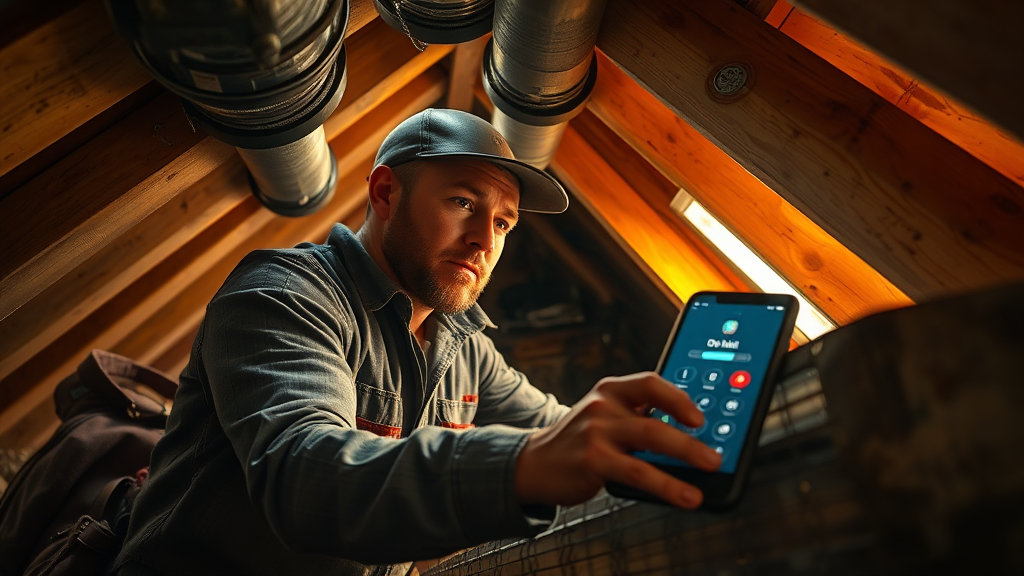
It’s 2:17 p.m. Your tech is in a 45°C attic, wedged between ducts, trying to bring a dead air conditioner back to life while the shop phone keeps vibrating in someone’s pocket downstairs. One call. Two. Seven. Then a dispatch text. Then the same customer calling again because nobody answered the first time. Meanwhile, temperatures are climbing across Montreal and Quebec City, systems are failing at the same time, and a Hydro-Québec outage can trigger a second wave of urgent calls before your team has even caught up with the first one.
The reality is simple: HVAC SMBs are not just losing calls. They’re losing booked jobs, replacement estimates, maintenance agreements, repeat customers, and referrals. Add that up over one cooling season and the damage can easily land between $45,000 and $120,000. The good news is that an AI voice agent HVAC Quebec, fully set up by TECHMA, trained on your company’s specifics, and continuously monitored after launch, can recover a major share of those missed opportunities within 90 days.
If you want broader context on how this compares with other service trades, read our article for plumbers and electricians in Quebec. And if you’re still weighing staffing against outsourcing against automation, we also published the receptionist vs answering service vs AI voice agent match-up.
1. Between 22% and 27% of inbound home service calls go unanswered
Industry data for home services, including figures summarized in resources like HVAC industry phone statistics 2026, points to a stubborn reality: roughly 22% to 27% of incoming calls are never answered. In plain terms, nearly one out of four callers may hit a dead end when things get busy.
That number feels very believable to any HVAC owner in Quebec. In spring, the front desk may still hold together. But once the first real heat arrives, or when Montreal, Laval, the South Shore, Quebec City, and surrounding areas all heat up at once, the phone system loses its buffer. Even a strong office team gets overwhelmed. And let’s be honest, in many 10-to-50-person businesses, the person answering calls is also handling invoices, parts follow-ups, appointment confirmations, and service coordination.
Why this matters for your HVAC SMB
A missed HVAC call is rarely “just one more voicemail.” It’s often a homeowner with no cooling, a small business losing comfort for customers, or a property manager calling three contractors at the same time. The first company that answers usually wins the chance to book. An AI voice agent HVAC Quebec helps absorb call spikes, qualify requests, respond in French or English, and route the right information to your team without letting the phone ring into nothing.
2. 85% of callers who hit voicemail hang up without leaving a message
Widely cited industry figures, including those associated with ACHR News summaries, show that 85% of callers who reach voicemail hang up without leaving a message. That hurts because voicemail feels like a backup plan, but in 2026 it often acts more like a hidden leak in the sales process.
A customer calling because their AC stopped cooling during a heat wave does not want to explain everything to a mailbox. They want clarity: can someone come out, how urgent is this, when will they hear back, what happens next? If they do not get that right away, they move on. That behavior is even stronger in dense and competitive Quebec markets where multiple HVAC contractors cover the same neighborhoods.
Why this matters for your HVAC SMB
If your current process still depends on “leave a message and we’ll call you back,” you are probably losing more demand than you realize. The value of a properly deployed AI voice agent is immediate response. TECHMA installs the solution, integrates it into your environment, trains it on your company’s specifics, and keeps monitoring performance over time. Your callers get an answer instead of a tone, and your team gets structured information instead of a pile of missed opportunities.
3. About 62% of HVAC calls come in after hours
Another critical HVAC statistic repeated across industry content is that 62% of calls arrive outside normal business hours. Nights. Weekends. Early mornings. Holidays. That makes perfect sense because equipment failures do not wait for office schedules.
In Quebec, that pattern gets even more intense during heat waves or after power interruptions. A Hydro-Québec outage followed by equipment restarts can create a sudden surge of service calls. Thermostats show errors, compressors struggle, indoor temperatures rise, and your phone starts exploding when your office is already closed.
Why this matters for your HVAC SMB
If most calls come in precisely when nobody is available to answer, the issue is not your team’s effort. It is your coverage model. An AI voice agent HVAC Quebec can answer 24/7, in both French and English, identify urgent situations, reassure callers, trigger dispatch SMS alerts when needed, and log call details cleanly for follow-up. That gives you broader coverage without having to fully staff every evening and weekend shift.
4. Call volume can jump by 340% from spring to summer
Seasonality in HVAC is not subtle. Industry reporting points to spikes as high as 340% between spring and summer. When the first major heat wave hits Montreal and Quebec City, that kind of increase stops being a theory and becomes your daily reality. You see it in your call logs, your scheduling bottlenecks, your office stress level, and your delayed callbacks.
The problem is that an SMB’s admin structure does not triple overnight. You cannot hire and train an experienced dispatcher in two days. You cannot teach a new staff member your service zones, emergency rules, install criteria, and VIP customer handling over one weekend. But the calls still come in anyway.
Why this matters for your HVAC SMB
A process that works in April can collapse in July. That is exactly where a well-built voice agent starts paying for itself. TECHMA configures the agent around real HVAC scenarios: no-cooling emergencies, maintenance requests, heat pump replacements, part follow-ups, appointment confirmations, after-hours routing, and more. Using features such as the Conversation Tags introduced in ElevenLabs updates, the system can classify calls more intelligently for faster dispatch and better reporting.
5. A missed HVAC call is often worth $350 to $700 CAD
This is the number that changes the conversation. The average cost of a missed call in HVAC often falls between $350 and $700 CAD, depending on service type, close rate, ticket value, upsell potential, and repeat business. A single service call can lead to a repair, and that repair can later turn into a replacement quote or a maintenance agreement.
Of course, not every call is identical. A residential estimate is not the same as a commercial emergency. Still, even with conservative assumptions, a handful of missed calls per day over a 90-day peak season creates a serious revenue gap. That is why the idea of losing $45,000 to $120,000 in one season is not exaggerated for many Quebec HVAC businesses.
Why this matters for your HVAC SMB
When owners ask whether an AI voice agent is worth it, the better question is usually not “what does it cost?” It is “what is the cost of doing nothing?” If your company misses four calls a day during peak season, you do not have a minor admin annoyance. You have a recurring revenue leak. And that leak keeps happening every week until something is put in place to catch those calls.
6. HVAC customer lifetime value can reach $12,000 to $15,000 CAD
In HVAC, a new customer is not only worth the first invoice. Over time, between maintenance, repairs, replacement work, and referrals, customer lifetime value can reach $12,000 to $15,000 CAD. This is where many business owners underestimate missed calls. They think they are losing one service opportunity when they may actually be losing an eight-to-twelve-year customer relationship.
Add Quebec’s market reality to that. Single-family homes with heat pumps. Seasonal tune-ups. Emergency calls during weather extremes. Neighbor referrals. Multi-unit buildings. Small commercial clients. A customer who gets fast, reliable service today may come back repeatedly and bring others with them.
Why this matters for your HVAC SMB
Missing a call today can cost far more than one job. That is why an AI voice agent HVAC Quebec should be treated as a capture and continuity system, not just an automated receptionist. TECHMA builds the agent, trains it on how your company speaks and operates, adapts it to your offers and service areas, and stays in continuous monitoring mode so results improve over time.
7. The first contractor to answer wins 78% of emergencies — and a solid deployment can cut missed calls by 60% in 90 days
In urgent service, speed wins. Industry data suggests that the first contractor to answer captures about 78% of emergency jobs. And when AI voice deployments are properly configured and integrated into operations, businesses can target a 60% reduction in missed calls plus roughly 35% more booked appointments within 90 days.
This point matters because generic tools do not create those outcomes by themselves. A rushed setup will not do much. A turnkey deployment that includes call logic, bilingual handling, dispatch rules, CRM or field-software integration, and ongoing optimization is what actually improves call capture. If you want to avoid the common mistakes, read the 7 deployment mistakes to avoid.
Why this matters for your HVAC SMB
In HVAC, fast response is not a nice extra. It is a direct sales advantage. A well-built voice agent answers quickly, identifies whether the caller has an emergency, a quote request, a maintenance need, or a follow-up, and routes the interaction into the right workflow. In Montreal especially, where a large share of the population is English-speaking, bilingual French/English support is not optional if you want to capture the whole market.
The math for your HVAC business in Quebec
Let’s keep the math simple. If your company misses 4 calls per day over a 90-day peak season, and each missed call is worth an average of $350, the formula looks like this:
- 4 calls/day × $350 × 90 days = $126,000
That is already a serious number, and it uses the low-end value per call. If some of those calls are worth $500 or $700, or if part of that demand turns into long-term recurring customers, the real cost climbs even higher. Even if you slash that estimate to stay conservative, you still land comfortably inside the $45,000 to $120,000 seasonal loss range. Many Quebec HVAC SMBs are already there without seeing it clearly in one line item.
Now imagine your voice agent recovers 60% of those missed calls within 90 days. On $126,000 in potential lost revenue, that means:
- $126,000 × 60% = $75,600 recovered
And if the system also drives 35% more appointments from the calls it captures, the impact shows up in both revenue and operational stability. Your office team gets a cleaner flow of information. Your dispatch process gets less chaotic. You do not create more hours in the day, but you stop giving them away to unanswered demand.
For a broader view of how voice agents fit into HVAC operations, see the ServiceTitan guide to AI voice agents in HVAC.
What TECHMA builds for you
With Agent IA Vocal, operated by TECHMA IT, the approach is completely turnkey. No self-setup. No DIY platform to configure at night after a full workday. TECHMA handles installation, integration, configuration, testing, training the agent on your business specifics, and continuous monitoring after launch.
For a Quebec HVAC SMB, that means TECHMA can build a voice agent that answers in French and English, recognizes emergency scenarios, qualifies callers, collects contact details, captures addresses, understands equipment categories, and pushes information to the right workflow. The agent can also use advanced conversation tagging to sort calls by request type, urgency level, service territory, or existing-customer status.
TECHMA can connect the setup with tools such as Jobber or Housecall Pro, depending on your stack, to support lead intake, appointment workflows, and routing to your team. If something requires immediate attention, a dispatch SMS can be sent to the right person. If it is less urgent, the call is documented clearly for fast follow-up.
There is also the compliance side. In Quebec, Law 25 means personal information handling cannot be treated casually. Businesses need to be serious about what data is collected, who can access it, how it is used, and how privacy obligations are addressed. TECHMA takes that reality into account when building the solution so your voice agent fits into a more responsible approach to customer data management.
In other words, you are not just adding a voice that answers the phone. You are putting in place a call capture, triage, and follow-through system designed for your HVAC reality and supported by a team that stays involved after implementation.
The objection: “My longtime customer prefers talking to a human”
This is probably the most common objection, and it is fair. Yes, some customers do prefer speaking with a person, especially longtime ones and especially when they are stressed. But for most HVAC SMBs during peak season, the real comparison is not human vs AI. It is immediate response vs no response.
When 85% of people hang up on voicemail and 62% of calls come in after hours, the alternative to a voice agent is usually not a calm, available receptionist at 9:30 p.m. on a Sunday. It is silence, voicemail, or a callback that comes too late. In that situation, many customers would rather get a fast, polite, useful answer than no answer at all.
And a good agent does not replace your whole team. It handles the first interaction, captures the urgency, reassures the caller, qualifies the need, and hands things off when appropriate. For VIP or longtime customers, TECHMA can configure specific rules such as number recognition, priority routing, human transfer windows, and tailored messaging based on customer type. That is the difference between a generic tool and a deployment built around your business.
What matters most is the experience. If the agent responds clearly, understands context, uses the right language, and does not waste the caller’s time, acceptance is usually much stronger than owners expect. Especially when the alternative is waiting and wondering whether anyone will call back.
Before the first June heat wave
The best time to fix missed-call leakage is not after your phones are already overloaded. It is just before that happens. Before the first real June heat wave. Before the heat pump calls stack up. Before the next Hydro-Québec outage creates a domino effect. Before your office team shifts into permanent catch-up mode.
If you want to stop losing profitable calls and see what an AI voice agent HVAC Quebec could do in your operation, Agent IA Vocal offers a straightforward path: TECHMA builds the agent, integrates it with your tools, trains it on your company’s specific workflows, and stays in continuous monitoring so the system performs in the real world. Not just in a demo. In the middle of the season when every call matters most.