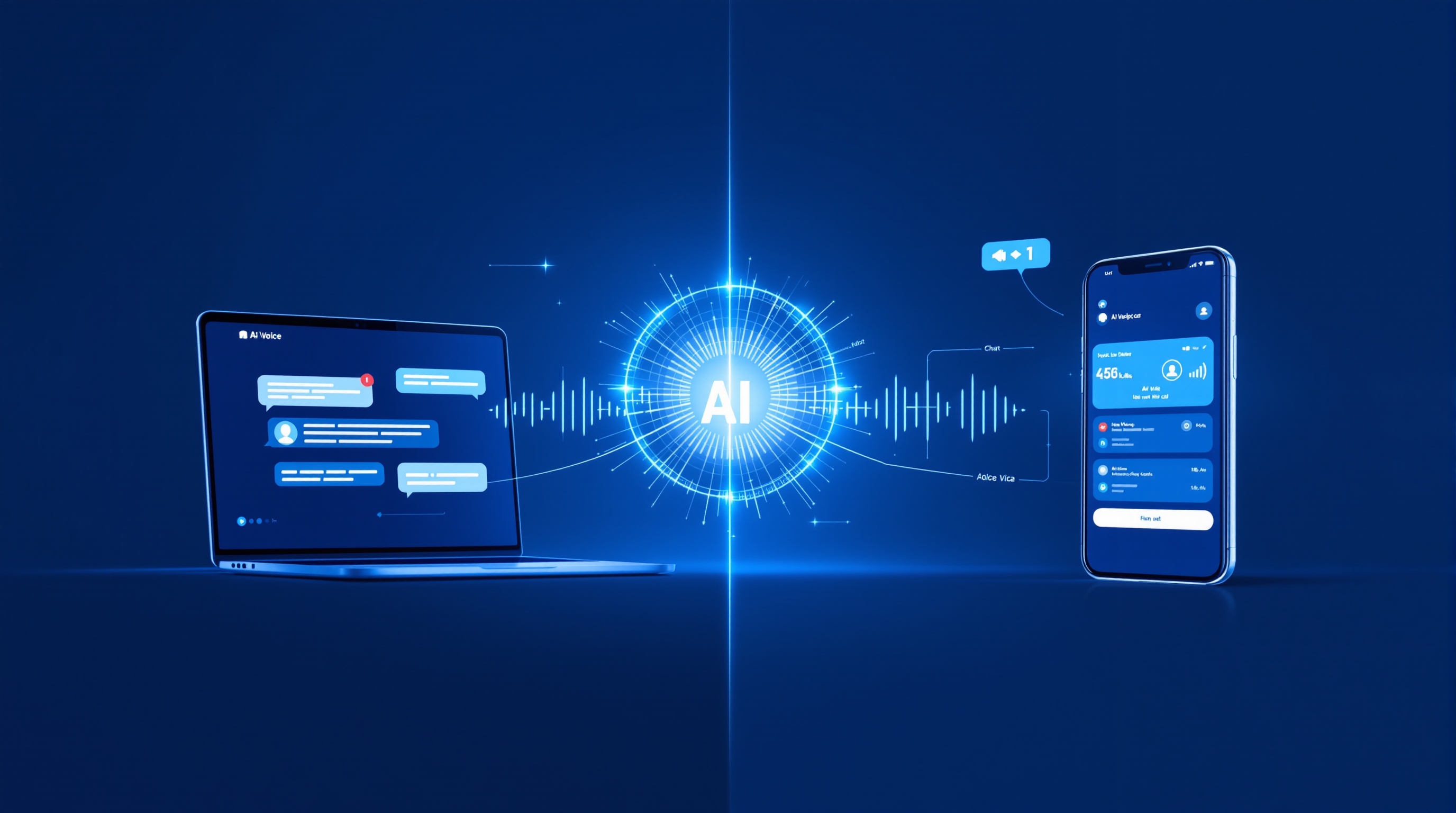
A potential customer calls your dental clinic at 2 PM. Your chatbot sits patiently on your website. Nobody visits it. The phone rings into the void, and the customer calls your competitor instead.
This scenario plays out thousands of times daily across Quebec SMBs. Yet when it's time to invest in automation, many business owners hesitate: chatbot or AI voice agent? The answer hinges on one simple question — how do your customers prefer to reach you?
Chatbot vs AI Voice Agent: Two Tools, Two Realities
A chatbot is a text-based tool. It lives on your website, answers common questions in writing, and can qualify leads through conversational forms. For an online store fielding 200 daily messages about return policies, it works well.
An AI voice agent is fundamentally different. It picks up the phone. It talks. It listens. It reads the nuances of voice — the rushed tone of an urgent customer, the hesitation of someone trying to book an appointment. According to Gartner's projections, conversational AI will save contact centers $80 billion in labor costs in 2026.
The real difference? A chatbot waits for the customer to come to it. An AI voice agent meets the customer where they already are — on the phone.
Comparison #1: Cost Per Interaction
Let's talk money, because that's what matters for an SMB in Sherbrooke or Laval.
A chatbot costs $10 to $100 per month in SaaS subscriptions. Cost per conversation? About $0.10 to $0.50. That's affordable, but it only handles text interactions — and only those that come through your website.
An AI voice agent costs $0.40 to $2.00 per phone call. More expensive per interaction? Yes. But compare that to the cost of a missed call. In our receptionist vs AI comparison, we calculated that a single missed call costs between $100 and $200 in lost revenue for a service-based SMB.
In other words: your $50/month chatbot saves pennies on FAQ questions. Your $99/month voice agent recovers thousands in captured revenue. It's not the same calculation.
Comparison #2: Availability and Contact Channels
Here's a fact many business owners underestimate: in Quebec, the phone remains the #1 channel for contacting a service business. Not chat. Not email. The phone.
Your chatbot is available 24/7 — but only on your website. If a customer calls at 7 PM after seeing your Facebook ad, the chatbot can't do a thing. The phone rings, and nobody answers.
An AI voice agent answers the phone 24/7, 365 days a year. It handles after-hours calls, weekends, holidays. It can even automate appointment booking during the call, syncing with your calendar in real time.
A chatbot and a voice agent aren't competing — they cover different channels. The question is which channel generates the most revenue for your type of business.
Comparison #3: Conversation Complexity
This is where the gap becomes obvious.
A chatbot excels at simple, predictable interactions: "What are your hours?", "Where are you located?", "How much does X cost?" Straightforward Q&A, no nuance required.
An AI voice agent handles complex conversations. A customer calls and says: "I have a dental emergency — is Dr. Tremblay available tomorrow morning? If not, can someone else see me?" The agent understands the urgency, checks the calendar, proposes alternatives, and confirms the appointment — all in under 90 seconds.
Voice carries information that text simply can't: urgency, emotion, hesitation. According to the RingCentral Agentic AI Report 2026, 14% of organizations already prefer interacting with AI agents by voice — a number expected to reach 23% within two years.
Comparison #4: Customer Experience
Let's put ourselves in the shoes of a hair salon owner in Trois-Rivières.
Chatbot scenario: a client visits the website, opens the chat widget, types her question, waits for a response, types again, waits more. In 3 minutes, she may have booked an appointment. Or she gave up because the chatbot couldn't understand "I just want a color touch-up, not a full dye job."
Voice agent scenario: the same client calls while driving. She says, "I'd like an appointment for a color touch-up this week, ideally Thursday afternoon." The agent responds, checks availability, confirms the slot. Done in 45 seconds, hands-free.
For service businesses (clinics, law offices, salons, plumbers, brokers), voice almost always wins. The customer wants an immediate answer, not a typed conversation.

Hybrid chatbot and voice agent working together
When Is a Chatbot the Right Choice?
We're not going to tell you chatbots are useless — that wouldn't be honest.
Chatbots are excellent for e-commerce (order tracking, return policies), high-traffic websites (automated FAQ, lead capture), businesses whose customers prefer to type (SaaS, tech, millennial demographics), and as a complement to a voice agent covering the web channel.
If 80% of your customer interactions happen through your website or social media, a chatbot makes sense. If 80% of your customers pick up the phone — and that's the case for most service-based SMBs in Quebec — the voice agent should be your priority.
The Hybrid Approach: Best of Both Worlds
The highest-performing businesses in 2026 aren't choosing between chatbots and voice agents. They're deploying both.
The chatbot covers the website: quick questions, lead qualification, online booking. The voice agent covers the phone: inbound calls, emergencies, complex conversations, post-visit follow-ups.
At Agent IA Vocal, clients who combine both channels see a 60% reduction in missed calls and a 35% increase in confirmed appointments. The G7 summit in Montréal highlighted that SMBs adopting AI strategically — not just one tool, but an integrated approach — achieve significantly stronger outcomes.
Our recommendation? Start with the channel that's losing you the most revenue. For most Quebec SMBs, that's the phone.
FAQ
Can an AI voice agent also do what a chatbot does? Partially, yes. Some voice agents integrate text messaging features (SMS, WhatsApp). But their core strength is phone conversation. For web chat, a dedicated chatbot will perform better. Check out our essential integrations guide to see how to combine both.
How much does it cost to set up an AI voice agent? At Agent IA Vocal, our plans start at $49/month for a basic agent, $99/month for the pro version with CRM integrations, and $199/month for the enterprise version. All configuration is handled by our team — you don't need to install anything.
Does the AI voice agent understand Quebec French? Absolutely. Our agents are trained to understand Quebec expressions and accents, plus English. This is a major advantage over American-built solutions that struggle with bilingual support.
My business needs both. Where should I start? Identify your #1 revenue-loss channel first. If it's the phone (missed calls, closed-hours losses), start with the voice agent. If it's the web (high traffic, low conversion), start with the chatbot.
The Verdict
A chatbot and an AI voice agent aren't competitors. They're complementary tools covering different channels.
But if you need to pick one investment for your Quebec SMB in 2026, ask yourself: do your customers call you or write to you? For 7 out of 10 service-based SMBs in Quebec, the answer is the phone. And the phone is the AI voice agent's territory.
Book 15 minutes with our team to see how an AI voice agent integrates with your business — or explore our plans starting at $49/month.