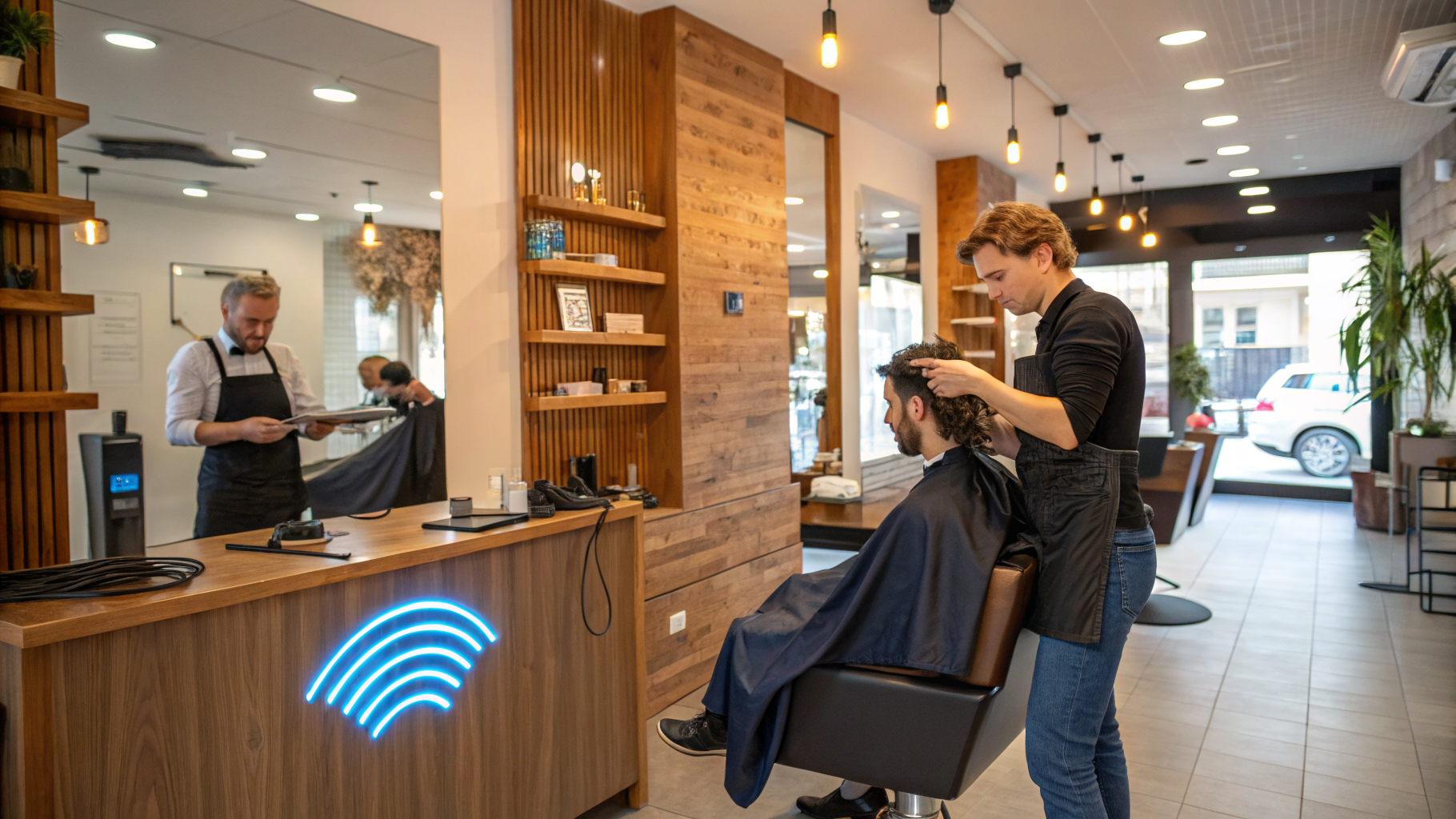
Saturday, 11:14 AM. Plateau Mont-Royal. Three clients are waiting for their appointments, two color treatments are mid-process, and a men's cut is about to start. The phone rings. Nobody picks up — the lead stylist is mid-balayage, the apprentice is at the shampoo bowl, and the owner just stepped out for coffee. Three rings, voicemail, hang up. Nobody's calling back.
Multiply that single moment by 8 to 12 times every Saturday, and you start to understand why Quebec hair salons leak between 15 % and 20 % of their annual revenue without ever seeing the money walk past.
Hair salons in Quebec: an industry where the phone decides the bottom line
Cross-referenced data from internal Quebec studies and North American benchmarks shows that an independent hair salon misses on average 23 % to 38 % of incoming calls. Not because the service is bad — quite the opposite. Because the skilled stylist a client comes to see is precisely in the middle of cutting, coloring, or consulting. She physically cannot pick up the phone.
And every missed call costs more than people think. An average service in Quebec in 2026 ranges from $75 (women's cut) to $280 (highlights + cut + blowout). A client who wants an urgent appointment doesn't leave a voicemail — she dials the next salon on Google. She probably won't come back. And if she has a wedding or an event coming up, you've also lost her daughter, her sister, and the colleague she would have referred.
Add to that the no-shows quietly bleeding out Quebec SMBs — a client who doesn't show up represents $80 to $200 of unsold time inventory — and the math gets brutal. For a four-chair salon running 1,200 services per month, you're easily looking at $38,000 to $55,000 in vaporized revenue every year.
Why 2026 changes the game (and 2024 didn't)
For two years, AI voice agents for SMBs were essentially gadgets. Too robotic. Too expensive. Incapable of handling the specific quirks of Quebec French. Salon owners who tried it in 2023 and 2024 came back with horror stories: "my client hung up because it sounded like a Boston GPS." Fair enough.
But 2026 changed three fundamental things at once. That's rare. And that's what makes this year a real inflection point.
1. The voice is now indistinguishable from a human receptionist
In late 2025, OpenAI moved its gpt-realtime model into general availability, with two key updates for the service industry: the ability to switch between French and English mid-sentence (the famous "Bonjour, Hi") and direct phone calling via SIP. ElevenLabs, in turn, announced on its official blog in April 2026 that its voice models can now run on-device and on-premise. In plain language: your AI agent's voice is no longer a generic voice rented from Silicon Valley. It can be tuned, calibrated, and hosted to meet Quebec-specific requirements.
The result is measurable. On Quebec deployments this spring, more than 7 callers out of 10 don't realize they're talking to an AI for the first 60 seconds — and those who do realize don't hang up anymore, because the conversation stays useful.
2. The price has dropped fivefold
As we documented in our analysis of voice AI's 2026 price drop, the cost per minute of conversation for an AI voice agent has fallen from around $0.80 in 2024 to under $0.18 today. For a salon receiving 400 calls per month with an average duration of 90 seconds, the actual monthly bill for the AI voice is now lower than half a day of receptionist coverage — and the agent works 24/7, weekends included.
3. Quebec bilingualism is finally native
This is probably the most important point for the hair industry. An anglophone client from Outremont calling a francophone salon, or vice versa, has to be served without friction. Natural code-switching like "Bonjour, hi, can I book a balayage for Saturday?" used to break voice agents in 2024. In 2026, it's standard — we cover this in detail in our piece on native Bonjour-Hi bilingualism.
What an AI voice agent actually does inside a salon
Concrete, not theoretical. Here's what happens when a Mile-End salon deploys an AI voice agent calibrated for hair:
The phone picks up within two rings, regardless of the time. Statutory holiday Monday at 7 PM, Sunday morning emergency, Tuesday 2 PM mid-balayage: the call gets answered. The agent identifies the requested service (cut, color, balayage, highlights, treatment), asks for a preferred stylist if the client has one, offers available slots from the booking software (Boulevard, Fresha, Vagaro, Phorest), and confirms the appointment by SMS within seconds.
Outbound reminders eliminate most no-shows. 24 hours before the appointment, the agent calls (or texts depending on client preference). If the client confirms, the slot is locked. If she can no longer make it, the agent immediately offers to refill the slot from the waitlist — something nobody at the salon does manually because it takes 20 minutes per call. On measured Quebec deployments, no-show reduction lands in the 70 % to 80 % range.
The agent handles the repetitive questions that eat up time. "Do you do California balayage?", "How much for a kid's cut?", "Are you open Sundays?". That's 30 % to 40 % of a salon's calls. The agent answers, without interrupting the stylist, without frustrating the client.
Quebec's Law 25 compliance is handled in the background. Recordings and transcripts are hosted in Canada, explicit consent is requested at the start of the call, and no client data is used to train third-party models. For a salon, it's a topic you don't have to learn — it ships preconfigured.
The real cost of waiting another 12 months
Here's the math few owners do out loud. An average Plateau salon missing 6 calls per business day, 25 days per month, with an average ticket of $110 and a 55 % call-to-booking conversion rate, loses roughly $9,075 per month in direct revenue. Over 12 months, that's $108,900 you never saw cross the till.
Meanwhile, the salon next door that deployed an AI voice agent in January 2026 is catching those calls. Those clients become regulars. They tell people about the salon. Word-of-mouth flips. And that's where the lag stops being recoverable — not because the technology becomes inaccessible, but because the customer base has already shifted.
What it requires from the salon (very little)
This is the common misunderstanding. Many owners assume they have to "get into AI", learn a new platform, manage prompts. Wrong. At Agent IA Vocal, the TECHMA team configures the agent based on a 1.5-hour onboarding call with the salon: stylist names, services and pricing, default scheduling rules, voice tone, bilingual handling, and integration with the existing booking software. Full deployment — including local number provisioning, booking system wiring, and quality testing — averages 5 to 7 days.
The salon touches nothing. The existing number is preserved (via port or forwarding), appointments sync automatically, and a simple dashboard shows in real time the calls answered, the appointments booked, and the no-shows prevented. If something falls outside the agent's scope — a discontinued product, an unusual request — it transfers the call or takes a clear message.
The moment the decision actually gets made
The question is no longer "does it work". Spring 2026 numbers have settled it: it works, and it works better than a human receptionist for the majority of a salon's calls. The question is: how many months of revenue left on the table are you willing to accept before moving?
For a hair salon, an AI voice agent is no longer an innovation. It has become baseline infrastructure, on the same shelf as a POS or an online booking system. The only difference is that it pays for itself directly — and it pays more, sooner.
If you'd like to see what it looks like for your salon, in Quebec French, with your existing booking software, reach out to the team at agentiavocal.ca for a tailored demo. Configuration and deployment are handled by the TECHMA team — you have nothing to learn, nothing to code, nothing to integrate yourself.
Three questions owners actually ask (and the honest answer)
"What if the client hates talking to AI?" In 2026, most clients don't even notice for routine booking calls. For those who prefer a human, the agent transfers smoothly to the owner or leaves a structured message the stylist can handle in 30 seconds instead of 4 minutes.
"What if the agent books the wrong appointment?" The system is connected in real time to the booking software: it only offers slots that are actually available. If a stylist changes her schedule, the agent sees it within a minute. Double-booking risk is lower than with a tired human receptionist on a Saturday at 4 PM.
"How long before I see a return?" On measured Quebec deployments, operational ROI shows up by the second month — typically through capturing evening and weekend calls that were previously simply unanswered. By month four, the effect on no-shows and waitlist refilling becomes quantifiable as well.