
At 2:07 a.m., the basement tenant smells sewage and the phone rings out
The call comes in after midnight. A tenant in a lower unit reports sewage backing up into the bathtub and floor drain. They call the property manager, then the backup number, then the office line. No answer. By 2:31 a.m., they are calling a plumber.
That is not a minor service failure. In Canada, depending on the province, an unanswered after-hours emergency can become the moment a tenant is allowed to take steps you would normally control: arranging urgent work, limiting damage, and later seeking reimbursement or rent abatement. The exact legal mechanics differ across Ontario, British Columbia, Alberta and Quebec, and this article is not legal advice. But the operational consequence is consistent across the country: if nobody answers, you may lose both control of the repair decision and the ability to contest what happened afterward with clean documentation.
Now add the 2026 rental market. A missed leasing call no longer disappears into a queue of backup applicants. With vacancy up, the same phone system that fails at 2 a.m. can also fail at 2 p.m., when a prospective tenant calls about a unit in Mississauga, Calgary, Halifax, Saskatoon, Victoria, Ottawa, Toronto, Edmonton, Vancouver or Winnipeg and reaches voicemail.
That is the case for an AI voice agent for property management in Canada. Not as a novelty. As call coverage, triage and record-keeping.
When nobody picks up, tenancy law starts to matter very quickly
Here is the part most competitor articles miss.
Residential tenancy law across Canada generally expects landlords and their agents to maintain rental housing and respond to urgent repair issues. Where the situation is necessary and urgent, tenants may in some circumstances arrange repairs themselves after making reasonable efforts to contact the landlord or property manager and failing to reach them. The details vary by statute, regulation, lease wording and tribunal interpretation. Ontario uses its own framework under the Residential Tenancies Act and disputes may reach the Landlord and Tenant Board. British Columbia has the Residential Tenancy Branch. Alberta has the RTA. Quebec has the TAL. The labels differ. The practical pressure does not.
If the tenant can show they tried to notify you and you were unreachable, your leverage drops.
That does not mean every late-night call authorizes any invoice. It does mean your phone process is part of your risk control. A tribunal may later ask: when were you notified, what was the reported condition, what steps did you take, and how quickly did you respond? If your answer is “there was a voicemail somewhere,” you are already in a weaker position than you should be.
Say it plainly: an unanswered phone can trigger third-party spending at emergency call-out rates without your approval.
And those rates are not gentle. Emergency plumbing, locksmith, restoration and HVAC visits often carry after-hours minimums, travel fees and priority premiums. Even when the work was genuinely necessary, the bill is usually higher than if your own vendor had been dispatched through your normal process.
For small and mid-sized portfolios, this hurts more. A 12-unit owner-operator with a day job does not have a rotating overnight team. A 40-door portfolio spread across two cities may rely on one manager carrying the phone. That is exactly where an AI receptionist for landlords becomes useful: it answers immediately, gathers the facts, applies your escalation rules and wakes a human only when the situation meets your threshold.
Meanwhile, the market flipped on the leasing side
For several years, many owners could afford to be sloppy with inbound leasing calls because demand covered the mistake. If one prospect did not hear back, another was waiting.
Not now.
CMHC reported that the national purpose-built rental vacancy rate rose to 3.1% in 2025, up from 2.2% in 2024 and above the 10-year average. Vancouver reached 3.7%, its highest level since 1988, according to the CMHC Rental Market Report and CMHC's 2026 mid-year rental market update. Those are national signals with local consequences.
In 2022, a missed inquiry on a one-bedroom in Toronto or Vancouver might not have mattered. In 2026, that same missed call can mean a vacant week, a price reduction, or both. On the leasing side, the cost of not answering has gone up. On the maintenance side, the cost of not answering has also gone up.
That is why the title of this article is not exaggerating. The missed call now costs you twice.
One more thing. The Canadian operating reality is not one market and one clock. Property managers and landlords are dealing with six time zones, different weather patterns, and tenant populations that may move between English and French during the same call. A Halifax owner using a Calgary-based answering service can easily end up with bad timing, weak context and poor urgency judgment. No heat in Winnipeg in January is not the same event as no heat in Victoria in October. Spring thaw flooding in Manitoba is not a generic “water issue.” A multilingual building in Montréal, Toronto or Vancouver may require a caller to explain a safety problem in the language they can manage under stress.
The four calls a property manager actually gets
Most inbound property calls are not mysterious. They fall into a few repeatable categories, and each category needs a different response path.
- Leasing and vacancy calls: availability, rent, pet rules, parking, showing requests, application steps.
- Maintenance calls: leaks, no heat, appliance failure, lock issues, electrical problems, odours, pests.
- Administrative calls: payment questions, lease documents, move-in instructions, building access, certificates, notices.
- Dispute or high-risk calls: contested rent increases, neighbour conflict, harassment allegations, threatened self-help, legal threats.
An effective property management answering service Canada setup does not treat these as one queue. It routes them by consequence.
Leasing calls need speed and basic qualification. Maintenance calls need triage. Administrative calls often need a straightforward answer or a logged task. Dispute calls need controlled transfer to a human with authority. That is the difference between “we answer the phone” and “we run a process.”
And yes, that distinction matters.
If you want a broader framework for deciding which calls you should actually hand to an AI voice agent, the short version is this: repeatable, rule-based calls are ideal; legally sensitive and emotionally volatile calls are not.
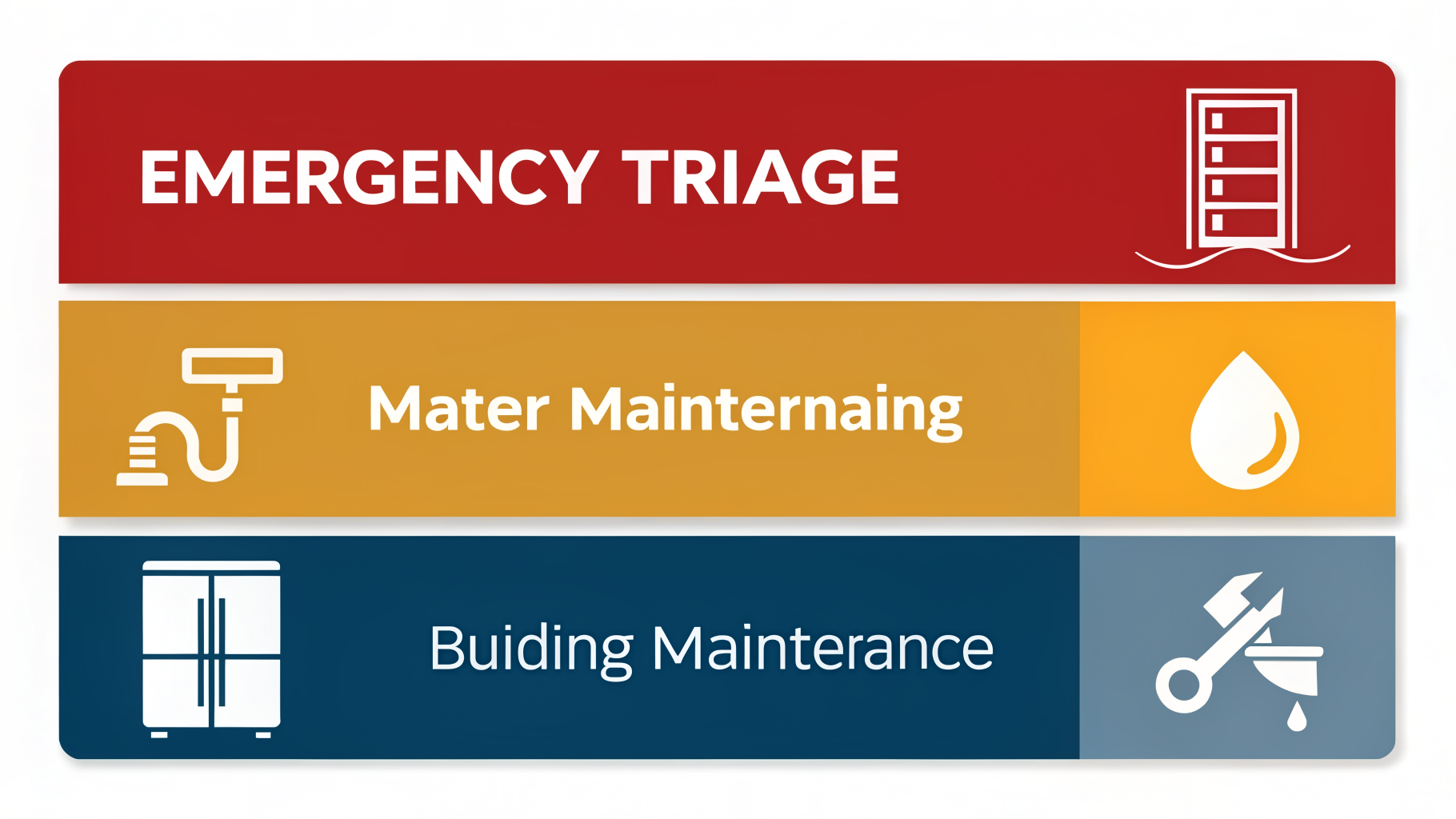
Triage des appels de locataires: urgence reelle, jour ouvrable, demande d'information
Emergency triage is where the money is won or lost
Good emergency maintenance triage is not just about speed. It is about classification. If you wake a manager for every chirping smoke detector battery, people burn out and start ignoring alerts. If you fail to escalate active flooding, a small repair becomes restoration, mould remediation and a dispute file.
Here is a practical triage model for answering tenant maintenance calls after hours.
The categories look simple. Applying them properly is not.
Take “no heat.” In Winnipeg in January, that can be an immediate life-safety issue, especially with children, older tenants or vulnerable occupants. In Victoria in October, the urgency may still be real, but the risk profile is different. The agent’s rules must account for geography, season and building type. A boiler outage in a 40-unit building is not the same as a baseboard issue in one suite.
Miscategorization is expensive in both directions. Under-escalate and you get property damage, tenant anger, chargeback risk and ugly documentation. Over-escalate and you pay overtime, train residents to use the emergency line for routine issues, and exhaust your on-call staff. The right system does not just answer; it asks the next question.
For many owners, this is the strongest case for an AI voice agent for property management. It can ask the same required questions every time, at 11:00 a.m. or 3:00 a.m., without skipping the basics because someone is tired.
What the voice agent actually does, call by call
At the call level, the job is concrete.
First, it answers immediately and identifies itself as an automated system. That disclosure matters for caller expectations and for privacy compliance. It should also state if calls may be recorded or summarized, subject to your legal review and applicable consent rules under federal privacy law and provincial requirements.
Second, it determines the call type. Is this a leasing inquiry, a maintenance issue, a routine question, or something that must go to a human right away?
Third, it gathers structured facts. For maintenance, that usually means address, unit number, best callback number, whether the issue is active or contained, whether there is risk to health or safety, and whether emergency services have been contacted. For leasing, it can capture desired move-in date, unit size, pets, parking needs and preferred showing time.
Fourth, it triggers the right workflow. That might mean:
- sending an SMS or email summary to the on-call manager for a true emergency;
- creating a next-day maintenance task with the tenant’s exact wording and callback number;
- booking a showing or collecting prospect details for follow-up;
- answering a routine building question from an approved script.
Fifth, it closes the loop with the caller. Not with vague comfort. With a precise next step: “I’ve notified the on-call manager now,” or “Your request has been logged for business-hours follow-up,” or “Here is the leasing link we will text you.”
This is where the difference between an AI agent and a generic answering line starts to show. If you want a side-by-side breakdown, see answering service versus AI voice agent, with the numbers. Traditional services often take a message. A configured AI agent can classify, route, summarize and integrate with your workflow.
That said, the setup matters more than the model name. OpenAI launched Presence on 22 July 2026, and xAI shipped a Voice Agent Builder. The tools are moving fast. The real question for property management is not which company announced voice features this month, but whether the system has your escalation tree, your vendor logic, your bilingual prompts and your do-not-say boundaries.
A tenant call is also evidence
When a dispute reaches a tribunal or internal escalation, one question appears again and again: when were you notified?
The answer should not depend on whether somebody still has a voicemail from three weeks ago.
A maintenance or leasing call is not just a conversation. It is a record of notice, timing, description and response. Date. Time. Unit. Reported issue. What the caller said. What your system said back. Whether the matter was escalated. Whether a human acknowledged it. Those details can matter in proceedings before the Landlord and Tenant Board, before the BC Residential Tenancy Branch, under Alberta processes, or before Quebec’s TAL, depending on the issue.
Voicemail is weak evidence management. Messages are incomplete, hard to search, inconsistent in format and easy to lose. A timestamped written summary of every call is much better operationally. It gives you a structured record that can be stored, searched and attached to a work order or tenant file.
That does not mean an AI summary is automatically perfect evidence. It means it is usually far better than memory plus voicemail.
You still need proper privacy handling. Call recording and transcription involve consent and disclosure issues under PIPEDA and, where applicable, provincial privacy law and employment policies. Callers should be informed that they are speaking with an automated system, and if recording or transcription is used, your legal and compliance review should cover notice wording, retention periods, access controls and who can retrieve records.
Still, from a property-management operations standpoint, the gain is obvious. Written summaries reduce “he said, she said” chaos. They help prove response time. They show whether the tenant described an active hazard or a routine annoyance. They also make morning handoff much cleaner for small teams.
Honestly, that morning handoff is where many small portfolios fail.
If one person took three overnight calls and left two voicemails plus a text message, the office starts the day reconstructing events. If the agent sends standardized summaries after every call, the office starts with a queue: emergency escalated at 2:07 a.m.; lukewarm water complaint logged at 9:16 p.m.; leasing inquiry from Ottawa for a July 1 move-in captured at 7:42 p.m.
For after-hours design details, this companion guide on how to set up an AI voice agent for after-hours calls is useful, especially when you are deciding who gets woken up, for what, and in what order.
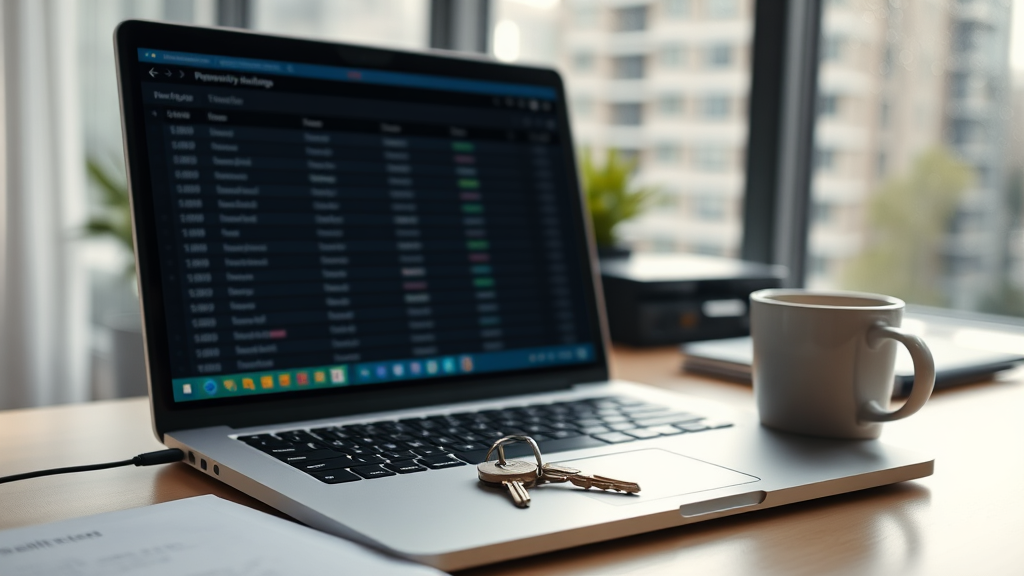
Resume horodate des appels de locataires sur un ordinateur portable
What the agent must never do
This section should be blunt, because over-automation creates risk.
An AI voice agent should not adjudicate a lease dispute or discuss a contested rent increase. It should not promise a repair window that no vendor has confirmed. It should not handle an eviction, a harassment complaint, or a caller in distress. It should not give legal information.
Those go to a human. Full stop.
There are good reasons for each limit.
Lease disputes and rent increase questions quickly become jurisdiction-specific. Ontario RTA and LTB processes differ from BC Residential Tenancy Branch rules, Alberta’s RTA framework and Quebec TAL procedures. A scripted answer that sounds plausible but is legally wrong is worse than no answer. The safe function for the agent is to collect the issue, acknowledge receipt and route it to the designated human contact.
Repair windows are another trap. If no vendor has confirmed attendance, the agent should say exactly that. Overpromising creates expectation, complaint risk and credibility damage. Better to state the process than invent certainty.
High-risk human situations also need boundaries. Harassment complaints, domestic incidents, threats, self-harm language or severe distress require immediate transfer instructions or emergency guidance established by your policy and legal review. This is not a place for improvisation.
The honest version is simple: the agent handles routine communication and structured triage. Humans handle judgment, legal sensitivity and vulnerable situations.
Implementation for a 5-to-50-door portfolio is simpler than most vendors make it sound
Most software content in this category is written as if the reader manages 4,000 units on Yardi or AppFolio. Many Canadian owners do not. They own 8 doors in Edmonton, 22 in Ottawa, 14 in Halifax, 35 across Calgary and Airdrie, or a mixed portfolio in Toronto and Mississauga while working another job.
That is exactly where a voice agent can be practical.
You do not need a giant systems project to start. You need a clear operating packet. In most cases, implementation comes down to assembling the information a good human after-hours operator would need and then making the rules explicit.
Prepare these inputs:
- Building list: addresses, unit naming conventions, building type, common issue notes, access instructions.
- Escalation tree: who gets called first for plumbing, heat, lockouts, electrical issues, elevator issues, flood response and security concerns.
- Vendor contacts: preferred trades by city or region, after-hours numbers, service boundaries, authorization limits.
- After-hours rules: what counts as wake-someone-up urgent, what waits until morning, what gets emergency services advice.
- Approved answers: leasing FAQs, parking rules, payment instructions, office hours, showing process, move-in basics.
- Transfer boundaries: legal disputes, harassment complaints, evictions, distressed callers, media inquiries, insurer contact.
For bilingual and multilingual coverage, add language rules. In Canada, this is not optional polish. In many Toronto and Vancouver buildings, a significant share of tenants speak a first language other than English. In Ottawa and Montréal, English-French switching is routine. Under stress, callers often revert to the language they can use most precisely. An agent that can continue in English or French without forcing repetition is materially better at collecting accurate facts.
A realistic timeline for a small or mid-sized portfolio is usually measured in days, not months. Week one is call mapping and policy definition. Week two is prompt configuration, escalation testing and sample-call review. Then you run a pilot on after-hours property management calls first, because that is where the ROI and risk reduction show up fastest. Leasing and routine office calls can follow once the emergency tree is stable.
Seasonality should be built in from the start. Spring turnover brings leasing volume. The first Prairie cold snap changes what “urgent” means. Spring thaw can create water calls in basements and parkades. Holiday periods thin out staffing. Your rules should reflect the calendar, not just the clock.
And because Canada spans six time zones, routing windows must be local to the property, not to the manager’s mobile phone or the vendor’s head office. That sounds obvious. It often is not.
The real value is control: over repairs, lease-up and documentation
A good AI voice agent for property management does three jobs at once.
It protects lease-up by answering prospect calls when vacancy is no longer forgiving. It protects maintenance spend by reducing the chance that an unreachable manager creates a tenant-arranged emergency invoice. And it protects your file by producing a written, timestamped summary of what was reported and what happened next.
That is the practical argument in 2026.
Not hype. Not “AI for everything.” Just a better way to cover the phone when the phone has become financially consequential on both sides of the business.
If you manage anywhere from 5 to 50 doors, this matters even more. You are large enough to feel the cost of missed calls, but often too small to staff 24/7 human coverage. That is the gap the technology fits.
The standard is not perfection. The standard is that the right calls are answered, the urgent ones are escalated, the risky ones are transferred, and every call leaves a usable record.