Somewhere in Calgary right now, a moving company owner is strapped under a sofa on a third-floor landing while his phone buzzes in the truck. That call was a $1,200 local move. It just went to voicemail — and then to his competitor.
Moving is the rare industry where the busiest weeks for the phone are exactly the weeks nobody can answer it. That's the whole problem an AI voice agent solves, and it's why movers have become one of the fastest-adopting trades in Canada.
The 12 weeks that make or break a moving company
The Canadian Association of Movers estimates that roughly 70% of all annual moving activity happens between mid-June and early September. Twelve weeks to earn most of the year's revenue — from Victoria to Halifax.
The calendar pressure is national. Statistics Canada tracks hundreds of thousands of household moves each year, and they cluster hard around month-ends, Canada Day and Labour Day weekends. In Toronto and Vancouver, condo elevator bookings sell out weeks ahead. In Winnipeg and Halifax, crews stack three jobs a day through July. Everyone is moving furniture; nobody is by the phone.
During those twelve weeks, a missed call isn't an inconvenience. It's a quote request walking straight to the next mover on the caller's list.

Seventy percent of annual moving activity concentrated in twelve summer weeks
The quote race: fastest credible answer wins
Almost nobody hires the only mover they called. A typical customer phones three to five companies in one afternoon, and the job usually goes to whoever produces a solid quote first. Industry research compiled by moveBuddha shows how competitive the funnel has become: more online quotes, more comparison shopping, less patience.
Run your own math. A local move in most Canadian cities bills $800 to $1,500. Long-distance jobs — Toronto to Ottawa, Edmonton to Vancouver — routinely clear $4,000. If your voicemail eats three calls a week in peak season, that's somewhere between $2,400 and $12,000 in potential work evaporating weekly. Not lost on price. Lost on pickup.
Here's the part most movers underestimate: a big share of those calls come after 6 p.m., when people are done work and finally planning their move at the kitchen table. Your office is closed; their decision window isn't. We broke down that evening-call phenomenon in our guide to handling after-hours calls with an AI voice agent — for movers, the evening is effectively a second business day.
What an AI voice agent actually does for a mover
An AI voice agent is a software receptionist that answers your existing business number, understands natural speech, and holds a real conversation. Not a press-1 menu. Not a smarter voicemail.
Its superpower for moving companies is structured intake. A proper moving quote needs a dozen data points: origin and destination addresses, floors, elevator access, home size, preferred date, heavy or fragile items — the inevitable piano — plus packing and storage add-ons. A dispatcher juggling two crews will miss half of those. The agent asks every question, in order, every single time, and drops a complete, qualified lead into your system before the caller hangs up.
Monday morning, your team isn't decoding garbled voicemails. They're opening a tidy queue of quote-ready leads with callback numbers that actually work.
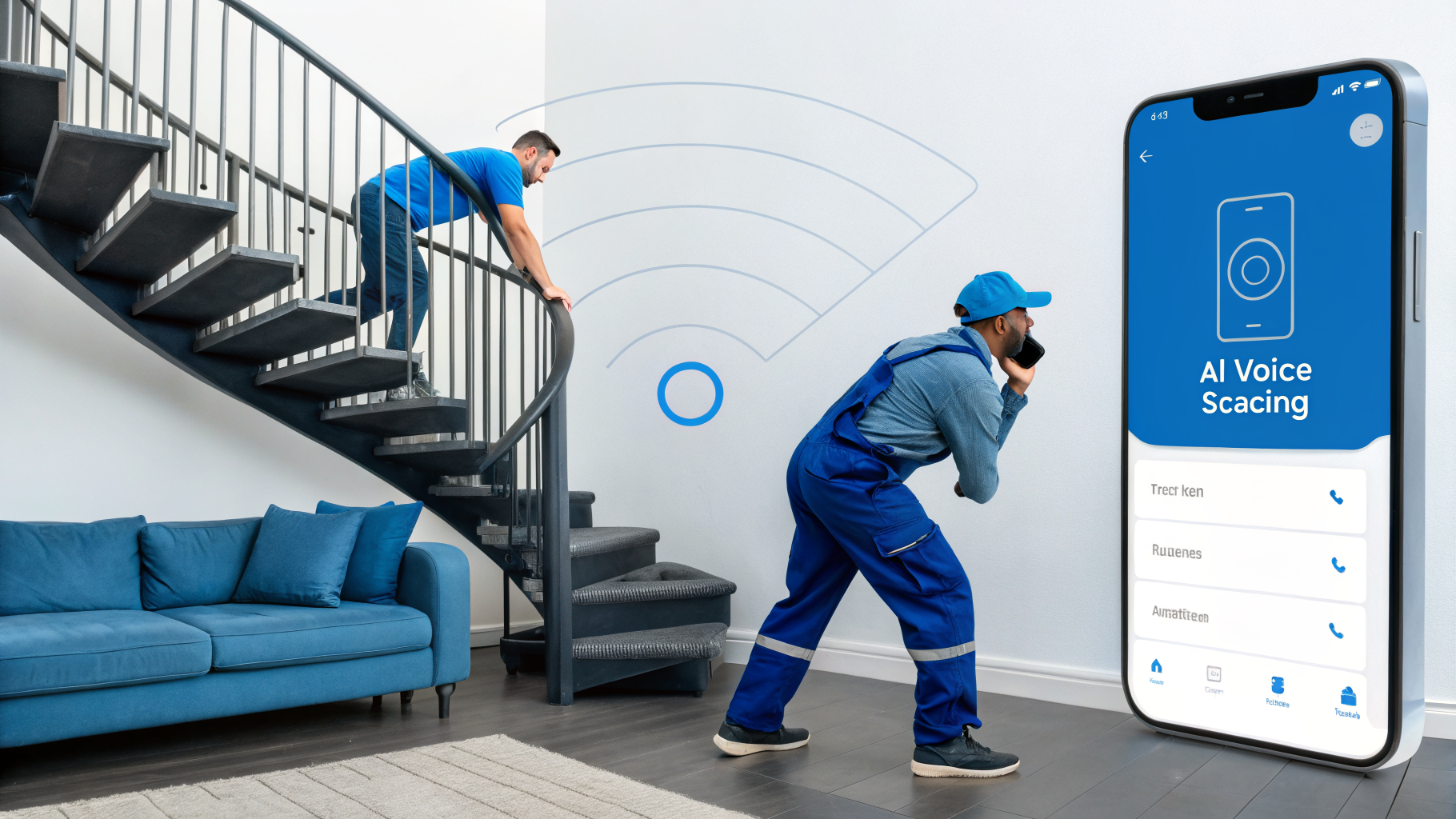
Movers on the job while an AI voice agent answers the incoming call and books an estimate
Four automations that pay for themselves in peak season
1. Quote intake, 24/7. Every call answered — Saturday night, long weekends, Canada Day itself. And the agent handles simultaneous calls, so when three customers phone at once on June 28th, none of them meets your voicemail.
2. Survey and estimate booking. For jobs that need an in-home or video survey, the agent offers real slots from your calendar. The caller hangs up with a confirmed appointment instead of a vague promise.
3. Day-before confirmations. A last-minute cancellation in July costs you a truck and a crew for a day. An automated confirmation call the evening before — arrival window, parking, elevator booking — catches problems while you can still fix them.
4. Moving-day triage. On the big day, half your calls are "what time is the truck coming?" The agent answers the routine ones and forwards only genuine emergencies to your cell. Your foreman keeps moving; your customers still get answers. If you're unsure where to draw that line, our framework on which calls to hand to an AI voice agent maps it out call type by call type.
One more, for the office team's sanity: everything the agent captures can land directly in the tools you already use. New lead in the CRM, survey in the shared calendar, text confirmation to the customer — while the caller is still on the line. No transcribing, no sticky notes on the dispatch board, no "who took this call?" at the Monday meeting.
What it should never do
A badly configured voice agent can do real damage, so let's be honest about the guardrails.
It should never invent a firm price. Moving quotes depend on volume, distance, stairs, access and parking — so a good agent quotes only the price ranges you've approved, then books a survey for the binding number. Honest for the customer, safe for your margins.
It should never freelance on claims. A customer whose dresser arrived scratched wants a human, full stop. The agent's job is to capture the details, respond with genuine courtesy, and transfer. And a caller who asks for a person should always be able to reach one during business hours — that rule is non-negotiable.
A Friday evening in June, replayed
Make it concrete. A mover in Mississauga, eight staff, two trucks. Friday June 26th, 6:40 p.m.: the crews just wrapped their third job of the day and everyone's phone-dead. A caller from Oakville needs a three-bedroom house moved on July 15th.
Without an agent: voicemail. She maybe leaves a message, dials two more companies, and books with whoever gives her a believable range that evening. Monday's callback lands two days too late.
With an agent: answered on the first ring. Four minutes later it has both addresses, the no-elevator walk-up detail, the date, the sectional sofa and the piano — and it quotes the approved range for that job profile, say $1,400 to $1,800, then books a video survey for Monday at 10 a.m. She stops shopping, because she got what she actually wanted: an answer.
The bilingual bonus most platforms can't match
Canada's phone traffic doesn't happen in one language. An Ottawa or Moncton mover fields French and English calls all day; movers in Toronto, Vancouver and Calgary hear a dozen languages a week. Hiring seasonal phone staff who can handle even two of them is expensive — when it's possible at all.
A properly configured voice agent answers in the caller's language and switches mid-conversation when needed. For a moving company, that means a francophone caller in Orléans and an anglophone caller in Kanata both get the same complete intake, the same price ranges, the same booking flow. No lead is lost to a language gap — a quiet but real edge in Canada's most multilingual cities.
The economics: cheaper than a summer hire
The traditional fix is hiring seasonal phone help from May to September. In most provinces that's $18–$22 an hour before training, scheduling headaches and the awkward fact that your best-trained phone person leaves in September.
An AI voice agent runs $49 to $199 per month depending on the plan — we've published a full cost breakdown if you want the details. It works nights, statutory holidays and all six Canadian time zones' worth of evening callers, and it answers ten calls at once. One recovered move per month pays for the service several times over — and unlike a summer hire, it keeps working through the off-season, capturing long-distance inquiries, storage requests and early bookings for next summer.
There's a hidden line item too: your own hourly rate. Every "what are your rates?" call an owner-operator takes from the cab of a truck is ten minutes not spent quoting, dispatching or actually moving. Give the routine calls to software, and the humans in the company get to do the work that actually bills.
Questions movers actually ask
Can it give an exact price over the phone? No — by design. It shares your approved price ranges and books an estimate for the firm number. It never invents figures; it only relays what you've validated.
Will it survive the month-end crush? That's precisely where it shines. Ten simultaneous callers at 8 a.m. on June 30th means ten parallel conversations and zero voicemail.
Will customers hang up on an AI? A few will. Most just want a fast answer and a quote. The agent identifies itself clearly, speaks naturally, and a caller who gets a credible price range in three minutes rarely hangs up annoyed.
How long does setup take? Days, not weeks — and you don't do it yourself. The TECHMA team configures your price ranges, service areas, calendar and transfer rules, and your existing phone number stays exactly the same.
Before next peak season gets away from you
The moving companies winning in 2026 aren't necessarily the ones with the biggest fleets. They're the ones that answer first, every time — including at 7 p.m. on June 30th, when the crew is exhausted and the phone is still ringing.
At Agent IA Vocal, we build voice agents for Canadian service businesses, including moving-specific quote intake. Book a demo to hear exactly what your callers would hear, or see our plans starting at $49 per month. Next Canada Day, let the truck be the only thing working overtime.