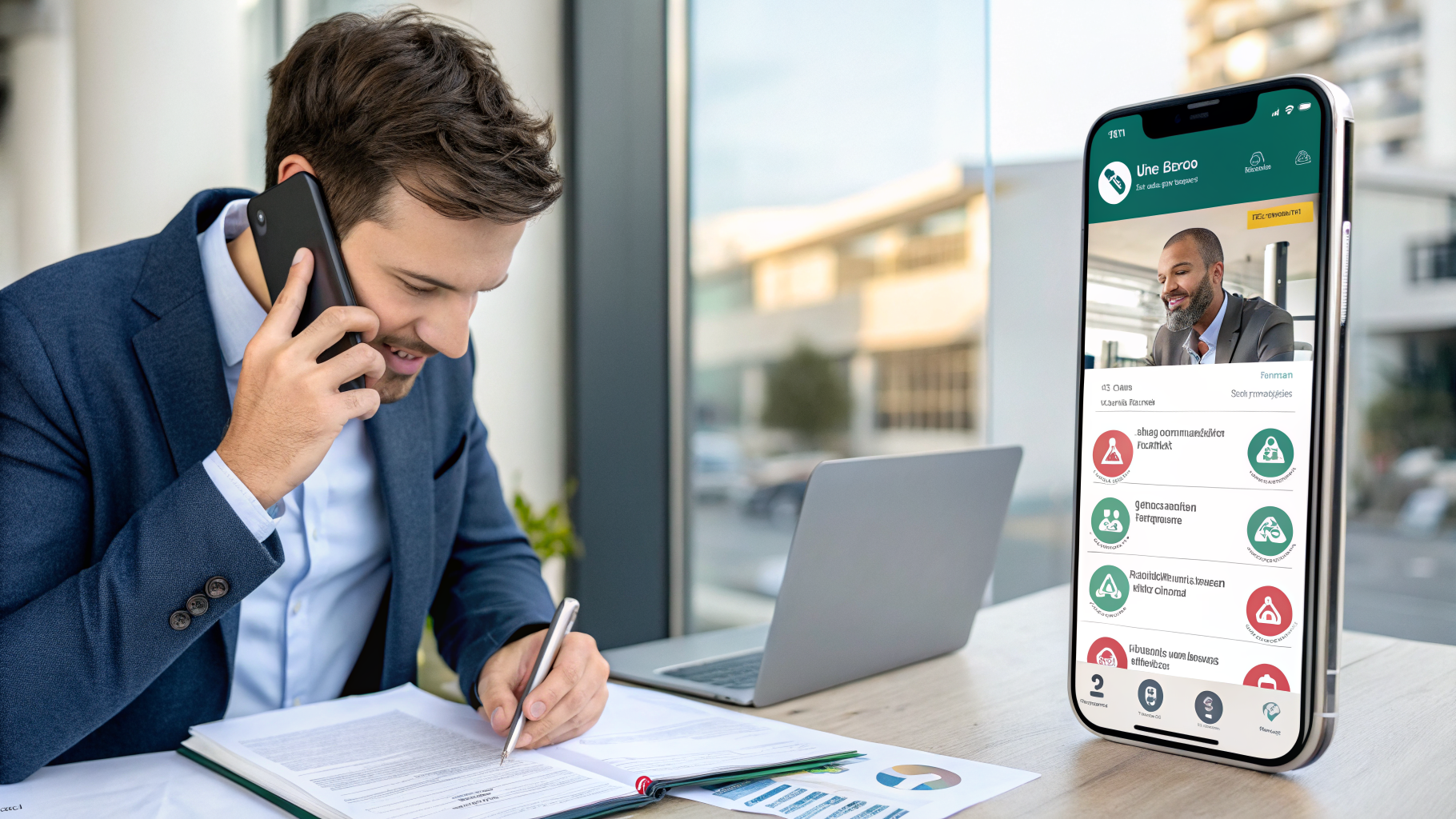
May 2026 just changed what an AI voice agent can actually do — and most Quebec small businesses haven't noticed yet.
ElevenLabs quietly added the ability for its ElevenAgents platform to handle photos, PDFs, audio notes, contacts and location pins in the same conversation. Not as a separate channel. As an extra layer on top of the same conversation, in the same session, with the same context. The agent who picks up your 7 a.m. call can now receive, twenty seconds later, the photo of the leaking water heater the customer just sent over WhatsApp.
And just like that, the sentence "please email us a photo and a technician will call you back" disappears from the customer journey.
For a small business that pays to answer phones but bleeds time on document back-and-forth, this is a bigger shift than any new synthetic voice released this year.
What ElevenAgents actually added (without the marketing)
According to the official ElevenLabs announcement published on May 6, 2026, the new modalities cover two channels: WhatsApp Business and the web widget you install on your site.
On WhatsApp, the agent can now:
- Read and interpret a photo (equipment condition, model plate, damage, prescription, invoice).
- Open a PDF (signed quote, contract, spec sheet, insurance certificate).
- Listen to an audio note in French or English and treat it like a voicemail.
- Receive a location pin and use it to calculate travel time or trigger the right pricing zone.
- Understand a shared contact (to add a family member to a file, for example).
On the web widget, your customers can drag and drop an image or PDF directly into the conversation, alongside voice and chat. Everything flows in the same thread. If the conversation starts on the phone, continues on WhatsApp and ends in the widget, the agent doesn't "start over" — it keeps the context.
ElevenLabs calls this its "one agent, every channel, every modality" architecture. The example they highlight: Rohlik, a European online grocery chain, runs 30 distinct actions through its agent Maia on WhatsApp, in six languages, across five markets.
You're not Rohlik. But the principle transfers to a veterinary clinic in Trois-Rivières as easily as it does to a delivery platform in Berlin.
Why this matters for a Quebec SMB in 2026
The Quebec market context in May 2026 makes this update particularly useful.
Since VAPI crossed a billion calls handled and closed a $50M Series B earlier this month, the competition between voice agent platforms has intensified. Amazon Ring chose VAPI over 40 other vendors. ElevenLabs is responding by stacking features that go beyond the "voice only" perimeter. The market is no longer played on synthetic voice quality alone — it's played on what the agent can actually resolve without human intervention.
And what prevents an AI voice agent from resolving a case end-to-end, in a typical Quebec SMB, is almost never the voice. It's the fact that at some point, the customer has to send something that isn't speech: a proof, a photo, a model plate, a document.
Before May 2026, the answer was: we take the message, we transfer, a human calls back.
Now, in the majority of cases, that's no longer necessary.
Seven concrete scenarios for Quebec SMBs
Here's how specific Quebec sectors can use these new modalities starting today. Not hypothetical cases — situations our teams see come through every week.
1. Residential plumbing — visual emergency triage
A call comes in at 11 p.m. for a leak. Before: the agent takes a message, a dispatcher calls back, a technician heads out with a vague description. Now: the agent asks the customer to take a photo on WhatsApp. It analyzes the photo, identifies an under-sink leak (T-fitting visible, no projected pressure), classifies the urgency as "non-critical night", confirms an 8 a.m. appointment for the next day, sends an instruction sheet to close the shut-off valve in the meantime.
Cost of a night call-out avoided: $250 to $400. The customer keeps morning service. Nobody got woken up.
2. Veterinary clinic — photo triage
An owner calls Sunday at 2 p.m.: her dog threw up. The agent asks for a photo of the vomit and a short audio note describing the behavior. It identifies no blood, no foam, no signs of gastric torsion, cross-references with the dog's registered weight and history, and offers a Monday morning appointment rather than sending to an emergency $350 visit. Or, conversely, it identifies a red flag and immediately transfers to a human.
This is exactly the kind of qualification we discussed in our analysis of Quebec vet clinics where 28% of calls go unanswered — except we move one step further: we don't just answer, we triage.
3. HVAC — model plate reading
A homeowner calls about a broken heat pump. The agent asks for a photo of the model plate. It extracts the model, year, serial number, checks via a tool integration whether the unit is still under warranty, prepares the service order with probable parts already noted. The technician arrives with the part in the truck instead of having to come back twice.
4. Beauty & spa — gift card or promo validation
A customer wants to book using a gift card she received. She sends the photo of the card on WhatsApp. The agent reads the code, validates the balance, applies it to the appointment, confirms. No human touched the file. No friction at checkout on arrival.
5. Notaries and professional services — preliminary ID proof
A client calls to open a file. The agent asks, via the secure web widget, for a photo of ID and a PDF of the latest Hydro-Québec bill. The agent prepares the client record, the notary receives a file already half-built before the first appointment. (Important legal note: final validation obviously remains a human task, and Loi 25 compliance must be respected. This is one of the points we documented in our analysis of Guardrails 2.0 and ElevenLabs' four security layers.)
6. Restaurants — capturing special requests
A group of 14 wants to book a birthday. The organizer sends an audio note explaining allergies, high chair needs, and a photo of the cake they want added. The agent extracts it all, structures an event sheet, drops it in the restaurant's PMS, confirms back. The maître d' walks in Monday with the file ready.
7. Auto mechanics — dashboard warning lights
A customer calls because their dashboard is flashing. The agent asks for a photo. It recognizes the light (engine, brakes, ABS, TPMS), asks two validation questions, classifies the urgency, and offers either a same-day slot or advice for driving safely until the next day. No need to describe "the little orange symbol that looks like an engine."
What these new modalities don't do (and what you need to know before you buy in)
Some nuance is warranted.
First, the feature depends on the LLM your agent uses. You have to enable the file_input field in the configuration, and use a model with multimodal input (GPT-4o, Claude Sonnet or above). On a text-only model, these capabilities don't work.
Second, image analysis quality is not magic. A multimodal LLM can confuse a faucet brand, hallucinate a poorly-lit serial number, misread a handwritten prescription. For critical cases (health, compliance, finance), you always need human verification at the end — which is exactly what the platform's guardrails are designed for.
Third, WhatsApp Business is not free. In Canada, each conversation session initiated by the business is billed by Meta according to category (service, utility, marketing). For most SMBs, it stays well below the cost of a missed call — but it's a budget line to anticipate, not a channel "included with your plan".
Fourth, setup is not plug-and-play. Connecting WhatsApp Business, configuring the web widget, activating the right LLM, wiring up the MCP tools that let the agent read your CRM or calendar — this is exactly the kind of integration where an SMB needs hands-on help. Which is why our teams take on the entire setup for our Quebec SMB clients: we don't deliver an account, we deliver a working agent wired into your stack.
How to decide if it's worth it for your SMB
The useful question isn't "does this look cool". It's: in how many of your typical calls does a human end up saying "please email us a photo / a PDF"?
If the answer is "almost never", this isn't a priority.
If the answer is "at least one in five", you just found a serious efficiency lever. Count the back-and-forths avoided per month, multiply by the average follow-up time, compare to the cost of activating the modalities, decide.
That's also the kind of trade-off we've been pushing in recent months, moving from "product tutorial" mode to "explicit ROI calculation" mode in most of our sector analyses — see for example our MCP protocol with ElevenLabs, Zapier and Google Calendar for Quebec SMBs.
The bottom line
The ElevenAgents modalities introduced in May 2026 are not a gadget feature. They shift the perimeter of what an AI voice agent can resolve on its own, without human escalation. For a Quebec SMB that regularly handles cases where the customer needs to prove, show or document something, it changes the amortization math on the solution.
The right reflex for next week: take one day of received calls, and flag the ones where your team had to ask "can you email us that?". This simple count will tell you whether you're ready to activate the new modalities — or whether the question can wait a few more months.
And if you'd like us to look at your case with you, we're here for that.