
A customer calls your clinic on a Tuesday night, well after closing. Nobody at the desk, nobody to pick up. Two years ago the ending was already written: voicemail, a message no one returns, an appointment lost to the business down the street. Today the voice that answers isn't a person — and more importantly, it doesn't just take a message. It opens your calendar, offers Thursday at 2 p.m., confirms the slot, fires off a reminder text, and writes the whole thing into the customer's record. The caller hangs up with a booked appointment. You were asleep.
That's where the real shift of 2026 actually happens. For years, AI voice agents were sold as better answering machines. That's no longer the interesting question. The question now is simpler and sharper: does your agent answer, or does it act?
From an agent that answers to an agent that acts
The first generation of voice agents did one thing, and did it fine: it answered. Hours, address, "leave your name and we'll call you back." Useful, but limited. The real work — booking, rescheduling, taking payment, updating the file — still landed on a human the next morning. The agent handled the call; a person handled the problem.
What we now call "agentic" voice AI flips that model. The agent no longer just understands the request: it completes it, end to end, inside the same conversation. It authenticates the caller, pulls up their record, applies your business rules, executes the action, confirms it, then closes the loop — with no human handoff. This isn't a cosmetic upgrade to the old answering service. It's a category change: from managing calls to completing work.
So what does "acting" actually mean for a small business?
Drop the big-contact-center jargon for a second. For a business in Toronto, Calgary, Halifax or Vancouver, "acting" translates into very down-to-earth moves:
- Book, move or cancel an appointment directly in your real calendar (Google Calendar, your scheduling software) — not in a notepad someone has to retype later.
- Create or update the customer record in your CRM: contact details, reason for the call, history. No more double entry the next day.
- Collect a deposit or down payment to lock in a booking, which also cuts no-shows in the same motion.
- Qualify and route a lead: ask the right questions, spot a genuine opportunity, and send it to the right person.
- Send the confirmation and reminder by text automatically, without you lifting a finger.
The difference is concrete. An agent that "answers" saves you reception time. An agent that "acts" saves you appointments, revenue, and hours of admin entry.
Why 2026, and not before?
Because three things lined up at once. First, the technology finally matured. Speech recognition now copes with background noise, regional accents and natural interruptions; large language models can reason across multiple steps and decide which action to take inside your systems; and latency has dropped to roughly 200 milliseconds — the threshold below which a conversation finally feels natural. Platforms like ElevenLabs recently gave their agents the ability to take real actions mid-conversation — check a CRM, book, process a payment — through API integrations and the MCP protocol.
Second, customer expectations have shifted with no road back. The people calling your business have spent two years using voice assistants that handle complete tasks. They're no longer comparing your phone line to what it used to be: they're comparing it to the assistant that handled their last five requests without a single transfer. Gartner projects that agentic AI will autonomously resolve 80% of common customer-service issues by 2029. In other words, the agent that acts isn't ahead of your customers — it's catching up to them.
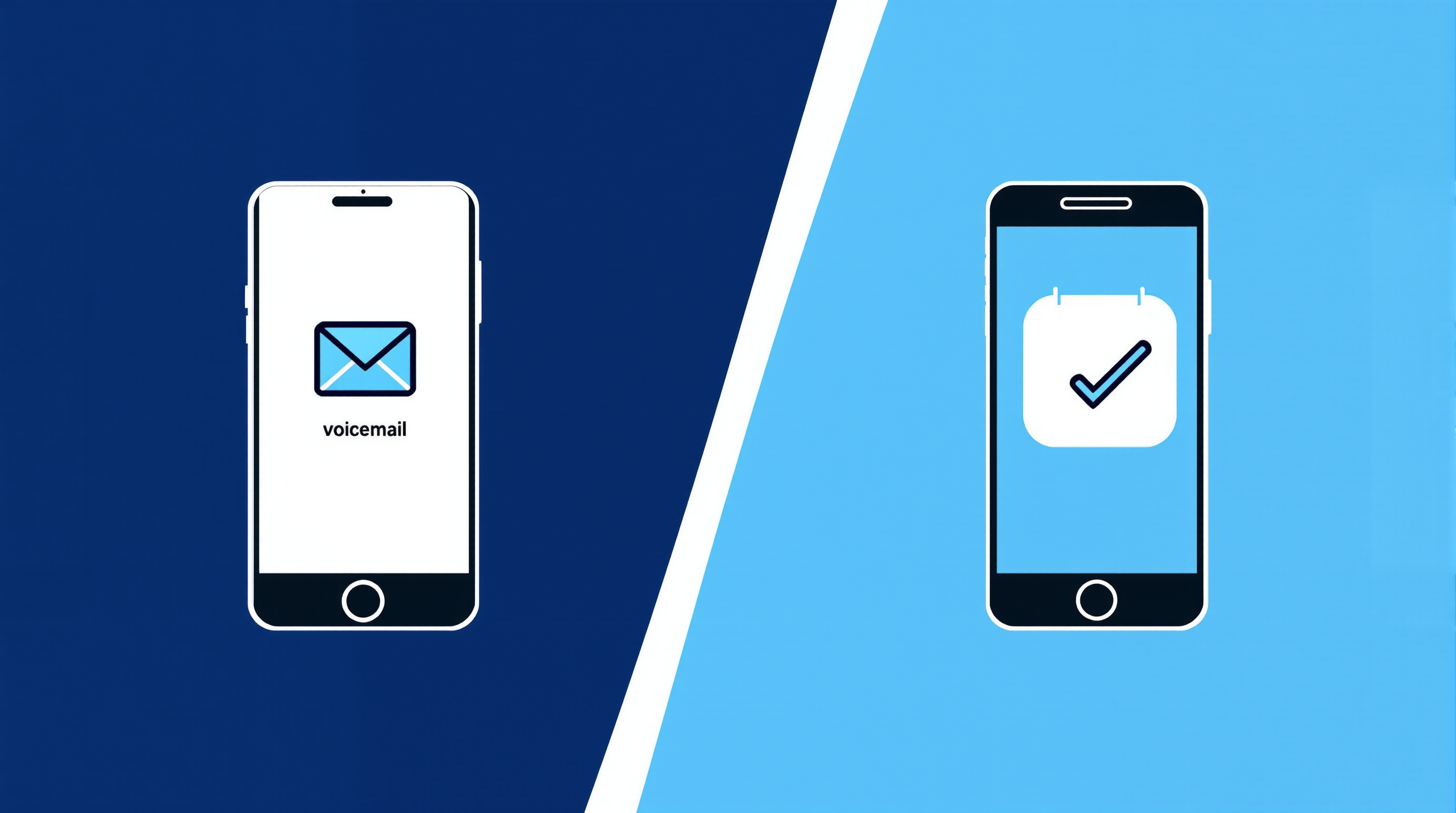
Un telephone en attente versus un agent qui reserve un rendez-vous
What this changes for a Canadian SMB (not a contact centre)
Here's the point most articles miss. Almost all the writing about "agentic" voice AI is aimed at banks and 250-seat contact centres, with metrics like "first-contact resolution" and "average handle time." If you run a one-to-three-location business, that vocabulary doesn't speak to you — and it shouldn't.
For you, the value fits in one sentence: no appointment slips through the cracks. The evening call gets served. The Saturday walk-in gets logged. The deposit gets collected while you're cutting hair or fixing an engine. And nobody retypes anything into a spreadsheet at 9 p.m. You don't need a twelve-metric dashboard; you need the work done. Spread across Canada's six time zones, that also means a caller in St. John's at 9 a.m. and one in Victoria at 6 p.m. both get the same complete service — without you staffing a phone for fourteen hours. That's exactly what an agent that acts makes possible, without hiring an evening receptionist.
The honest part: what it doesn't do (yet)
Let's be clear, because nobody wins from overselling. An agent that acts is not a universal human replacement. Emotionally charged calls — an upset customer, a delicate negotiation, a sensitive situation — are better routed quickly to a person. A good agent knows this and hands off instead of digging in.
Second truth: "acting" assumes your tools are connected. If your calendar and CRM don't talk to the agent, it drops back to being a fancy answering machine. Integration isn't a detail; it's the heart of the project. Third, and this matters across Canada: the moment an agent creates or edits customer records, you're handling personal information, so privacy law — PIPEDA federally, and provincial equivalents — applies. Data residency, consent, and an audit trail are questions to settle before you sign, not after. We walk through them in our guide to choosing an AI voice agent in Canada.
Finally, you don't deploy everything at once. The businesses that succeed start with a single high-volume action, validate it, then expand.
How to tell whether your agent "answers" or "acts"
The test is simple. Ask these three questions about the solution you're being pitched (or the one you already use):
- By the end of a call, has something changed in your systems — an appointment created, a record updated, a payment taken? If the answer is "no, the team will deal with it tomorrow," you have an answering machine.
- Does the agent confirm the action is done before hanging up? Saying "it's all set" when nothing actually moved is the classic flaw of the old generation.
- Does the customer have to call back to finalize anything? Every necessary callback is an action the agent failed to take.
An agent that acts leaves a concrete trail behind it: a booked slot, a sent text, a complete record. Not just a promise.
Where to start
Don't try to automate everything in month one. Pick the action that comes up most often and costs you the most when it's missed — for most service businesses, that's booking. Connect the agent to your calendar, add the text reminder, and measure one simple thing: how many extra appointments show up, especially evenings and weekends. It's also the most direct lever for cutting no-shows. Once that foundation is solid, add deposit collection, lead qualification, and CRM updates.
And before you sign, run the numbers coldly. An agent that acts isn't justified by novelty — it's justified by recovered appointments and avoided admin hours, the same reasoning we quantify in our breakdown of the numbers behind an AI voice agent paying for itself.

Un agent IA vocal met a jour une fiche client et envoie une confirmation
The bottom line
The real news of 2026 isn't that synthetic voices sound more human. It's that they no longer just talk — they do the job. For a Canadian small business, the right question is no longer "does it answer well?" but "does it act — and is it wired correctly into my tools, in line with Canadian privacy law?" If the answer is yes, you're not replacing a receptionist: you're simply going to stop losing customers after 5 p.m. And that shows up in the numbers in the very first month — in booked appointments you would otherwise have lost, and in admin hours you get back. Start with one action, prove it, and let the agent earn the next.
Frequently asked questions
Can an AI voice agent really book into my calendar?
Yes — as long as it's integrated with your calendar or scheduling tool. Once connected, it checks your availability in real time, books the slot, and sends the confirmation, with no action needed from you.
What's the difference between an agent that "answers" and an "agentic" one?
An agent that answers provides information and takes messages. An agentic agent performs concrete actions inside your systems — booking, record updates, deposit collection — all during the call and with no handoff to a human.
Does this comply with Canadian privacy law?
It can, but it isn't automatic. The moment an agent handles personal information, you need to confirm data residency, consent, and audit trails with the vendor before deploying — under PIPEDA federally and any provincial equivalents. Settle it in the contract, not after.