April 9, 2026 may end up being one of those quiet product-release dates that matters a lot more than it looks.
That’s when ElevenLabs officially introduced on-premise and on-device deployment options for its voice AI stack. For Quebec businesses, that is not just another technical update. It changes the compliance conversation around the AI voice agent Quebec Law 25 SMB question in a very practical way: where voice data is processed, who controls it, and whether sensitive audio ever leaves your environment.
Before this release, most small and mid-sized businesses had two realistic choices. Use a public cloud setup, often involving U.S.-hosted infrastructure, or pay more for a private deployment in a Canadian region through a VPC. That second option was already much better for compliance. But it still wasn’t the same as keeping audio processing entirely inside your own clinic, office, or device.
Now there are four real deployment models on the table: Cloud, Canadian VPC, On-Premise, and On-Device.
Plain talk: for a dental clinic in Laval, a physiotherapy clinic on the South Shore, or an accounting firm in Longueuil, this is a meaningful new option under Quebec’s privacy rules. Not every business should jump to on-prem. Most should not. But some absolutely need to re-evaluate their setup now.
What ElevenLabs actually launched on April 9, 2026
The headline is simple. ElevenLabs now supports deployments where models can run on the client’s own infrastructure rather than exclusively through hosted cloud delivery.
According to the company’s launch material, the new setup allows models to run on the client’s GPU, NPU, or ARM-based environment, with the key promise that audio data does not need to leave the client’s infrastructure. That includes two distinct approaches:
- On-Premise: the voice AI runs on a server controlled by the business or its provider.
- On-Device: the voice processing runs directly on a local device such as a workstation, phone, kiosk, or edge device.
That distinction matters.
On-premise is usually about a controlled local server environment. On-device is even tighter in some cases, because the processing can happen directly on the endpoint used by staff or customers. For a professional office handling sensitive calls, that can sharply reduce the amount of personal information transmitted externally.
Here’s the thing: this does not automatically make every deployment compliant. Law 25 is broader than geography alone. You still need governance, access controls, retention rules, and a proper privacy analysis. But the release gives Quebec SMBs a new architecture choice that did not really exist in a practical commercial form before.
Why this matters under Quebec Law 25
If you run a small business in Quebec, Law 25 is not just a concern for banks and hospitals. It applies to you too.
The Commission d’accès à l’information outlines the major changes here: principal changes under Law 25. The legal framework itself sits under Quebec’s private-sector privacy law.
For AI voice agents, three issues come up again and again.
1. Cross-border transfers and section 17
Law 25 requires an assessment before communicating personal information outside Quebec. Section 17 is the pressure point. If your voice agent sends call audio, transcripts, appointment details, or account data to infrastructure outside Quebec, you need to evaluate whether the information would receive adequate protection.
That is where older cloud-only voice AI setups became uncomfortable for many SMBs. A garage in Trois-Rivières answering service calls may have low sensitivity. A psychology clinic in Brossard does not.
2. Privacy impact assessments
If sensitive information is involved, a privacy impact assessment, or PIA, becomes central. The business has to understand what data is collected, where it goes, who accesses it, how long it is retained, and what risks arise from the transfer or processing.
If your voice agent books appointments, verifies identity, or surfaces patient or customer history, you are no longer talking about a simple chatbot. You are dealing with personal information flows that need structure.
3. Penalties are not theoretical
The maximum penalties cited under Law 25 can reach $25 million CAD or 4% of worldwide turnover, depending on the situation. For an SMB owner, that number sounds remote, but the real risk is more immediate: complaints, investigations, breach response costs, lost trust, and contracts you can’t sign because your privacy posture is weak.
A law firm in Quebec City or a medical aesthetics clinic in Laval may never face a maximum penalty. But they can absolutely lose business if they cannot explain where voice data is processed.
The four deployment models Quebec SMBs can now compare
Before April 2026, the market often acted like there were only one or two real choices. That is no longer true.
Let’s compare the four models in plain business terms.
Cloud
This is the classic fast-start option. The voice agent runs through a public cloud environment, often outside Canada or through infrastructure that may involve foreign subprocessors.
Best for: low-sensitivity use cases, fast deployment, lowest initial cost.
Law 25 implication: highest cross-border scrutiny. If the agent handles names, phone numbers, account data, health details, or call recordings, this setup can create a heavier section 17 analysis burden.
Typical cost: roughly $300 to $1,200 per month for a smaller SMB voice assistant, depending on usage and integrations.
For a restaurant on the South Shore taking reservations and answering opening-hour questions, this may still be acceptable if data collection is minimal and the risk is documented properly.
Canadian VPC
This is where many Quebec SMBs should focus first. A VPC, or virtual private cloud, in a Canadian region gives you a more controlled environment, better network segregation, and clearer data residency than a generic public cloud setup.
Best for: most SMBs with moderate sensitivity, including clinics, professional services, and service businesses with customer records.
Law 25 implication: significantly better posture for residency and access control, though not identical to fully local processing. You still need contracts, retention rules, role-based access, and a PIA where required.
Typical cost: roughly $900 to $3,000 per month depending on call volume, redundancy, monitoring, and integration complexity.
In practice, this is the sweet spot for many businesses. It balances privacy, reliability, and cost without forcing you to buy and maintain GPU hardware.
On-Premise
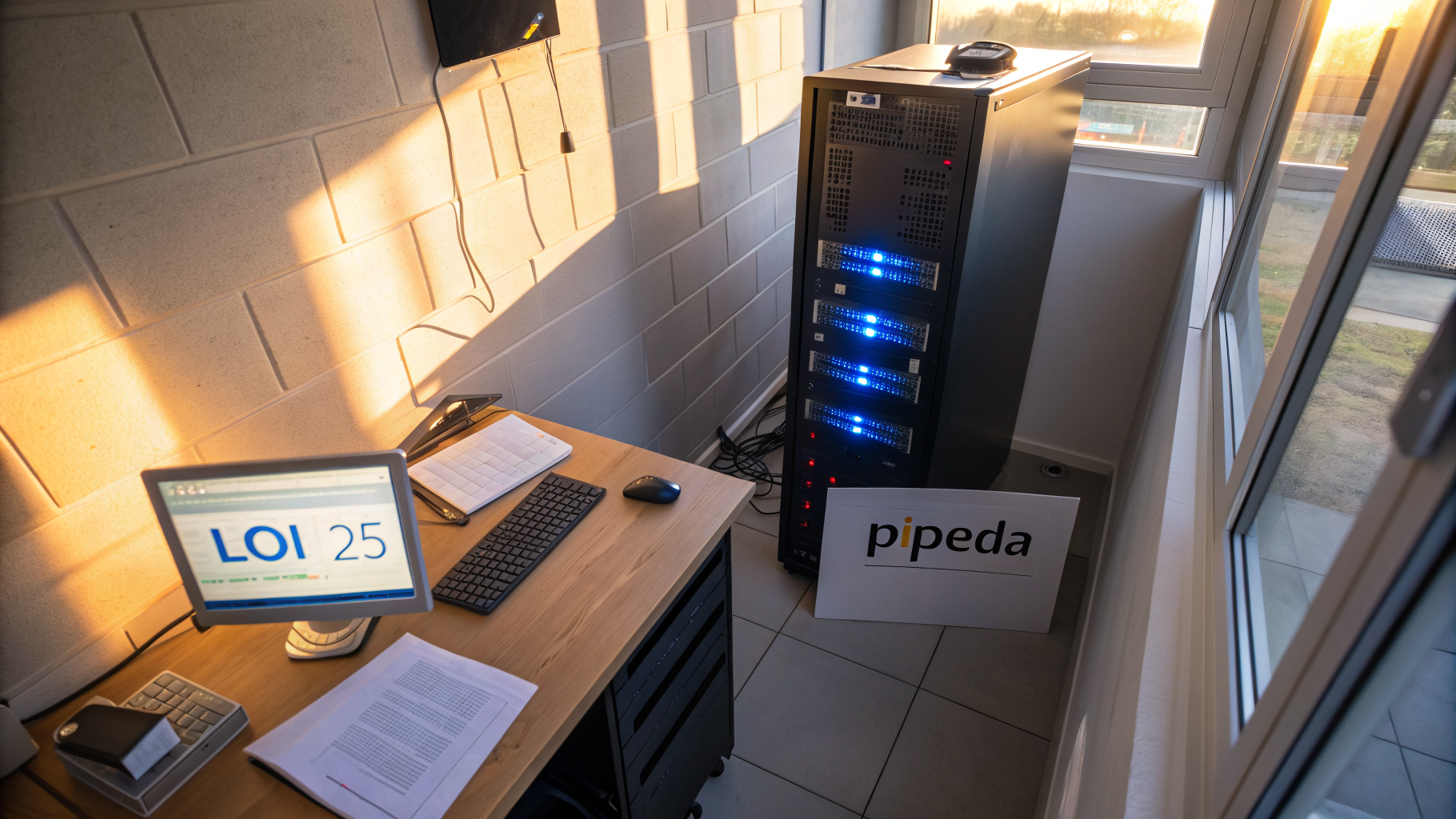
Now we get to the real April 2026 shift. On-premise means the voice models run on a server controlled by the client environment.
Best for: businesses with highly sensitive data, internal IT support, and predictable usage.
Law 25 implication: strongest control over data location and processing path. Very helpful when a business wants to minimize or eliminate external transfer of audio data.
Typical cost: often $8,000 to $25,000+ upfront for suitable hardware, then perhaps $500 to $2,500 monthly in maintenance, support, electricity, backups, and lifecycle costs.
That is why on-prem is not the default answer for a 12-employee plumbing business in Sherbrooke. It may be justified for a larger multidisciplinary clinic or a legal office with strict confidentiality concerns, but it is rarely the cheapest compliant route.
On-Device
This is the most interesting new option for certain Quebec SMBs. Instead of routing voice interactions to an external service or even to a local server, processing can happen on the endpoint itself.
Best for: mobile professionals, front-desk workstations, local intake stations, or narrow workflows involving highly sensitive information.
Law 25 implication: potentially excellent from a minimization and transfer perspective, because audio may never leave the device environment at all.
Typical cost: lower infrastructure cost than on-prem if the device already has adequate hardware, but setup and workflow design still matter. Think roughly $100 to $500 per device monthly equivalent when software, management, and support are factored in.
For most businesses, on-device will not replace every voice workflow. But for a clinic intake station, a lawyer’s dictation assistant, or an accountant reviewing client files from a controlled workstation, it suddenly becomes viable in a way it wasn’t before.
A concrete case: physiotherapy clinic on the South Shore
Imagine a physiotherapy clinic in Boucherville with 14 employees. The clinic wants an AI voice agent to answer calls after hours, confirm appointments, handle cancellations, and answer common questions about insurance receipts, opening hours, and treatment preparation.
At first glance, that sounds simple. But the moment the system accesses patient names, appointment schedules, treatment types, or callback notes, you are handling sensitive personal information. If calls are recorded or transcribed, the privacy stakes rise again.
Before April 2026, the clinic had two realistic options.
Option one: use a standard cloud deployment because it is cheaper and fast. The problem is obvious. If audio or transcripts are processed outside Canada, the clinic needs a stronger cross-border assessment under section 17 and a clear explanation of safeguards.
Option two: use a Canadian VPC. This is much better. Data residency improves. Segregation improves. Contracts and access control can be tighter. For many clinics, this was already the sensible path.
Now there is a third serious option: run the most sensitive voice workflow locally. For example, the clinic could keep after-hours triage and patient-identity-related interactions on-premise or on-device, while less sensitive FAQ-style interactions remain in a Canadian VPC.
That kind of hybrid model matters. It lets the clinic reduce external data transfer for the highest-risk conversations without overbuilding an expensive full local environment for every single call.
And yes, the business still needs governance. It still needs consent language where appropriate, retention rules, role-based access, and documentation. If you need a refresher on the broader framework, this guide is useful: agent IA vocal et Loi 25 au Québec.
Who should actually choose on-prem, and who should stay with Canadian VPC?
Not every new option is a good option for every company.
That is the part some vendors skip.
For most Quebec SMBs, Canadian VPC remains the right answer. A manufacturer in Drummondville, a car dealership in Lévis, or a family restaurant chain on the South Shore usually does not need to buy local GPU infrastructure to answer calls, route leads, and manage basic customer service. A well-designed Canadian VPC deployment will often provide the right balance of privacy and economics.
On-premise starts making sense when three conditions are present:
- the business handles highly sensitive information regularly;
- the voice agent needs access to internal systems or records in real time;
- the business can support the operational burden or has a managed provider handling it.
That profile fits certain medical clinics, law firms, accounting firms, and specialized financial services businesses.
On-device is a different story. It may become attractive even for smaller organizations because it avoids some of the cost and complexity of full on-prem servers. A notary office in Laval might use on-device voice assistance for internal transcription or client-intake support on controlled workstations. A psychologist’s clinic may prefer a local endpoint model for especially sensitive interactions.
But there is a catch. Hardware matters. Workflow design matters. Security policies matter. If the device is poorly managed, local processing alone does not save you.
Also, the voice agent is only as useful as the data it can safely access. If you are connecting to internal documents, FAQs, or service policies, your knowledge architecture matters just as much as the deployment model. This article on knowledge base search for Quebec SMBs explains that side of the equation well.
The cost reality SMB owners need to hear
Let’s talk money, because compliance decisions are never made in a vacuum.
A basic cloud deployment may look attractive at $300 to $1,200 per month. For a low-risk use case, that can be fine. But if the setup triggers a heavier PIA burden, raises customer concerns, or limits what data you are comfortable automating, the “cheap” option can become expensive in hidden ways.
A Canadian VPC generally lands in the $900 to $3,000 monthly range for a serious SMB setup. That sounds like a jump, but many businesses gain enough privacy comfort and operational flexibility to justify it. Compared with hiring or extending receptionist coverage, it can still be economical. For a broader cost lens, see receptionist vs AI voice agent total cost.
On-premise is where budgets change fast. You may need a suitable GPU server, secure networking, redundancy planning, monitoring, patching, backups, and support. Even if the monthly software economics look reasonable, the real total cost includes hardware refresh cycles and IT overhead. For many 5-to-50-employee businesses, that is simply too much.
On-device may soften that picture for selected use cases. If the process can run on existing hardware and remain limited to a narrow workflow, it can deliver strong privacy benefits without the full server burden. But it is not magic. If you need enterprise-grade logging, endpoint management, and secure integration with patient or client records, the total cost still rises.
So what changed on April 9, 2026? Not that every SMB should move local. What changed is that local deployment is now a credible option instead of a custom, niche, enterprise-only discussion.
A 6-point checklist to assess your own Law 25 risk level
If you are evaluating an AI voice agent Quebec Law 25 SMB deployment, start here.
- What kind of information will the agent process?
Names and phone numbers are one thing. Health details, payment issues, legal matters, and account history raise the risk level fast. - Will any audio, transcript, or metadata leave Quebec or Canada?
If yes, you likely need a stronger section 17 analysis and documented safeguards. - Do you need a privacy impact assessment?
If the workflow involves sensitive personal information, automated decision support, or cross-border communication, assume the answer may be yes. - Can you separate low-risk and high-risk use cases?
A restaurant FAQ bot and a patient intake workflow do not need the same architecture. Sometimes a hybrid approach is the smart one. - Do you actually have the budget and operational maturity for on-prem?
If not, a Canadian VPC may be the better compliance outcome because it is easier to maintain properly. - Can your provider explain the deployment in plain language?
If they cannot clearly tell you where data is processed, stored, retained, and accessed, stop there.
The short version? ElevenLabs’ April 2026 launch does not remove your Law 25 obligations. It gives you better ways to meet them. For many Quebec SMBs, Canadian VPC still makes the most sense. For clinics, law firms, accountants, and other high-sensitivity environments, on-premise and especially on-device now deserve a serious look. TECHMA configures the right deployment model for each client, so the business does not have to handle the technical setup itself.