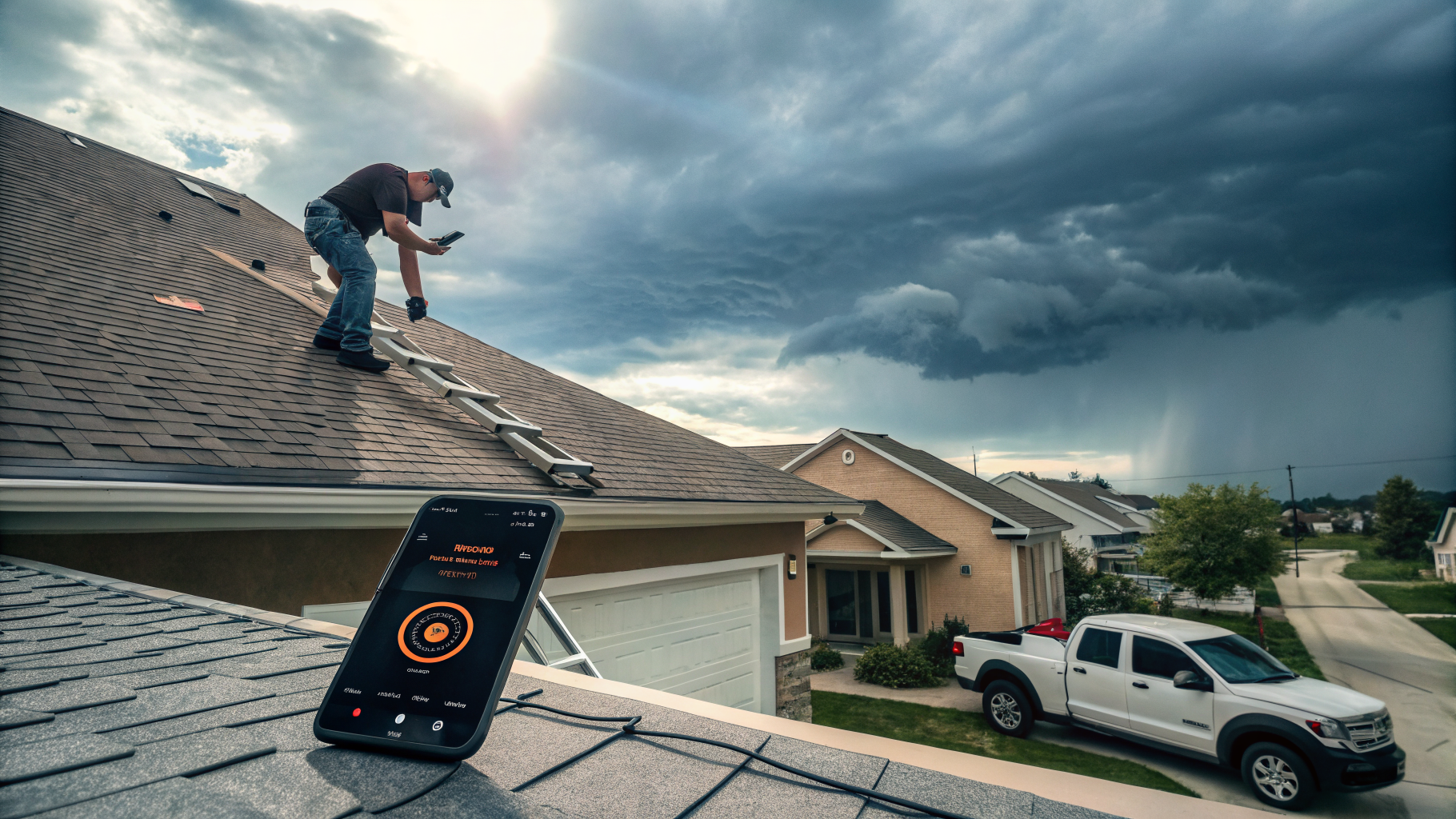
Tuesday, 10:30 a.m. in Calgary
A Calgary foreman is halfway across a steep slope, air nailer in hand, finishing a re-roof two days after a June hailstorm. His phone buzzes three times in his pouch, but there’s no safe way to answer. By lunch, one of those missed calls has already turned into a $14,000 replacement for the competitor who picked up first. That’s the real-world case for an AI voice agent for roofing companies in Canada.
This is not a rare edge case. For Canadian roofing companies, the busiest calling hours are usually 9 a.m. to 4 p.m., which is exactly when crews are on ladders, on steep pitches, or managing tear-offs and emergency tarps. Homeowners don’t care that your team is tied off on a two-storey roof in Edmonton or racing a thunderstorm in Toronto; they just want someone to answer now. And when nobody does, they move to the next roofer on Google in under five minutes.
Why Canadian roofing companies miss so many calls
Roofing in Canada runs on a compressed calendar. In most provinces, the real money window is roughly May through October, and every week counts.
That seasonality creates pressure that many U.S.-based software vendors simply don’t model well. A contractor in Winnipeg, Ottawa, or Halifax may have only a handful of peak months to capture inspections, storm work, and full replacements before cold weather, snow, or fall rain slows production. July is especially intense because severe weather spikes demand fast: hail in Alberta, summer windstorms in Ontario, post-tropical systems in Atlantic Canada, and later-season rain urgency in Vancouver. If your business line is still the owner’s personal cell, those surges can overwhelm the team in a single afternoon.
Then there’s the safety issue. Roofers are physically unable to answer while they’re working — and they shouldn’t try.
A lot of small and mid-sized roofing businesses still route incoming calls to the owner, estimator, or foreman. That works when call volume is light, but it breaks down fast once crews are on-site all day and the phone becomes one more impossible task. It also explains why missed-call rates of 30% to 40% are common for smaller operators using a mobile line as the main office number. Add the fact that roughly 85% of callers won’t leave voicemail, and a missed call becomes a silent lost opportunity, not a callback waiting patiently in the inbox.
What a missed call really costs a roofer
Let’s put Canadian dollars on it. A typical residential repair might be worth $750 to $2,500 CAD. A residential replacement often lands between $8,000 and $15,000 CAD. Commercial work can start at $20,000 and climb from there.
Now imagine a roofing contractor in Ottawa getting 120 inbound calls in a busy storm month. If 35% go unanswered, that’s 42 missed opportunities. If only 20 of those were legitimate estimate or emergency-repair calls, and just 25% would have converted into booked jobs, that’s five jobs gone. At an average ticket of $9,500 CAD, the revenue at risk is $47,500 in a single month. Even if your close rate is lower, the math still hurts. This is why missed-call tracking matters, and why industry analysis from JobNimbus on missed-call costs gets so much attention among contractors.
And storm work is even more brutal. The first roofer to answer often wins the inspection.
Insurance-driven customers are stressed, short on time, and usually calling several companies in a row. If a homeowner in Calgary has water intrusion after hail, or a property manager in Halifax needs someone after high winds, they are not waiting three hours for a callback. They want a human-sounding response, a booked inspection, and confidence that the company is organized. Research cited in the roofing space also points to a meaningful unanswered-call problem — roughly 27% of inbound calls in some contractor contexts — which is why pieces like this industry review of AI answering for roofing contractors keep surfacing in the conversation.
How an AI voice agent for roofing companies in Canada actually works
An AI voice agent for roofing companies doesn’t sit in a dashboard waiting for your team to remember to log in. It answers the phone in about two rings, 24/7, using your business number.
From there, it follows a roofing-specific call flow. Is this an active leak or a quote request? Is the property residential or commercial? What’s the service address, the roof type, the approximate age of the roof, and is there an insurance claim involved? If the caller has an urgent issue — say water entering a home in Moncton after a storm — the call can be escalated or transferred based on your rules. If it’s a standard estimate request in Vancouver, the system can gather details and book an inspection without forcing the customer to wait for an evening callback. For contractors already exploring broader field-service use cases, this guide to AI voice agents for home-service businesses shows how the workflow extends beyond basic call answering.
The key is that it frees up the team instead of asking roofers to become phone operators. That matters.
A well-configured AI receptionist for roofers doesn’t replace your office manager or estimator. It handles the repetitive front-end work: answering, qualifying, routing, booking, and logging the interaction so your team starts with context instead of chaos. That means fewer interruptions for crews on the roof, faster response times for homeowners, and a cleaner handoff when someone on staff is ready to take over.
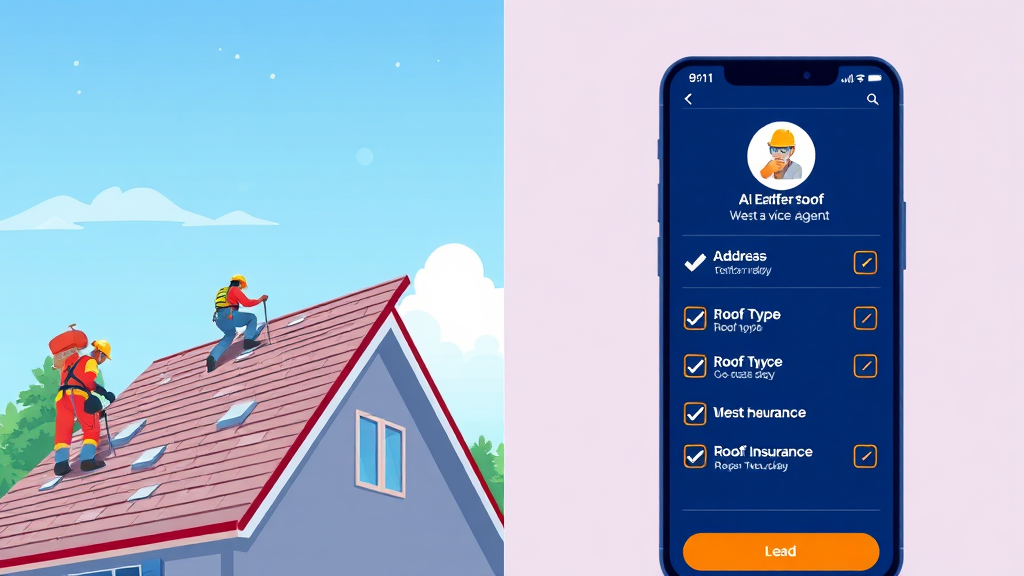
Agent IA vocal qui qualifie un appel pendant que l equipe de couvreurs travaille sur le toit
Four automations that matter most for roofers
The first is storm-surge triage. When hail hits Calgary or windstorms sweep southern Ontario, 50 to 200 calls can come in over 24 to 48 hours.
A roofing answering service Canada businesses can rely on has to do more than take messages. The system should sort active leaks, fallen shingles, emergency tarping, insurance inquiries, and standard replacement requests into different paths. It can handle multiple inbound calls in parallel, so the tenth caller doesn’t hear a busy signal while your office line is tied up. That alone can be the difference between capturing a storm book of business and watching it spill to competitors.
The second is quote qualification. Not every caller is ready, and not every lead fits your service area.
An AI voice agent can ask the practical questions your team would ask anyway: the full address, neighbourhood, roof type, whether it’s asphalt shingle, metal, flat, or cedar, approximate roof age, visible damage, and whether the homeowner has already opened an insurance claim. That helps your estimator show up prepared. It also filters out poor-fit leads before someone burns 45 minutes driving across town in Edmonton for a property outside your target zone.
The third is booking inspections straight into the calendar. The fourth is follow-up on dormant quotes.
If a homeowner in Toronto calls during lunch and wants an inspection this week, the system can offer available windows and lock in the appointment immediately. Then, if an estimate goes quiet for seven or 10 days, it can place a polite follow-up call or reminder to reconnect while the job is still warm. Why let a solid $11,000 replacement quote sit untouched because everyone got busy on-site? This is where automation stops being a novelty and starts acting like operating leverage.
The storm-season advantage when speed-to-lead decides the job
Picture July in Alberta. Hail hits two neighbourhoods outside Calgary, and phones light up before the clouds are even gone.
Now layer in Ontario windstorms the same month, or a post-tropical event affecting Halifax and surrounding communities. In roofing, speed-to-lead is not a marketing cliché; it’s often the deciding factor in who gets the inspection, who gets the insurance conversation, and who gets the signed contract. Homeowners dealing with damaged shingles, leaks, or debris impact are stressed and usually contacting several companies at once. The roofer who answers first sounds more organized, more available, and more trustworthy — even before the truck rolls out.
That’s why a missed calls roofing contractor problem is really a revenue-timing problem. During storm season, delay compounds fast.
If your competitor answers every inbound call while your line goes to voicemail, they build the inspection queue first and control the next 48 hours. Your team may still be excellent at production, claims support, and customer service, but the customer never gets far enough to see it. For Canadian roofing companies, where the season is short and weather events create sudden spikes, consistent phone coverage is less about convenience and more about protecting the months that generate most of the year’s demand.

Pointe d appels apres un orage geree en parallele par un agent IA vocal
Common roofer objections, answered plainly
“It’ll sound robotic.” Fair concern. Nobody wants callers in Vancouver or Winnipeg feeling like they’ve reached a clunky menu tree from 2009.
The difference is in configuration and scripting. A modern AI receptionist for roofers can sound natural, ask direct questions, and keep the interaction moving without making people repeat themselves three times. The goal is not to impress callers with fancy tech language; it’s to answer quickly, collect the right information, and get them to the next step without friction. In practice, most homeowners care more about speed and clarity than whether the first voice is human or AI — especially when they have a leak.
“My customers are older.” Maybe. But older customers still value getting an answer instead of voicemail.
If the voice is clear, the prompts are simple, and the handoff rules are sensible, adoption is usually less of an issue than owners expect. Another objection is setup time: “I don’t have time to build this.” That’s exactly why Agent IA Vocal is positioned as a done-for-you service, not a self-serve tool. The TECHMA team handles setup, call flows, and integrations for you, which matters in peak season when nobody has spare hours. And on pricing, contractors can review what an AI voice agent really costs and compare it with the difference between a traditional answering service and an AI voice agent before deciding what fits their operation.
“What does it cost?” Usually a lot less than one lost replacement job.
Agent IA Vocal plans start from $49 to $199 CAD per month, depending on needs and call volume. For a roofing business, that cost has to be weighed against even one missed repair, one unbooked inspection, or one storm-related replacement that went to the company that answered first. Not exactly a hard comparison, right?
FAQ from Canadian roofing companies
Can it handle emergency leak calls differently from quote requests? Yes. You can set separate call flows so active leaks, storm damage, and urgent tarping requests are prioritized, while standard estimate requests are qualified and booked into the calendar.
Will it work if my business line is currently my cell phone? In many cases, yes. Calls can be routed so the AI voice agent answers first, gathers details, and only interrupts you when a transfer meets your urgency rules. That helps free up the team while reducing unsafe attempts to answer on the roof.
Can it answer in both English and French for markets like Ottawa or Moncton? Yes. That bilingual capability matters in parts of Canada where customers may switch languages naturally and expect service in either one. For roofing companies operating in Ottawa, Moncton, Montreal, or nearby regions, English-and-French call handling can improve conversion on inbound leads that might otherwise bounce to another contractor.
Do I need to set up the system myself? No. The TECHMA team handles the setup, configuration, and integrations, which is important for busy roofing companies that need a turnkey solution rather than another software project.
When you're on the roof, someone still needs to answer
That’s the whole issue. Canadian roofing companies don’t lose calls because they don’t care; they lose them because the work itself makes answering impossible at the exact moment customers call.
An AI voice agent for roofing companies in Canada gives those businesses a practical way to respond during the hours that matter most, especially through the compressed May-to-October season and the chaos of July storm events. It can answer in two rings, qualify the lead, capture addresses and insurance context, book inspections, and escalate emergencies — all while freeing up the team to stay focused on safe, productive field work. For owners using a personal cell as the business line, or office teams swamped after hail and wind events, that can mean fewer missed opportunities and a more professional first impression across Calgary, Toronto, Ottawa, Winnipeg, Halifax, Vancouver, and Edmonton.
If you want to see how it would work for your roofing company, you can book a demo at https://agentiavocal.ca/demo.
And if you want the numbers first, review plans starting at $49 CAD per month at https://agentiavocal.ca/pricing. Setup is turnkey and handled by the TECHMA team, so you don’t have to build it yourself in the middle of roofing season.