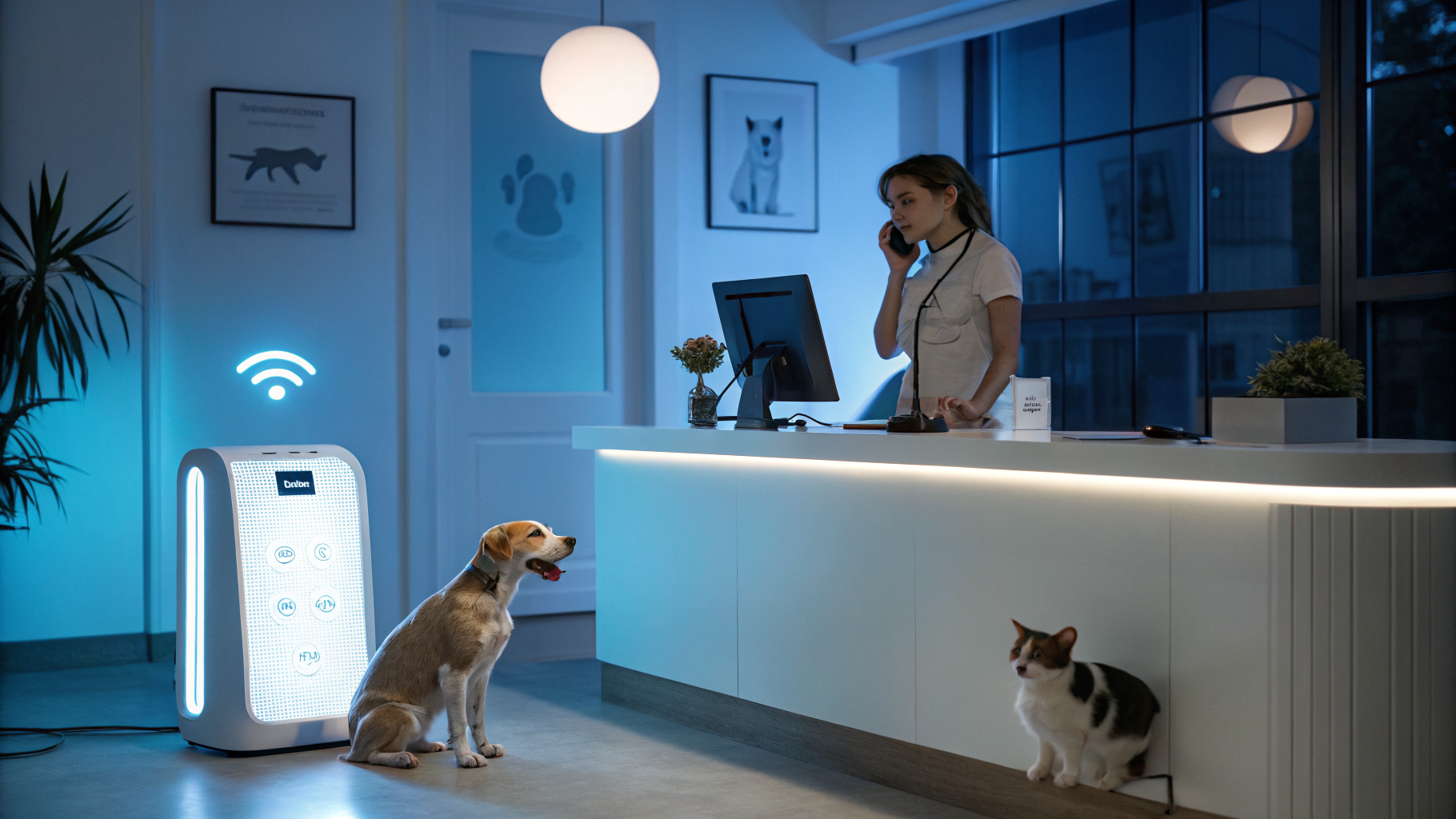
It’s 2:07 a.m. in Calgary. A frantic pet owner grabs the phone because their Labrador just ate a box of dark chocolate. Your front desk staff is asleep, your voicemail picks up on the third ring, and the caller hangs up before the beep. Two minutes later, they’re calling the 24-hour emergency hospital two towns over instead.
That wasn’t just a missed call. It was a worried client, a clinical case, and very likely future revenue that slipped away because nobody could answer in the moment. That is exactly why more clinics are looking at an AI voice agent for veterinary clinics Canada can rely on: not as a gimmick, but as a practical way to make sure every caller gets help when it matters most.
The phone is still the front door for veterinary care. A large share of new clients call before they ever book. Existing clients call because they’re worried, confused, late, emotional, or trying to decide whether something is urgent. And industry figures are sobering: many clinics miss roughly 20% to 30% of incoming calls during business hours, about 1 in 4. Of the people who can’t get through, roughly 85% do not call back, and many simply try another clinic instead. After hours, most callers won’t leave a voicemail. Add the fact that satisfaction drops fast once hold times pass about 40 seconds, and the problem becomes obvious.
For veterinary clinics in Toronto, Ottawa, Vancouver, Calgary, Winnipeg, Halifax, and everywhere in between, the issue isn’t that teams don’t care. It’s that the front desk is being asked to do the impossible.
Why the veterinary front desk is uniquely hard
A vet reception desk is not a typical reception desk. At 10:15 a.m., the phones spike. A technician is asking for a chart. A client at the counter needs to pay. An exam room is ready. Someone is crying because their cat hasn’t eaten in two days. Someone else wants a refill on Apoquel. Meanwhile, the phone keeps ringing.
And unlike many other businesses, a veterinary clinic is dealing with emotion on nearly every call. Fear. Guilt. Urgency. Sometimes grief. It is hard enough to reassure a pet owner when you have time. It is much harder when you’re trying to answer with one hand while helping restrain a 40 kg dog with the other.
That’s one reason voice automation is moving so quickly into service industries. The broader trend is reflected in 2026 voice AI statistics, but the veterinary use case is especially clear: every missed ring has both clinical and commercial consequences. A missed grooming inquiry is one thing. A missed “my dog may have ingested antifreeze” call is another entirely.
Voicemail does not solve this. Most after-hours callers never leave one. They want immediate guidance, not a beep. And during business hours, “please hold” only works for so long before a caller gives up and phones the clinic across town.
How an AI voice agent works in a clinic
At its best, an AI voice agent does not replace your team. It protects your team’s attention and makes sure callers are never left in limbo.
Here’s the simple version. The system answers on the first ring, 24/7. It greets the caller in a natural voice, identifies the reason for the call, and follows a clinic-approved workflow. If the person needs to book an appointment, the agent can offer available times and write directly into systems such as ezyVet, Cornerstone, or Vetspire through approved integrations and workflows managed by TECHMA. If the caller wants a medication refill, it captures the details and places the request into a review queue for the morning. If the situation sounds urgent, it triages conservatively and escalates.
It also means your clinic gets the practical benefits of 24/7 phone support without asking receptionists to work longer, burn out faster, or spend their evenings clearing voicemails.
Because this is a managed service from Agent IA Vocal, your team is not left to figure it out alone. TECHMA handles setup, call flows, integrations, routing logic, testing, and ongoing improvements. That matters. Clinics do not need another self-serve dashboard to babysit.
And in a country with six time zones and a bilingual or multilingual caller base, that coverage becomes even more valuable. A line can ring from Vancouver after supper or from Halifax before the morning rush. The system is ready either way.
AI voice agent for veterinary clinics Canada: after-hours emergency triage and routing
This is where the value becomes immediate.
Not every after-hours call is a life-threatening emergency. But a meaningful share are urgent enough that a pet owner needs direction right now. The challenge is that the clinic cannot keep a live receptionist on duty all night just in case. So what happens? Calls pile up in voicemail, owners panic, and true emergencies may lose precious time.
A vet-specific voice agent follows a structured triage path built for common scenarios. If the caller says the dog ate chocolate, chewed xylitol gum, may have ingested antifreeze, is retching with a swollen abdomen, is struggling to breathe, is actively seizing, or has been hit by a car, the system does not “wait and see.” It escalates immediately based on your clinic’s rules: route to the on-call veterinarian, provide the nearest emergency hospital details, send an urgent alert, or do all three.
If the issue is a torn nail, mild itching, a question about post-op instructions, or “my cat skipped one meal but is otherwise acting normal,” the agent can capture the details, reassure the owner that the clinic will review it first thing in the morning, and place it in a clean follow-up queue. That’s a very different experience from a generic voicemail box with 14 mixed messages waiting at 8:03 a.m.
Think about the operational difference. Instead of arriving to a blinking phone system and trying to decode rushed overnight messages, your team opens to organized call logs, reason-for-call summaries, timestamps, caller details, and escalation notes. Who needs a callback? Who was routed to ER? Who requested a same-day appointment? It’s all there.
And for worried owners, the emotional difference is just as important. They are heard immediately. They get direction. They are not left wondering whether anyone will listen to a voicemail in time.
Appointment booking and fewer no-shows
During the day, one of the biggest leaks in a clinic’s schedule is not demand. It’s friction.
A caller phones while commuting in Toronto, on a job site in Edmonton, or between school pickups in Ottawa. They want the fastest path to “Do you have anything Thursday after 4?” If they hit hold for a minute and a half, many are gone. If they reach voicemail, they are usually gone for good.
An AI voice agent can handle appointment scheduling in real time with two-way calendar sync, using clinic-approved rules around appointment types, species, provider availability, and buffer times. A vaccine booster is not booked the same way as a sick visit. A new puppy exam is not booked the same way as a surgical recheck. The workflow can reflect how your clinic actually operates, not some generic script.
It also helps reduce no-shows and last-minute confusion. Once an appointment is booked, the system can trigger confirmations, reminders, and follow-up prompts in a coordinated flow. If a client needs to reschedule, that can be captured early instead of becoming an empty slot on the day of the appointment. For clinics trying to protect doctor time and keep schedules full, that matters a lot. You can read more about reducing no-shows with this kind of workflow.
Why does this matter financially? Because every unfilled appointment slot has a dollar value attached to it. A missed wellness exam may be worth one amount; the diagnostics and follow-up that would have flowed from it may be worth much more. When a caller can book instantly instead of waiting for a callback, conversion improves. Simple as that.
And no, this doesn’t mean every call should stay with automation. If a long-time client is upset about a complex case or needs a nuanced discussion, the system can hand off to a person. The point is to remove the repetitive scheduling traffic that keeps your staff from handling the calls where human care matters most.
Prescription refill requests and new-client intake without the chaos
Refill calls are small on their own, but together they eat hours.
Someone needs more flea and tick prevention. Someone else wants a refill for gabapentin before the weekend. Another client is checking whether their pet’s food order is ready. None of these calls is dramatic, but all of them interrupt the desk, and all of them need accurate details: pet name, owner name, medication, dose, quantity, timing, and preferred pickup.
A voice agent can collect those details consistently and queue them for staff review. That means your medical team can approve or decline based on the chart, while your reception team is not scribbling notes on sticky pads during a rush. It also reduces the “Can you repeat the dosage?” problem that happens when voicemail quality is poor or messages are rushed.
New-client intake is another major opportunity. A surprising amount of acquisition still starts with a phone call. A family in Winnipeg gets a new Golden Retriever puppy and starts calling nearby clinics. A couple in Halifax just moved and needs a new vet for their senior cat. A newcomer family in Surrey may prefer to speak in French, English, Punjabi, or another language before they decide where to book. If nobody answers, the inquiry often disappears.
With the right flow, the system can capture the owner’s name, pet name, species, breed, age, sex, whether the pet is spayed or neutered, vaccination status, previous clinic, and reason for visit. It can then offer the correct next step: book immediately, request records, or flag a same-day concern. Reception is no longer retyping basic intake details while the phone rings off the hook. Instead, they start with structured information already captured.
That kind of consistency is not flashy, but it saves time every single day. And over a month? It adds up fast.
Speaking the pet owner’s language across Canada
Canada is not a one-language phone environment, and veterinary clients don’t stop being anxious just because they’re speaking in their second language.
A clinic in Ottawa may get both English and French callers. Vancouver and the Lower Mainland may see strong demand for multilingual support. Toronto clinics regularly serve clients from dozens of language backgrounds. In Quebec, French-first service is essential; elsewhere, bilingual and multilingual flexibility can still be a major advantage. When a pet owner is worried, clarity matters.
That is why many clinics are interested in a bilingual/multilingual agent that can greet callers naturally, understand the issue, and route them correctly without creating confusion. If someone is trying to explain that their dog may have eaten raisins, do you really want language friction to be part of the problem?
The goal is not novelty. The goal is access. A caller who feels understood is more likely to stay on the line, follow instructions, and trust your clinic enough to book.
What it means for your clinic
The obvious benefit is that more calls get answered. But the bigger impact is what that changes downstream.
First, you capture revenue that would otherwise leak away through missed calls, abandoned holds, and unreturned voicemails. Second, you protect staff energy. Reception teams are not machines; they are often handling one of the most emotionally demanding jobs in the clinic. Giving them relief from repetitive, interrupt-driven phone traffic can lower stress and improve the quality of human interactions at the desk.
Third, you create a better client experience. Pet owners remember how they felt when they called. Did someone answer quickly? Did they get a clear next step? Did the clinic sound organized? In veterinary medicine, trust starts before the appointment ever begins.
Fourth, you get cleaner operations. Calls are logged. Requests are categorized. Urgent issues are escalated. Routine issues are queued. Instead of chaos, there is structure.
And because Agent IA Vocal is managed by TECHMA, your clinic does not need in-house technical capacity to make this work. TECHMA handles the setup and integration process for you, then maintains and improves the system over time. For busy practices, that’s the difference between a nice idea and something that actually gets used.
Whether you’re a small two-doctor clinic in Saskatoon or a multi-location hospital group in the GTA, the business case is similar: fewer missed opportunities, less front-desk overload, and better service when owners are most anxious.
Common objections from veterinary clinics
“Won’t it feel cold to a scared pet owner?”
It can, if it’s badly designed. But a well-built voice agent uses warm, clinic-specific language, short empathy statements, and fast escalation paths. “I’m sorry you’re dealing with that. Let’s get you the right next step now” lands very differently from “Please listen carefully, as our menu options have changed.” For many owners, an immediate compassionate response is far better than voicemail.
“What if it misses a real emergency?”
That is the wrong design standard. Veterinary triage should be conservative. The workflow should err toward escalation, not dismissal. If there is any doubt around toxins, bloat, respiratory distress, collapse, uncontrolled bleeding, or seizures, the system should route urgently based on clinic-approved rules. In Canada, privacy, consent, and record-handling expectations also matter, which is one reason clinics often look to guidance from the Canadian Veterinary Medical Association and internal compliance practices aligned with PIPEDA.
“We’re too small, or too busy, to set this up.”
That’s exactly why a managed approach matters. With Agent IA Vocal, TECHMA builds the call flows, handles integrations, configures routing, and maintains the system. Your clinic does not need to become a software company on the side. You provide the operational rules; TECHMA does the heavy lifting.
“Our team already answers calls pretty well.”
Maybe they do. But can they answer every call on the first ring at 2 a.m.? Can they speak to every caller instantly during a mid-morning rush? Can they reduce hold-time abandonment when three exam rooms, the front counter, and the phone all need attention at once? Even strong teams have limits. The point is not replacing good people. It’s extending their reach.
FAQ
Can an AI voice agent book directly into our veterinary software?
Yes, with the right workflow and approved integration process. Agent IA Vocal is a managed service, and TECHMA handles setup so the system can support scheduling processes that align with platforms such as ezyVet, Cornerstone, or Vetspire, depending on the clinic’s environment and rules.
Will it only help after hours, or during the day too?
Both. After hours, it can answer every call, triage urgency, and route emergencies. During business hours, it can absorb overflow, book appointments, take refill requests, and reduce hold times when reception is overloaded.
Is this only for large hospitals?
No. Smaller clinics often feel the pain even more because one or two people are trying to cover phones, the counter, and exam-room interruptions at once. A managed voice agent can be valuable for independent practices, multi-doctor clinics, and larger hospital groups across Canada.
See how Agent IA Vocal can help your clinic
If your clinic is losing calls, stressing out the front desk, or sending anxious pet owners to voicemail when they need help most, it may be time for a different approach. Agent IA Vocal gives veterinary clinics a managed AI phone system that answers 24/7, handles routine requests, and escalates urgent situations fast, with setup and support handled by TECHMA.
You can book a demo to hear how it works in a real clinic scenario, or review pricing to compare the monthly plans at $49, $99, and $199. If one missed after-hours emergency call can cost you a client, a case, and future referrals, the real question is: how many more can you afford to lose?