The Caller Hung Up Before Finishing Their Sentence
Picture a clinic in a busy Canadian city on a Tuesday morning. The phone rings. A caller starts in French: "Bonjour, j'aimerais prendre un rendez-vous…" The receptionist, juggling two patients at the desk, reflexively answers "one moment please." Awkward pause. The caller hangs up and dials the clinic down the street — the one that answered in their language on the first try.
This isn't about manners. It's about revenue, and in Canada it's often about more than that. A call where the customer doesn't feel served in their language is a lost customer — and frequently their whole family and network with them. That's why a bilingual AI voice agent is no longer a nice-to-have in 2026. It's the tool that decides who wins the customer and who watches them walk to a competitor.
Canada's Linguistic Reality: Two Official Languages, Hundreds Spoken
Start with the numbers. According to Statistics Canada census data, more than 7.8 million Canadians have French as their first official language spoken, and a record one in four Canadians — about 9 million people — has a mother tongue that is neither English nor French. Canada is officially bilingual, but on the ground in Toronto, Vancouver, Ottawa-Gatineau, Calgary, and Winnipeg, the phone rings in far more than two languages.
Think about who actually calls a local business. In Greater Toronto you'll hear Mandarin, Punjabi, Tamil, and Urdu. In Metro Vancouver, Cantonese and Punjabi. In Ottawa-Gatineau and across New Brunswick — Canada's only officially bilingual province — French service isn't optional, it's expected. You can't hire a receptionist for each of those languages. But you can lose those callers one by one, every week, without ever knowing it happened.
You Can't Hire Your Way Out of This
"I'll just hire someone bilingual" hits a wall fast. A genuinely bilingual, reliable receptionist is expensive and scarce — the bilingual premium runs roughly 15 to 30% on top of salary, and the fully-loaded cost of one full-time hire clears $55,000 a year easily. And that buys you one person, on one shift, in two languages at best. Who covers lunch? Vacation? The 7 p.m. call on a Thursday that still comes in?
It's the same math we walked through in our overview of voice AI statistics and trends. The conclusion is consistent: no human team can cover every language at every hour across six time zones. Software can. That's the whole shift.
How a Voice Agent Actually Handles Two Languages (No "Press 1 for English")
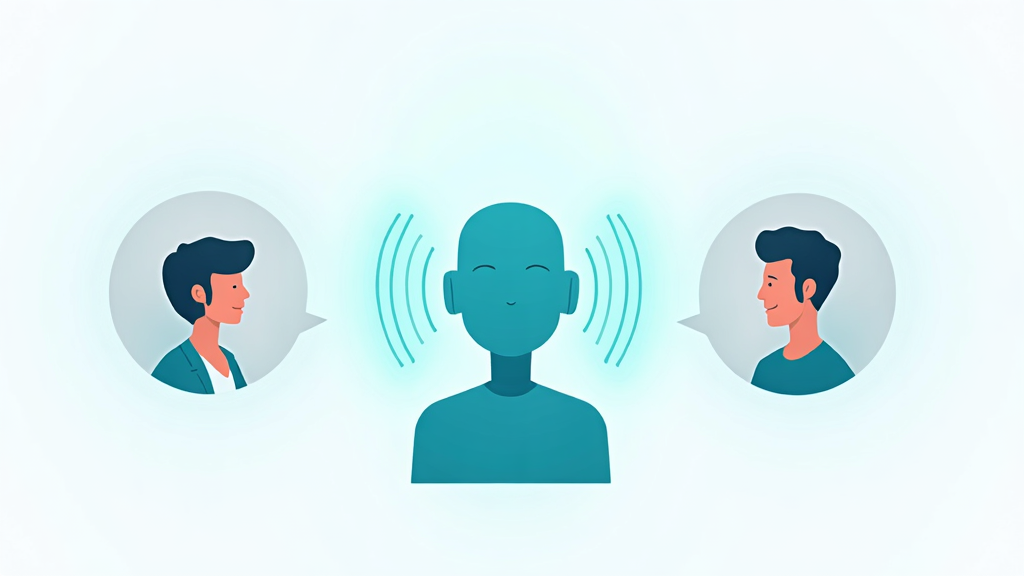
Here's what changed. A good AI voice agent detects the caller's language from their first sentence and answers in it — no "press 2 for French" menu. A caller says "Bonjour," the agent continues in French. A caller opens in English, the agent answers in English. And if the person switches mid-call — "actually, peux-tu continuer en français?" — the agent follows, with no transfer, no hold music, no "let me find someone who speaks French."
That natural feel comes down to speed. In June 2026, voice platforms like ElevenLabs pushed real-time recognition and synthesis fast enough to stay under 500 milliseconds, even when switching languages. Below that threshold, the brain stops perceiving a delay and the conversation "clicks." We unpacked why that threshold matters in our piece on the 200 milliseconds that make a voice agent finally sound human. The practical result: a bilingual agent no longer sounds like a robotic translation. It sounds like a receptionist who genuinely speaks both languages.
The Real Question: How Do You Know If the Agent's French Is Any Good?
This is where most vendors leave you in the dark, and it's exactly what you should check before signing. "Bilingual" on a sales page means nothing until you've heard it. Here's the checklist I'd hand any Canadian business owner:
Canadian French, not European French. A caller in Montreal or Moncton says "souper," not "dîner," "magasiner," not "faire des courses." If the agent talks like a Parisian tour guide, your francophone customers will feel it in two seconds. Call the demo and listen to the vocabulary and accent.
Accent handling. Your callers don't all speak the same French or the same English. A Maritime French accent, a newcomer's accented English, a francophone switching into English — the agent has to understand all of them. Test it with different voices before you deploy.
Escalation at the right moment. A good agent knows when it's hit its limit. For a sensitive question, a complex file, or a frustrated caller, it should hand off cleanly to a person — not loop in circles. Ask exactly how escalation is configured.
Consistency in both languages. Human bilingual staff are usually stronger in one language than the other. A good agent should be equally sharp in English and French — same accuracy, same warmth. Test both paths and complete the same task in each.
If a vendor won't let you hear a real French demo or dodges these questions, that's your red flag. A serious AI voice agent gets tested before it gets bought.
Bilingual Service: Compliance and Competitive Edge
For businesses serving Quebec, the legal layer is real. Under Quebec's Bill 96, which amended the Charter of the French Language, consumers have the right to be served in French, with fines reaching $30,000 for a first offence and francization obligations for businesses with 25 or more employees. But the principle travels well beyond Quebec: in New Brunswick and across the federal sphere, bilingual service is an expectation, and winning government contracts often requires it.
Flip it around, though. An agent that answers in the caller's language 24/7, without ever "accidentally" starting in the wrong one, puts you on the right side of those expectations effortlessly — and sends a clear signal of respect to your customers. While a competitor stresses about coverage, you turn it into a selling point. For the Quebec-specific version of this argument, we wrote about treating French-language service as a competitive advantage.
One more thing: an agent that captures names, numbers, and call history touches privacy law directly. Before you choose, ask the right questions about retention and consent — we built a full guide on exactly that. A serious vendor answers without flinching.
What This Looks Like in Practice
A dental clinic in Toronto. A Mandarin-speaking patient calls to reschedule. The agent handles the conversation, confirms the new slot, and texts a reminder — without the front desk having to interrupt the patient already standing at the counter.
An auto shop in Ottawa-Gatineau. A caller starts in English to describe an engine noise, then switches to French to give their address. The agent follows the switch without missing a beat, books the appointment, and logs the vehicle model.
A law firm in Moncton. A francophone caller phones at 8 p.m. about an urgent matter. The agent answers in French from the first word, captures the details, and books a consultation — while the competitor's line dropped them into an English-only voicemail.
Where It Can Go Wrong
Let's be honest: a bad bilingual agent is worse than a unilingual one. If it answers in English to a caller who clearly spoke French, translates word-for-word phrases nobody actually says, or freezes the moment a caller has an accent, you've just insulted your customer instead of serving them. Bilingualism is only a strength when it's tuned properly. That's exactly the kind of configuration the TECHMA team handles end to end — Canadian French vocabulary, language switching, escalation rules — rather than leaving you to wire settings together on a Sunday night.
The Questions Owners Actually Ask Us
Can the agent really switch languages mid-call? Yes. It detects the switch and follows the caller, with no transfer or awkward delay. It's common in bilingual regions like Ottawa-Gatineau, and the agent is built for it.
Will the French sound robotic? With a properly configured agent and a Canadian French voice, most callers don't realize they're talking to AI on a routine call. The keys are local vocabulary and response speed.
What about languages beyond English and French? A strong agent handles several — Spanish, Mandarin, Punjabi, Arabic — which matters a lot in diverse metros from Surrey to Mississauga.
How long does setup take? Because TECHMA handles configuration, we're talking days, not months.
Let Your Customers Speak Their Own Language
In Canada in 2026, answering the phone in the caller's language — French, English, and beyond when they ask for it — is what turns a single call into a loyal customer. The good news is you no longer have to choose between compliance, cost, and quality of service.
The best way to judge it is to hear it. Book a 15-minute demo to hear the agent answer in French and switch to English live, explore our plans starting at $49/month, or reach out and let's look at your customer base together. No pressure — just a real conversation, in the language of your choice.